



- Home
- /
- Top Stories
- /
- 'Taxpayers Footing Inflated...
'Taxpayers Footing Inflated Medicine Prices Reimbursed To Hospitals Under Govt Schemes': Supreme Court
Amisha Shrivastava
22 Sept 2026 7:42 PM IST
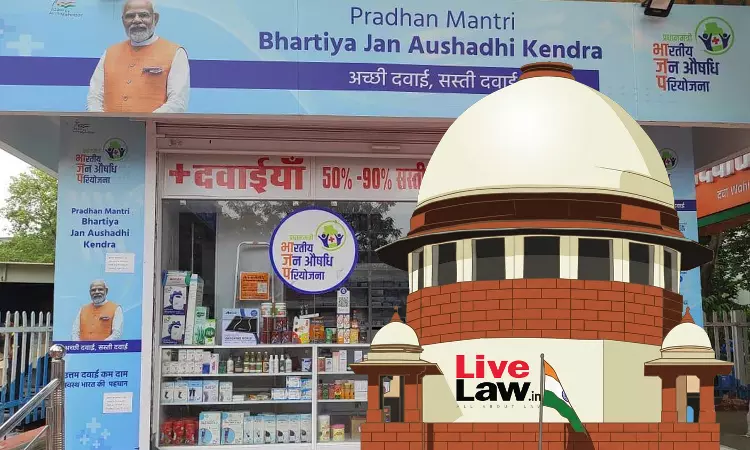
The Supreme Court on Tuesday observed that charging patients for medicines at prices far above the price at which they are sold by manufacturers amounted to a “clear-cut case of fraud”, particularly when hospitals later receive reimbursement from government health schemes.A bench of Justice Vikram Nath and Justice Sandeep Mehta made the observation while hearing petitions seeking...
This is a premium content
Available exclusively to
Our subscribers
Subscribe Premium 
INR 1099+GST
Your support helps us to bring you more content at
an affordable subscription scheme !!!
All payment options available
The Supreme Court on Tuesday observed that charging patients for medicines at prices far above the price at which they are sold by manufacturers amounted to a “clear-cut case of fraud”, particularly when hospitals later receive reimbursement from government health schemes.
A bench of Justice Vikram Nath and Justice Sandeep Mehta made the observation while hearing petitions seeking regulation of medicine prices and raising concerns over the wide disparity between the price at which manufacturers sell medicines to retailers and the MRP printed on them.
The Court's observation came during submissions on the pricing practices of corporate hospitals.
Justice Mehta noted that under government health schemes, the cost of medicines may ultimately be borne by public funds when hospitals receive reimbursement for treatment.
“Many patients are now getting treatment under the PMJAY, that, what do you say? Ayushman Bharat. So, ultimately, it's the taxpayer's money which goes into all this. Because the medicine, which is supposed to be sold for 200 rupees, is dispensed for 2,000 rupees, and the hospital gets the reimbursement, and the taxpayer pays it. This is a clear-cut case of fraud on the face of it,” Justice Mehta observed.
The remarks came during the hearing of a petition filed by Dr. Sanjay Kulshresthra, who submitted that corporate hospitals could require patients to purchase medicines from their own hospital stores and charge the full MRP.
Kulshresthra distinguished such hospitals from traditional chemists. He submitted that traditional chemists often forego part of their profit, but corporate hospitals could charge the full MRP while requiring patients to purchase medicines from the hospital's own store.
“One is the traditional, or the chemist shop. They, many times, forego their profit. But if the corporate hospitals, they accept full MRP with a rider, that you have to purchase the medicine from the hospital shop, from the hospital store only,” he submitted.
He submitted that hospitals refuse to take responsibility for administering a medicine if the patient purchased it from elsewhere.
He contrasted the situation with hotels, where a customer can decide whether the price is affordable before purchasing a service.
“These hospitals are not like five-star hotel. For a hotel, we will go by their affordability. But here, the poor patient also are compelled to go,” he submitted.
Kulshresthra also sought to distinguish the role of manufacturers from that of retailers in the pricing chain. He submitted that manufacturers may merely print the MRP, while the actual exploitation of patients takes place at the retailer's end.
Justice Mehta, however, pointed to the role played by the high MRP itself in enabling retailers to charge substantially more than the price at which they obtain medicines.
“Why this permissibility of printing the MRP 10 times the actual cost of the medicine? Why this? This is the leverage to the retailer to charge anything he wants,” the he observed.
He also raised concerns about the effect of large discounts from the MRP on consumer confidence.
“One more thing which comes to mind, that if you have a MRP of say, Rs. 5,000, and if your chemist gives you the medicine for half, or maybe Rs. 2,000, then there will be a lack of confidence in the consumer,” he observed.
Kulshresthra responded that such a situation was peculiar to medicines and contrasted it with ordinary consumer products.
“But then he is giving me a genuine medicine. This is happening only in medicine…If you take a mobile phone, costing Rs. 50,000 on one shop, it may not be available in the same model, same company, same day, same city, it may not be available in Rs. 5,000. But in medicine, it is happening. The drug is costing Rs. 5,000, and it is available for Rs. 350 to my patient. Many of them are my patients,” he submitted.
The Court questioned why such a wide difference between the price at which a medicine is supplied to a retailer and its MRP should be permissible and whether there should be a fixed criterion limiting the disparity.
The matter is kept on September 29 to hear submissions of the respondents.
Cases: W.P.(C) No. 794/2023 Diary No. 25176 / 2023 Kishan Chand Jain v. Ethics And Medical Registration Board (EMRB) (Erstwhile Medical Council Of India) and W.P.(C) No. 717/2026 Diary No. 25121/2026 Dr. Sanjay Kulshresthra v. Union of India
Tags

Amisha Shrivastava
Amisha Shrivastava is a Senior Correspondent with LiveLaw, covering the Supreme Court of India. She can be reached at amisha@livelaw.in

