Thiruparankundram Row | Thousands Of Survey Pillars Will Become Religious If HC Order Not Stayed, TN Govt Tells Supreme Court
Gursimran Kaur Bakshi
18 Nov 2026 4:17 PM IST
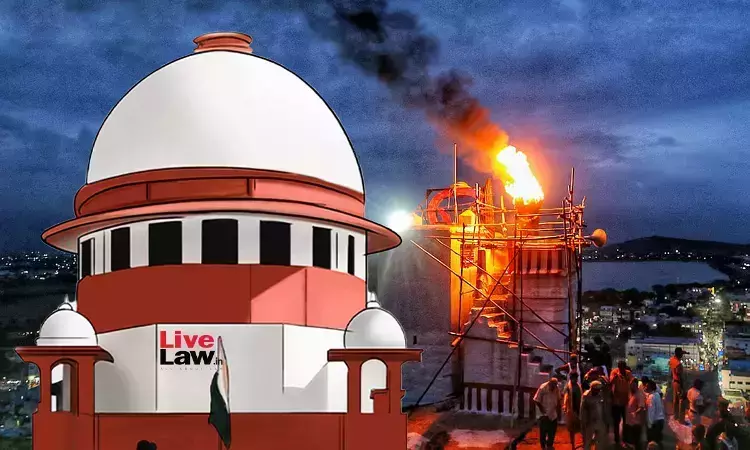
The Tamil Nadu government on Wednesday urged the Supreme Court to stay a Madras High Court order permitting the lighting of the traditional Karthigai Deepam on a stone pillar near a dargah atop Thiruparankundram hill in Madurai, cautioning that allowing the judgment to operate could lead to thousands of survey pillars across the acquiring a religious character.
Senior Advocate Gopal Sankaranarayanan, appearing for the Tamil Nadu District Collector, told a bench of Justice Aravind Kumar and Justice Vipul M. Pancholi that the pillar in question came into existence for a completely different purpose and was not a Deepathoon (stone pillar) meant for lighting the temple lamp. “Our fear as a State is that if the judgment remains undisturbed, all these pillars will find religious colours and people will start doing these things,” he submitted.
"Let the Court's jurisdiction not be expanded, otherwise thousands of survey pillars in country will start becoming religious," he asserted.
Sankaranarayanan referred the bench to photographs and a drone image of the hill, pointing out the Subramaniaswamy Temple at the foothill and the dargah on the other side. He stressed that the only place where the lamp has traditionally been lit is at the Uchi Pillaiyar Temple (also referred to as the Deepa Mandapam site). Attempts to light the lamp at other spots, he said, had been rejected on at least three earlier occasions. He argued that allowing an additional spot would divide the sanctity of the established practice and that courts should not intervene in such questions of religious custom in the manner claimed.


The State's plea seeks a stay of the Madras High Court's January 2026 division bench judgment, which upheld a December 2025 single-judge order directing the Arulmigu Subramaniaswamy Temple management to light the Karthigai Deepam at the disputed stone pillar (located about 50 metres from the Sikandar Badusha Dargah as per the High Court). The High Court had rejected the State's apprehensions of public-order disturbance as an “imaginary ghost” and held that the pillar stood on temple land.
The Tamil Nadu government has maintained that there is no established custom of lighting the Deepam at the contested pillar and that the practice for over 150 years has been confined to the traditional site near the Uchi Pillaiyar Temple. It has also argued that the structure is a survey pillar linked to trigonometrical survey work rather than a religious Deepathoon, and that implementing the High Court direction ahead of the festival (falling on November 24) risks law-and-order issues at a sensitive site with a history of communal tension.
Senior Advocate Huzefa Ahmadi, appearing for the Sikandar Badhusah Dharga, submitted that the single bench passed the order without giving adequate time to them to file the reply as per the High Court Rules. He added that before passing the order, the Single Judge had conducted a site visit without notice to the Dharga. He contended that the Deepathoon was in an area between the Nellithope and the Dharga, and the Single Judge would not have made a finding that it was within the temple property had notice been given to the Dharga before the site visit.
Ahmadi further said that the Division Bench more or less agreed with the contention that the Dharga was not given adequate opportunity, but held that since they were heard in the appeal, the defect was cured.
Pointing out that there are previous judgments which rejected the plea to light the lamp at a new site, Ahmadi said that if a new custom is sought to be established, then it has to be done in a civil suit rather than in a PIL.
Yesterday, the Court had heard the arguments of Senior Advocates Jaideep Gupta, Shekhar Naphade and Addl Advocate General PC Sen for the State. They essentially argued that there was no established custom to light the lamp at the hilltop, and that as per Agama practice, it was being traditionally .
The arguments will continue tomorrow.