



- Home
- /
- Top Stories
- /
- Time To Revisit Centre's Electric...
Time To Revisit Centre's Electric Vehicles Policy Of 2020, Says Supreme Court
Gursimran Kaur Bakshi
13 Nov 2025 2:23 PM IST
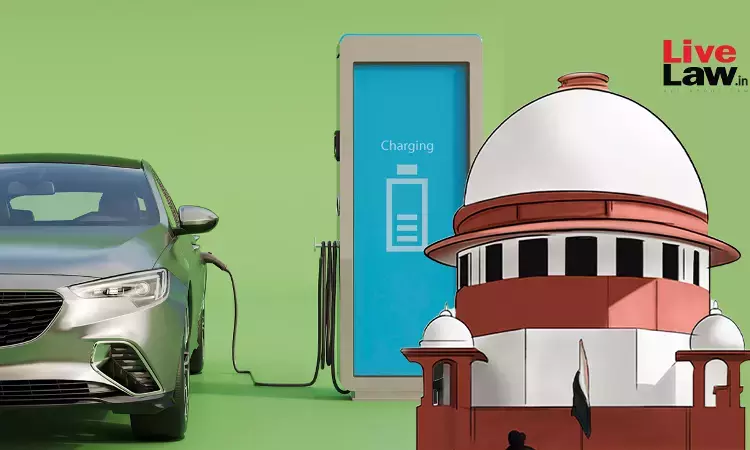
The Supreme Court today(November 13) continued to hear a public interest litigation seeking promotion and implementation of electric vehicle policies. It orally remarked that it's high time for the Government to revisit the National Electric Mobility Mission Plan (NEMMP), 2020, on promotion and adoption of electric vehicles and maybe initiate a pilot project in metropolitan cities....
This is a premium content
Available exclusively to
Our subscribers
Subscribe Premium 
INR 1099+GST
Your support helps us to bring you more content at
an affordable subscription scheme !!!
All payment options available
The Supreme Court today(November 13) continued to hear a public interest litigation seeking promotion and implementation of electric vehicle policies. It orally remarked that it's high time for the Government to revisit the National Electric Mobility Mission Plan (NEMMP), 2020, on promotion and adoption of electric vehicles and maybe initiate a pilot project in metropolitan cities.
Appearing before a bench comprising Justice Surya Kant and Justice Joymalya Bagchi, Advocate Prashant Bhushan submitted that they are trying to seek directions in terms of the Government's declared policy, NEMMP, in which some rebate is given on the purchase of electric vehicles, considering that their cost is higher than that of a regular vehicle.
"Therefore, the proposal of the NITI Aayog was that you give some incentives so that the upfront cost gets reduced. Second, you give various tax exemptions so that road tax and others are exempted from the electric vehicles, which are non-polluting. Then you mandate all government vehicles to be electric vehicles. Then there was a recommendation that there should be mandatory charging points. Today, this is also a bottleneck, the need for charging points," he said.
Justice Surya Kant averred that these are "market forces-related issues". He orally stated that as for the charging points, existing petrol pump stations, bus stations and all can provide it. However, he concurred with Attorney General for India, R Venkataramani, that the complete transition is a "major policy decision" where many aspects need to be considered, including whether all segments of the population can afford an electric vehicle or not. At the same time, Justice Kant acknowledged that the recommendations were taken in 2020, and already five years have gone by.
"Passage of time of more than 5 years. Even the policy may be required to be revisited...somewhere you have to start a pilot project. Or maybe in respect of the metropolitan cities like Delhi, Mumbai, Kolkata, Madras, Bengaluru," Justice Kant suggested.
AG Venkataramani said that he will place a comprehensive report specifying what all notifications have been issued, how it has been facilitated, etc.
It ordered: "There are 13 Ministries of the Union of India actively participating in the project for promotion and adoption of electric vehicles. Post the matter after 4 weeks."
Earlier, in 2020, the Court had noted that the issues raised had an impact on the environment not only in NCR, but the whole country. As such, it called for assistance from the parties on the following points:
(i) Procurement of electric vehicles;
(ii) Providing charging ports;
(iii) Feebate system, i.e, imposing fee on vehicles with high emissions and providing a subsidy on electric vehicles;
(iv) Use of hydrogen vehicles;
(v) Any other alternate means of power for vehicles;
Background
The PIL was filed in 2019 by the Centre for Public Interest Litigation, Common Cause, and SitaRam Jindal Foundation.
The petitioners submit that the fundamental rights of citizens to health and a clean environment under Articles 14 and 21 are being violated due to the government's inaction in mitigating the impact of climate change and air pollution, partly attributable to emissions from fossil fuel-powered vehicles.
“government has abdicated its duty to protect the citizens right to health and clean environment under Article 14 and Article 21. Governmental apathy in suitably implementing the recommendations of its own agencies has led to spiraling emissions from fossil fuel-based vehicles contributing to the problems of Climate Change and Air Pollution turning our cities into virtual 'gas chambers'”.
The petitioners seek directions to the Centre to implement the recommendations of the National Electric Mobility Mission Plan (NEMMP) 2020, promulgated in 2012 by the Ministry of Heavy Industries, and the recommendations of the Zero Emission Vehicles: Towards a Policy Framework, promulgated in September 2018 by the Niti Aayog.
They further seek directions to the respondents to adopt the best practices of the international community incentivizing Demand Creation and Charging infrastructure such as preferential parking, exemption from paying toll, subsidizing private ownership of charging infrastructure, providing for fast as well as normal charging infrastructure at parking spaces, mandating charging infrastructure in private apartments etc.
It is contended that the government's failure to suitably implement these recommendations is the direct cause of high air pollution levels in Indian cities, which have severe negative health impacts on citizens, especially children.
The petition highlights that the burning of fossil fuels contributes significantly to the buildup of greenhouse gases, leading to global warming, climate change, and air pollution.
The petitioners have specifically sought for measures to create assured demand for electric vehicles by government fleets and public transportation, provide demand-side incentives to consumers to bridge the initial cost gap for acquiring electric vehicles, develop requisite charging infrastructure for buses at depots and adequate charging facilities in cities, encourage private investment in charging infrastructure, mandate charging facilities in public buildings, and implement a feebate system to finance the transition towards e-mobility by levying fees on polluting vehicles to provide rebates for electric vehicle adoption.
Case Details: CENTRE FOR PUBLIC INTEREST LITIGATION Vs UNION OF INDIA|W.P.(C) No. 228/2019
Gursimran Kaur Bakshi
Gursimran is the Principal Correspondent with LiveLaw for the Supreme Court. She can be reached out at: simrankaurbakshi@livelaw.in

