



- Home
- /
- Top Stories
- /
- To Say Passport Is Only A Travel...
To Say Passport Is Only A Travel Document Is Complete Misreading Of Law: Justice Lokur Criticises MEA Stand
LIVELAW NEWS NETWORK
4 July 2026 9:45 PM IST
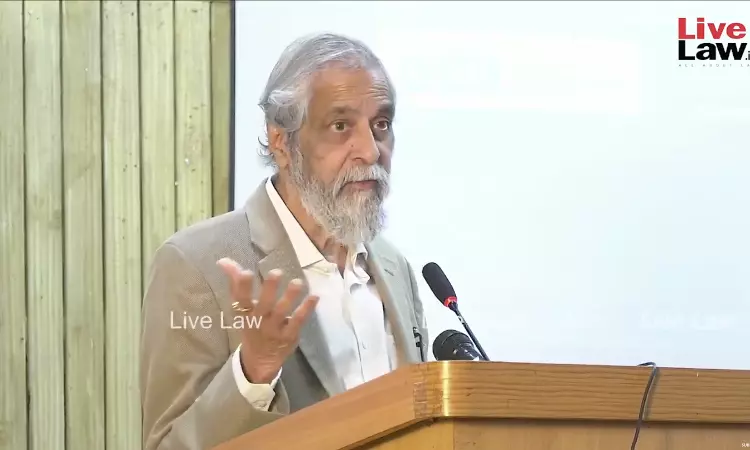
Justice Lokur said the legal position should be made clear that "a person who holds an Indian passport is a citizen of India."
Former Supreme Court judge Justice Madan B. Lokur on Saturday strongly criticised the Ministry of External Affairs' recent assertion that a passport is only a travel document and not proof of Indian citizenship, calling the position "a complete misreading" of the law with potentially serious constitutional consequences.Speaking at the "Conclave on Federalism and Citizenship", organized by...
This is a premium content
Available exclusively to
Our subscribers
Subscribe Premium 
INR 1099+GST
Your support helps us to bring you more content at
an affordable subscription scheme !!!
All payment options available
Former Supreme Court judge Justice Madan B. Lokur on Saturday strongly criticised the Ministry of External Affairs' recent assertion that a passport is only a travel document and not proof of Indian citizenship, calling the position "a complete misreading" of the law with potentially serious constitutional consequences.
Speaking at the "Conclave on Federalism and Citizenship", organized by the Constitutional Conduct Group at the Constitution Club in New Delhi, Justice Lokur said the Passports Act itself clearly distinguishes between a "passport" and a "travel document", making it legally untenable to treat the two as synonymous.
Referring to the Preamble of the Passports Act, Justice Lokur noted that the legislation was enacted "to provide for the issue of passports and travel documents, and to regulate the departure from India of citizens of India and other persons." He emphasised that Parliament had deliberately used the terms "passport" and "travel document" separately throughout the statute.
"Parliament does not make laws and use superfluous words or words that have no meaning. Therefore, when the Passports Act talks about a passport and a travel document, it means these are two separate documents. To say that a passport is nothing but a travel document is a complete misreading of the provisions of the Passports Act," he said.
Justice Lokur said the legal position should be made clear that "a person who holds an Indian passport is a citizen of India."
His remarks come in response to a recent statement made by the Ministry of External Affairs during a press briefing that an Indian passport is only a travel document and does not by itself establish citizenship.
Questioning the practical implications of the government's stand, Justice Lokur said Indian embassies and foreign consulates issue visas on the premise that the passport holder is an Indian citizen. If the Indian government itself disowns the passport as proof of citizenship, it could create serious international complications.
"The officer will say, 'You are presenting to me a travel document. I want a passport which says that you are a citizen of India. Your government says that this passport you are showing me is not proof that you are a citizen of India, so I am not giving you a visa,'" he said, illustrating the consequences of such an interpretation.
He remarked that reducing a passport to a mere travel document effectively reduced it to "a ticket, not even an airline ticket, but perhaps a bus ticket," adding that such a position was "totally contrary to the law and totally contrary to the Constitution of India."
Justice Lokur also questioned the reliance placed on Section 20 of the Passports Act by certain quarters to defend the MEA stand. As per Section 20, the Indian Government can issue passports to non-Indian citizens in exceptional circumstances.
Addressing reliance placed on Section 20 of the Passports Act, Justice Lokur said the provision had little practical relevance in the present debate.
"How many people who are not citizens of India have been given passports of India? We don't know. I would be surprised if there is anybody who has been given an Indian passport who is admittedly a foreigner and not a citizen of India," he said.
Without evidence of any such cases, he said, invoking Section 20 to argue that passports are not linked to citizenship was "neither here nor there", describing the provision as "a dead letter" on the available evidence.
Drawing an analogy with the Bharat Ratna, which may be conferred on foreign nationals but has only exceptionally been awarded to non-Indians such as Nelson Mandela and Khan Abdul Ghaffar Khan, Justice Lokur said the mere existence of an enabling provision does not alter the general legal position.
Justice Lokur also discussed citizenship by birth, noting that while both the Indian Constitution and the United States Constitution recognise birth-based citizenship, each empowers the legislature to enact laws governing citizenship. He pointed out that India had already introduced statutory qualifications to citizenship by birth through the Citizenship Act.
Highlighting the constitutional implications of citizenship disputes, Justice Lokur stressed that thel fundamental rights under Article 19, such as the freedom of speech and expression, freedom of movement and the right to practise any profession, are available only to citizens, unlike Articles 14 and 21 which protect all persons.
He said if individuals were denied recognition as citizens without any accepted documentary proof of citizenship, they could effectively be deprived of these constitutional guarantees.
Posing a hypothetical scenario, Justice Lokur asked what would happen if a person approached a court alleging violation of Article 19 rights but was told that a passport could not establish citizenship because it was "only a travel document."
"In effect, all these persons who have not been allowed to vote, and are therefore considered non-citizens, perhaps stateless persons,have been deprived of a fundamental constitutional right guaranteed under Article 19," he said.
Justice Lokur concluded that the controversy over passports and citizenship carried profound constitutional consequences and required careful public debate rather than being reduced to a brief administrative clarification.
"When we are looking at this controversy about citizenship and passports, or citizenship per se, we are looking at something which is extremely serious. It requires considerable debate and discussion,not just some press conference where a Joint Secretary says that just because you have a passport, it doesn't mean you are a citizen of India," he said.


