



- Home
- /
- Top Stories
- /
- Trade Unions Largely Responsible...
Trade Unions Largely Responsible For Stopping Country's Industrial Growth; Many Units Closed Due To Them : CJI Surya Kant
LIVELAW NEWS NETWORK
29 Jan 2026 12:00 PM IST
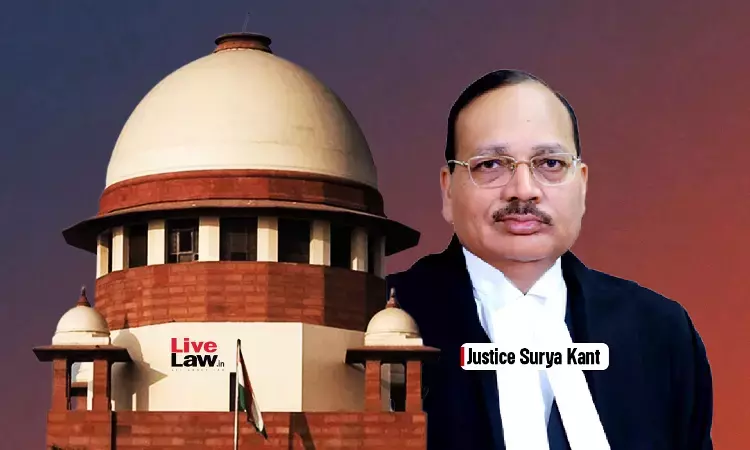
Chief Justice of India Surya Kant on Thursday remarked that trade unionism was largely responsible for stopping the industrial growth in the country."How many industrial units in the country have been closed thanks to trade unions? Let us know the realities. All traditional industries in the country, all because of these jhanda unions have been closed, all throughout the country. They don't...
This is a premium content
Available exclusively to
Our subscribers
Subscribe Premium 
INR 1099+GST
Your support helps us to bring you more content at
an affordable subscription scheme !!!
All payment options available
Chief Justice of India Surya Kant on Thursday remarked that trade unionism was largely responsible for stopping the industrial growth in the country.
"How many industrial units in the country have been closed thanks to trade unions? Let us know the realities. All traditional industries in the country, all because of these jhanda unions have been closed, all throughout the country. They don't want to work. These trade union leaders, they are largely responsible for stopping industrial growth in the country. Of course exploitation is there, but there are means to address exploitation. People should have been made more aware of their individual rights, people should have been made more skilled, there were several other reforms which should have been done" CJI Kant observed.
A bench comprising the Chief Justice and Justice Joymalya Bagchi was hearing a PIL filed by Penn Thozhilargal Sangam and other unions seeking welfare measures for domestic workers. The petitioners, among other things, sought to bring domestic workers under the minimum wages notification.
As soon as the matter was taken, CJI Kant expressed disinclination to entertain the matter, saying "every household will be in litigation."
Senior Advocate Raju Ramachandran, for the petitioner, submitted that in countries like Singapore, one cannot hire a domestic worker without registration and has to ensure mandatory weekly-off, minimum wages etc.
CJI Kant observed that the anxiety to bring in welfare measures can sometimes bring about unintended results, which can lead to other forms of exploitation.
"In our anxiety for reforms, to bring something non-discriminatory through the legislative means, we sometimes unwittingly cause further exploitation. You fix a minimum wages....look at the need for employment in the country. It is a question of demand and supply. You fix minimum wages, people will refuse to hire and will cause further hardship," CJI Kant said.
When Ramachandran said that "collective bargaining works" and that the petitioners are "not some interlopers and were registered trade unions", CJI made the comment about trade unions. Ramachandran requested the CJI not to make generalisations.
CJI added that it was the employment agencies that were actually exploiting domestic workers.
"These trade union leaders, they will leave these people in the lurch. People will stop hiring domestic help. In all major cities, service provider agencies have taken over. Now you only use the services of these entities, there is a word for them, which I cannot use in open court. In all major cities, these big entities are there, who are exploiting these people. They are the real exploiters," CJI Kant said.
In this context, CJI revealed that even when the Supreme Court hired the services of an agency at the rate of Rs 40,000 per worker, the worker actually got paid only Rs 19,000.
"I have personally and officially seen this. The Supreme Court paid to an agency for hiring a particular set of skilled employees, paying 40,000 rupees and actually those poor girls were getting only Rs 19,000. The moment you break the trust between the domestic help and the employer, there are millions of families engaging domestic helps and treating them as part of the extended family...they stay in the same house, have the same food, because the element of trust is there. When you start hiring through these agencies, what will happen? Certainly, you will find some heinous offences are committed by domestic workers because that human connection is not there" CJI said.
"When a minimum wage is enforced, these unions will ensure that every household is dragged into litigation," CJI said.
Ramachandran argued that employing a domestic worker without adequate wages amounts to bonded labour or begar, in terms of the Supreme Court's judgment in Bandhua Mukti Morcha case. He argued that it was an issue of deliberate exclusion of domestic workers by mere executive action, and it was not a case of underinclusion as per a legislative policy. He emphasised that it was leading to violation of Articles 21 and 23 of the Constitution.
He submitted that while some states have brought domestic workers under minimum wages notiication, many other states have not. He urged the Court to seek an explanation from those States for not notifying the minimum wages for domestic workers. "Character of domestic employment does not change from state to state. Union says it is for the states to take a call," Ramachandran said.
The petition was filed by workers' unions and associations of domestic workers from different states.
The petitioners relied on the judgment authored by Justice Kant in 2025 in Ajay Mallik v State of Uttarakhand which directed the Union to explore the possibility of enacting a law for the welfare of domestic workers. When the petitioners approached the Union Government on the strength of the judgment, the Centre took the stand that it was for the respective States to make suitable laws. Since none of the States came forward with any scheme, the petitioners approached the Supreme Court.
The bench ultimately refused to entertain the petition, observing that the reliefs sought are in the nature of a mandamus to enact laws, which the Court cannot direct.
The bench disposed of the petition urging the States to look into the grievances highlighted by the petitioners.
Case : PENN THOZHILALARGAL SANGAM Vs UNION OF INDIA | W.P.(C) No. 42/2026
Click Here To Read/Download Order


