



- Home
- /
- Top Stories
- /
- Unnao Rape Case : Supreme Court...
Unnao Rape Case : Supreme Court Allows Victim To Be Heard In CBI's Plea Against Kuldeep Singh Sengar's Bail
Anmol Kaur Bawa
9 March 2026 1:39 PM IST
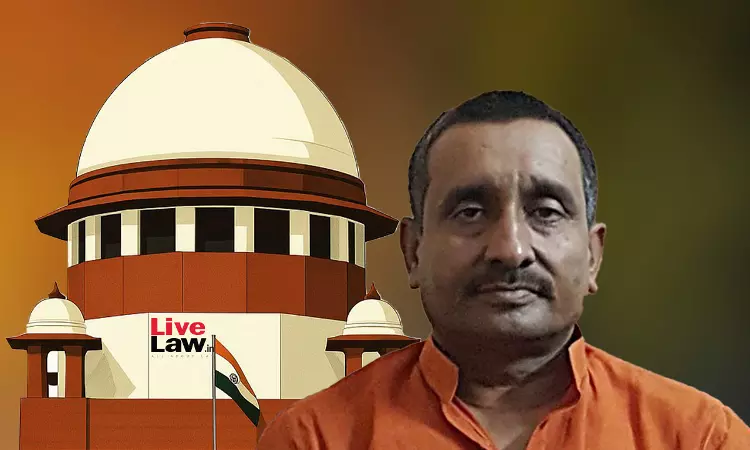
The Supreme Court on Monday allowed the impleadment of the Unnao rape victim in the petition filed by the Central Bureau of Investigation challenging the bail granted to former BJP MLA Kuleep Singh Sengar in the case, observing that she has a right to be heard.At the same time, the Court rejected the intervention application filed by her cousin. The intervention application was filed by the...
This is a premium content
Available exclusively to
Our subscribers
Subscribe Premium 
INR 1099+GST
Your support helps us to bring you more content at
an affordable subscription scheme !!!
All payment options available
The Supreme Court on Monday allowed the impleadment of the Unnao rape victim in the petition filed by the Central Bureau of Investigation challenging the bail granted to former BJP MLA Kuleep Singh Sengar in the case, observing that she has a right to be heard.
At the same time, the Court rejected the intervention application filed by her cousin. The intervention application was filed by the minor son of the brother of the father of the Unnao rape victim. The applicant cited a threat to his life and liberty if bail was granted to Sengar.
The bench comprising Chief Justice of India Surya Kant and Justice Joymalya Bagchi observed that the applicant ought to avail an independent remedy instead of seeking to intervene in CBI's petition. Reserving the remedy of the applicant to approach the High Court seeking protection of life and liberty, the application was disposed of.
However, the bench allowed the impleadment of the rape victim in the matter, observing that she has a right to be heard in the proceedings, in terms of the judgment in the Lakhmipur Kheri case.
The bench did not hear the CBI's petition today as Solicitor General of India Tushar Mehta was not available. Senior Advocate N Hariharan, for Sengar, sought that the matter be heard at the earliest, saying that the liberty granted to him by the High Court has been curtailed. The Chief Justice said that a date will be fixed for the hearing soon.
The bench was hearing the CBI's petition challenging the Delhi High Court's order suspending sentence awarded to former Uttar Pradesh MLA Kuldeep Singh Sengar and granted him bail during the pendency of his appeal against conviction in the Unnao rape case.
In December last year, the Supreme Court had stayed the High Court's order.
Background
Sengar was convicted in 2019 by a special CBI court for raping a minor girl in Unnao district of Uttar Pradesh and was sentenced to life imprisonment. The case had drawn nationwide attention, with the survivor and her family alleging sustained harassment and intimidation by the former legislator and his associates. Several related cases, including those involving attacks on the survivor's family members, were also investigated by the CBI on the directions of the apex court.
He is also serving a 10 year sentence imposed on him in 2020 in a separate case related to the culpable homicide of the survivor's father.
The High Court, while granting bail to Sengar, held that aggravated offence provisions under Section 5(c) of the Protection of Children from Sexual Offences Act and Section 376(2) of the Indian Penal Code were not attracted in the case, as he could not be categorized as a “public servant” within the meaning of those provisions. On that basis, it proceeded to suspend the sentence.
Challenging this decision, the CBI contends that the High Court's decision had the effect of diluting the protective framework of the POCSO Act, and was legally unsustainable given the gravity of the offence and the settled principles governing suspension of life sentences.
The investigating agency took exception to the High Court's conclusion that an MLA does not fall within the definition of a “public servant” for the purposes of Section 5(c) of the POCSO Act. According to the CBI, such a narrow and technical interpretation defeats the object of the statute, which is to provide enhanced protection to children against sexual offences and to treat abuse of authority as an aggravating circumstance.
The plea argued that the High Court failed to adopt a purposive interpretation of the POCSO Act, despite the case involving sexual assault of a minor. It said that POCSO is a special welfare legislation and its provisions must be interpreted in a manner that advances, rather than restricts, the safeguards intended by Parliament.
Assailing the reasoning for suspension of sentence, the CBI submitted that long incarceration by itself cannot be a ground to suspend a life sentence in cases involving heinous crimes such as rape of a minor. The agency pointed out that the Supreme Court has consistently held that suspension of sentence in cases punishable with life imprisonment is an exception and not the rule, and can be granted only in rare and compelling circumstances.
Case Title:
(1) CBI v. Kuldeep Singh Sengar, SLP(Crl) 21367/2025

Anmol Kaur Bawa
Reporter

