



- Home
- /
- Top Stories
- /
- Unproven Treatment Cannot Be...
Unproven Treatment Cannot Be Demanded By Patient As A Matter Of Right : Supreme Court
Gursimran Kaur Bakshi
31 Jan 2026 12:37 PM IST
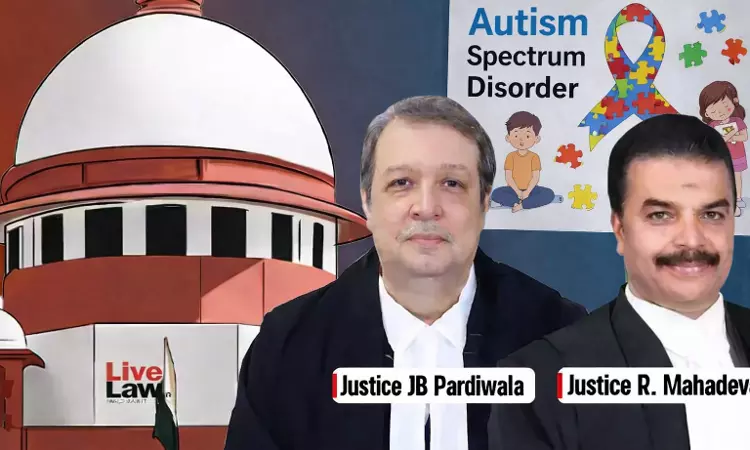
The Supreme Court yesterday observed that to seek Stem Cell Treatment(SCT) as a cure for Autism Spectrum Disorder(AST) cannot be claimed as a matter of right by the patients.A bench comprising Justice JB Pardiwala and Justice R Mahadevan disapproved the use of SCT for ASD as regular clinical treatment. It stated that medical practitioners and clinics engaging in such unscientific treatment...
This is a premium content
Available exclusively to
Our subscribers
Subscribe Premium 
INR 1099+GST
Your support helps us to bring you more content at
an affordable subscription scheme !!!
All payment options available
The Supreme Court yesterday observed that to seek Stem Cell Treatment(SCT) as a cure for Autism Spectrum Disorder(AST) cannot be claimed as a matter of right by the patients.
A bench comprising Justice JB Pardiwala and Justice R Mahadevan disapproved the use of SCT for ASD as regular clinical treatment. It stated that medical practitioners and clinics engaging in such unscientific treatment amount to malpractice.
While holding so, the Court also answered whether patients can exercise autonomy in stating that they would still like to choose a particular treatment and give consent for the same. On this, the Court categorically stated that this treatment can't be demanded as a matter of right by the patient because there is no adequate information about it.
"As regards the question whether patient autonomy enables a person to give consent to an unproven treatment, we are of the considered view that a treatment cannot be demanded by a patient as a matter of right," the Court observed.
It relied on its earlier judgment of Samira Kohli v. Dr. Prabha Manchandra and Another (2008), which held that 'adequate information' as regards a particular treatment is the bedrock and consent must be based on that. This enables the patient to make a balanced judgment as to whether he should submit himself to a particular treatment or not. The doctor is therefore required to disclose 1. nature and procedure of the treatment and its purpose, benefits and effects; 2. alternatives, if any; 3. an outline of substantial risks, and 4. adverse consequences of refusing treatment.
"It is undisputed that stem cell therapy for treatment of ASD does not fulfil the essentials of 'adequate information'. The validity of consent stems from the nature and information available about the treatment. In the absence of such knowledge, the patients may remain under therapeutic misconception and anticipate such results from an unproven treatment as may be expected from routine treatment and care. Following through with the medical treatment even when patients are under such misconception is, in our view, a gross violation of medical ethics," the Court noted.
It concluded that even though the patient may have voluntarily opted for such a procedure, such a choice does not amount to giving a valid consent due to the lack of 'adequate information' which forms the basis of the treatment. It added that the patients have the liberty to participate in approved and regulated clinical trials.
Case Details: YASH CHARITABLE TRUST AND ORS. v UNION OF INDIA AND ORS.|W.P.(C) No. 369/2022
Citation : 2026 LiveLaw (SC) 93
Appearances: For Petitioner(s) Mr. Siddharth Nath of Pro Bono, Adv. Mr. Prateek K Chadha, AOR Mr. Anunay Chowdhury, Adv. Mr. Asjad Hussain, Adv. Mr. Sreekar Aechuri, Adv. Ms. Surbhi Soni, Adv. Mr. Aniket Chauhaan, Adv.
For Respondent(s) Mr. Vikramjit Banerjee, ASG Ms. Aishwarya Bhati, A.S.G. Mr. Sudarshan Lamba, AOR Mr. Ketan Paul, Adv. Mr. Ashok Panigrahi, Adv. Mr. Piyush Beriwal, Adv. Mr. Pratyush Shrivastava, Adv. Ms. Shivika Mehra, Adv. Mr. Abdesh Chaudhary, Adv. Mr. Gaurav Sharma, Sr. Adv. Mr. Prateek Bhatia, AOR Mr. Dhawal Mohan, Adv. Mr. Paranjay Tripathi, Adv. Mr. Rajesh Raj, Adv. Ms. Ankita Dogra, Adv. Mr. Omkar Deshpande, Adv. Mr. Siddharth Dharmadhikari, Adv. Mr. Aaditya Aniruddha Pande, AOR Mr. Ankur Khandelwal, Adv. Mr. Sahil Siddiqui, Adv. Mr. Utkarsh Sharma, AOR Mr. Nikilesh Ramachandran, AOR Mr. Nitesh Ranjan, AOR Mr. Akshay Sapre, Adv. Mr. S. Sahel Sood,Adv. Shruti Shivkumar, Adv.
Tags
Gursimran Kaur Bakshi
Gursimran is the Principal Correspondent with LiveLaw for the Supreme Court. She can be reached out at: simrankaurbakshi@livelaw.in

