



- Home
- /
- Top Stories
- /
- US Sinking Of Iranian Warship IRIS...
US Sinking Of Iranian Warship IRIS Dena Raises International Law Questions
Gursimran Kaur Bakshi
7 March 2026 10:43 AM IST
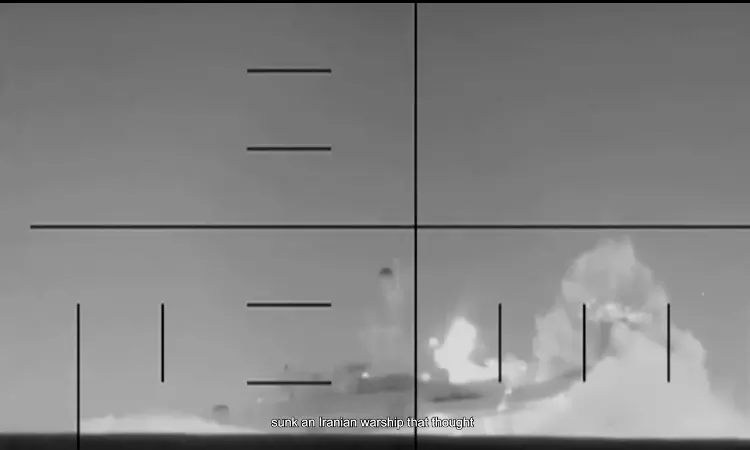
Recently, an Iranian warship identified as Frigate IRIS Dena was torpedoed by a United States submarine near the coast of Galle in Sri Lanka. Reportedly, the Sri Lankan Navy received a distress call and rescued 32 injured sailors within their search and rescue zone, while more than 80 bodies were discovered.After the incident, the United States Secretary of War, Pete Hegseth, in a press...
This is a premium content
Available exclusively to
Our subscribers
Subscribe Premium 
INR 1099+GST
Your support helps us to bring you more content at
an affordable subscription scheme !!!
All payment options available
Recently, an Iranian warship identified as Frigate IRIS Dena was torpedoed by a United States submarine near the coast of Galle in Sri Lanka. Reportedly, the Sri Lankan Navy received a distress call and rescued 32 injured sailors within their search and rescue zone, while more than 80 bodies were discovered.
After the incident, the United States Secretary of War, Pete Hegseth, in a press briefing, said: “An American submarine sunk an Iranian warship that though it was safe in international waters. Instead, it was sunk by a torpedo.”
The warship was heading back to Iran from a global naval exercise, International Fleet Review, hosted by India in Visakhapatnam. Some sources suggest that it was invited by Sri Lanka for a courtesy port call but amidst the escalating tensions, it was instructed suddenly to not proceed. Because of the diplomatic shift, it waited for 11 hours in international waters before being attacked by the US Navy.
This incident raises many questions of international law, such as whether the ship was a legitimate target, whether it was in a warzone and whether it could have been attacked in international waters. All these questions assume significance, particularly in the backdrop of an undeclared “preemptive” war by the United States and Israel against Iran. This piece explains these nuances.
What is Frigate IRIS Dena?
Frigate IRIS Dena is a domestically built warship, equipped with modern anti-ship “Qader” missiles and a vertical launching system. It becomes the second warship to be torpedoed by a submarine since the World War II. The first was an Indian anti-submarine frigate INS Khukri, which was torpedoed by Pakistan's PNS Hangor during the 1971 India-Pakistan war.
Reportedly, the fleet exercise required the ship to be unarmed, and therefore, weapon systems were kept in a non-operational mode. Iranian Foreign Minister Seyed Abbas Araghchi responded to the incident, saying that the warship was a “guest of India's Navy carrying almost 130 sailors” and it was “struck in international waters without warning”. Araghchi had said that the ship mostly had non-combatants and ceremonial staff.
Dr Brahma Chellaney, Indian Geostrategist, on X(formerly Twitter) said that in multilateral naval exercises focused on camaraderie and collaboration do not carry a full combat load of live ammunitions as a matter of "peace protocols".
The naval exercise was carried out in many phases. It began with the harbour phase followed by sea phase, which included "high-intensity operational drills" such as integrated air defence exercises, anti-submarine warfare operations and maritime interdictions drills. Then in the operational phase, live firing exercises are conducted as reported in Times of India.
Chellaney added that in its harbor phase, participating ships are required to maintain a safe configuration. Even during the sea phase, where operational drills and live-fire events occur, the ammunition carried is limited to specific drills.
Which law applies?
It must first be noted that for the US to officially go to war, it requires a prior sanction from the US Congress under the War Powers Resolution, 1973. In order to skip this, US Presidents often invoke their Commander-in-Chief powers under Article II of the US Constitution and take the controversial route of “preemptive self-defence” or “anticipatory self-defence” in response to a sudden and imminent threat. Even then, Congress must be notified within 48 hours of the hostilities.
Under Article 2(4) of the United Nations Charter, the use of force is prohibited. However, Article 51 is considered an exception to Article 2(4). A non-obstante clause, Article 51, allows States to act in individual or collective self-defence if an armed attack has occurred in its traditional understanding. However, States now increasingly use force under anticipatory self-defence to justify that they had to act first against an “imminent threat”.
This doctrine traces its roots to the 1837 Caroline affair, which was a diplomatic incident which took place between the US and the United Kingdom. It may be recalled that Canada was one of the colonies of France, which was won over by the British government in the Seven Years' War. In 1837, there was a rebellion in Upper Canada against the British colonisers. After the movement suffered defeat, leaders of the uprising fled to Navy Island in the Niagara River and declared their own territory and received support from American sympathisers.
The sympathisers delivered support to the Island by steamboat named Caroline. During the night of December 29, 1837, the British and Canadian authorities crossed into US territory and destroyed Caroline and set her on fire. In this exchange, an American bystander was also killed. Although the incident was settled during diplomatic negotiations, the Caroline test came to be known in a series of letters exchanged between the then US Secretary of State and the then British Foreign Minister.
The US counterpart stated that in order to apply anticipatory self-defence, the threshold is high. The use of force is only justified when the necessity is “instant, overwhelming and leaving no choice of means and no moment for deliberation”.
This doctrine assumed significance in the backdrop of the 9/11 terrorist attacks on the US, after which it declared war against terrorism as a matter of foreign policy. Also termed as the “Bush doctrine,” it has been used to justify unilateral actions such as invading countries to fight terrorism or destroy weapons of mass destruction. Examples of such instances are the 2001 invasion of Afghanistan and the 2003 invasion of Iraq.
Either way, since it is a war, considering the ground realities, international humanitarian law(IHL) applies. IHL is a branch of international law that does not prohibit the use of force, but rather regulates the actions of both parties. To state, IHL requires the parties to a war not to act indiscriminately and to only target the enemy and its objects based on principles of proportionality and necessity. Civilians, civilian objects and civilian infrastructure can't be attacked and inflicting unnecessary suffering is prohibited.
In peacetime, the actions of the parties would have been regulated under the 1982 UN Convention on the Law of the Seas(UNCLOS). However, since there is war, IHL as a branch of specialised law would take precedence over general law.
But to state briefly, under the UNCLOS, beyond 12 nautical miles from the baseline of a State is international waters. Since the attack took place 40 nautical miles from the Southern coast of Sri Lanka, it would have been within its Exclusive Economic Zone(EEZ), which extends upto 200 nautical miles.
While EEZ gives Sri Lanka exclusive jurisdiction over the exploration of resources, UNCLOS does not prohibit freedom of navigation. Moreover, as per Article 95, warships enjoy sovereign immunity, and it can't be attacked in peacetime. But the US is not a party to UNCLOS, and Iran is only a signatory. While Sri Lanka has ratified the Convention.
As for the IHL, the rights and duties of the parties to the hostility are governed by the four Geneva Conventions of 1949 and Additional Protocols, whereas the means and methods of warfare are regulated by the Hague Conventions.
Here, we are concerned with the 1949 Geneva Convention for the Amelioration of the Conditions of Wounded, Sick, and Shipwrecked Members of Armed Forces at Sea(Geneva Convention II). Unlike UNCLOS, the Geneva Conventions have universal ratification and their provisions are largely considered as customary principles of international law and therefore, binding on the parties.
Does the Iranian warship become a legitimate target?
This can't be answered in black and white, as armed conflicts, especially naval warfare is complex as facts continue to change with the changing situation. By and large, warships are legitimate military targets.
Article 52 of Additional Protocol I read with Rule 8 defines military objectives are those which by their nature, location, and purpose or use make an effective contribution to military action. Their partial or total destruction, capture or neutralisation of the circumstances offers a definite military advantage. This is a part of principle of distinction followed under IHL that only combatants and enemy targets must be attacked in order to secure military objectives.
Article 52 includes a two-prong test. First, whether by nature, object and purpose it could be used for effective military actions. Some objects by their very nature remain military objectives regardless of their location or use. Examples include warships. But whether IRIS Dena could have effectively contributed to military actions?
If Caroline's test is to be applied, the warship's weapon system was limited in operation and there are no reports that it displayed any active hostilities. Therefore, it may not have posed an imminent threat to the US. It was returning from a friendly naval exercise and was not even in the combat zone, for instance, near the Strait of Hormuz.
Second part of the prong test is whether its total or partial destruction could have advanced military goals. What military advantage the US would have achieved by attacking the warship 2000 km away is clearly not established.
Was there a duty to rescue?
After attacking the ship, the combatants were rendered hors de combat. Rule 47 of the ICRC Customary IHL Study says that attacking persons recognised as hors de combat is prohibited. It includes a person who has become defenceless because of a shipwreck. This is widely considered as a norm of customary international law, which is also codified in many military manuals, Common Article 3 of the Geneva Conventions, Article 23(c) of the Hague Regulations and Article 41(1) of the Additional Protocol I.
There is a duty on the adverse party to take all measures to protect and collect the shipwrecked and the dead against ill-treatment.
Article 18 of the Geneva Convention II mandatorily obligates the parties engaged in the hostilities to take "all possible measures", without any delay, to search for and collect the shipwrecked, wounded, and sick. It is also obligated to protect them against pillage and ill-treatment and to search for the dead. This is also reflected in the customary San Remo Manual on international law applicable to armed conflicts at sea, 1994.
"All possible measures" is a legal requirement and it may include the following:
- measures must be determined in good faith, based on circumstances
- if the operating commander is unable to take measures, it does not absolve the duty of the overseeing commander from alerting nearby coastal authorities, or other vessels in the vicinity
- vessel's operational capacity circumscribes what is possible, especially in cases of submarine. However, as per international law, submarines are bound by the same law as surface vessels
- for submarines, many practitioners say that it may not be possible to carry out a search and rescue operations but that does not mean it is not required to assess what other measures may be possible, provided it does not render the submarine detectable to the enemy
Violation of Article 18(1) is considered a grave breach of international humanitarian law of wilful killing by omission and is considered a war crime under international criminal law. It may incur individual criminal responsibility
While this is non-negotiable, clause (2) says that whenever circumstances permit, the party shall also make local arrangements for the removal of wounded and sick by sea. There is no reservation to Article 18, and that's why it is one of the most fundamental principles of naval warfare.
Article 17(2) of Additional Protocol I provides that the adverse party may also appeal to the nearby civilian population to collect and care for the shipwrecked and to search for the dead.
Early naval practices, especially during WWII suggests that parties had declared “combat area” within which enemy vessels were forbidden and would be sunk without warning. However, there still existed an obligation to take care of the survivors, if the military situation permits.
In the Tenth Hague Convention, 1907, Article 16 provides a similar provision, but it was conditional in the sense that if the military interest permitted. But in the Geneva Convention, this reference was dropped, and it was made as a mandatory requirement to act without delay.
The commentary on Article 18 suggests that it does not negate the possibilities of the parties to take such measures. It suggests that if the warship is forced to leave shipwrecked persons, it will have to endeavour to provide them with the means to enable them to await rescue or reach the coast. Another interpretation of this suggests that the duty to rescue extends to all, whether military or civilian, to rescue such persons.
Additional Protocol I adds that the shipwrecked will continue to be considered shipwrecked during rescue, provided they refrain from any act of hostility.
Since it was a submarine, many may argue that it would not usually surface on waters just for the rescue operations. But that is not true. During World War II, many of Nazi Germany's submarines sank Allied ships but rescued the people. For instance, RMS Laconia, a British passenger ship in the Atlantic Ocean, was torpedoed by U-156, a German submarine. When the German submarine discovered that the RMS was carrying soldiers and Italian prisoners of war, it surfaced to commence rescue operations and was joined by U-506. After rescuing, it headed to transfer the survivors with a Red Cross flag but was attacked midway by the B-24 Liberator bomber of the US.
The then Grand Admiral of the German Navy Karl Dönitz issued what is known as the Laconia Order, forbidding attempts at rescue(also known as unrestricted submarine warfare). The order said that rescue ran counter to the rudimentary demands of warfare.
Earlier practices had suggested that the German submarine arm abided by the 1936 London Submarine Protocol, which governed their operations in war. Under this, the protocol was that a merchant ship couldn't be sunk without warning and the rescue of their crew. It was considered a custom of the sea.
Even with the Laconia order, sources suggest that the German submariners continued to provide assistance.
The Grand Admiral who had issued the Laconia order was then prosecuted in the International Military Tribunal at Nuremberg on war crimes. It was alleged that the order was an attempt to kill all survivors. Evidence of this included a conversation between Germany's Hitler and Oshima, the Japanese Ambassador to Germany. Hitler had said that the German submarine warfare policy was to shoot all the survivors, as the US had difficulty in recruiting new crew. Oshima, in his reply, said that Japan would also follow this policy.
However, Dönitz was not found guilty as the tribunal concluded that evidence should not establish with certainty that he had deliberately ordered killing.
Conclusion
Amidst the escalating war between US, Israel and Iran, one thing is certain: this naval attack will be remembered in history as one involving not just naval customs but also diplomacy.
Though full facts and circumstances related to the incident are yet to emerge, one thing that can be said with certainty - that the US submarine failed to take "all possible measures" as it simply left the sailors drowning.
This Iranian warship thought it was safe in international waters. It wasn't.
— The White House (@WhiteHouse) March 4, 2026
The @DeptofWar is fighting to win. 🇺🇸 pic.twitter.com/4bGMubuSQu

Gursimran Kaur Bakshi
Gursimran is the Principal Correspondent with LiveLaw for the Supreme Court. She can be reached out at: simrankaurbakshi@livelaw.in

