



- Home
- /
- Top Stories
- /
- 'We Can't Be Part Of Annihilation...
'We Can't Be Part Of Annihilation Of Religion; Let's Not Open Age Old Customs' : Supreme Court In Sabarimala Reference Hearing
Gursimran Kaur Bakshi
29 April 2026 1:41 PM IST
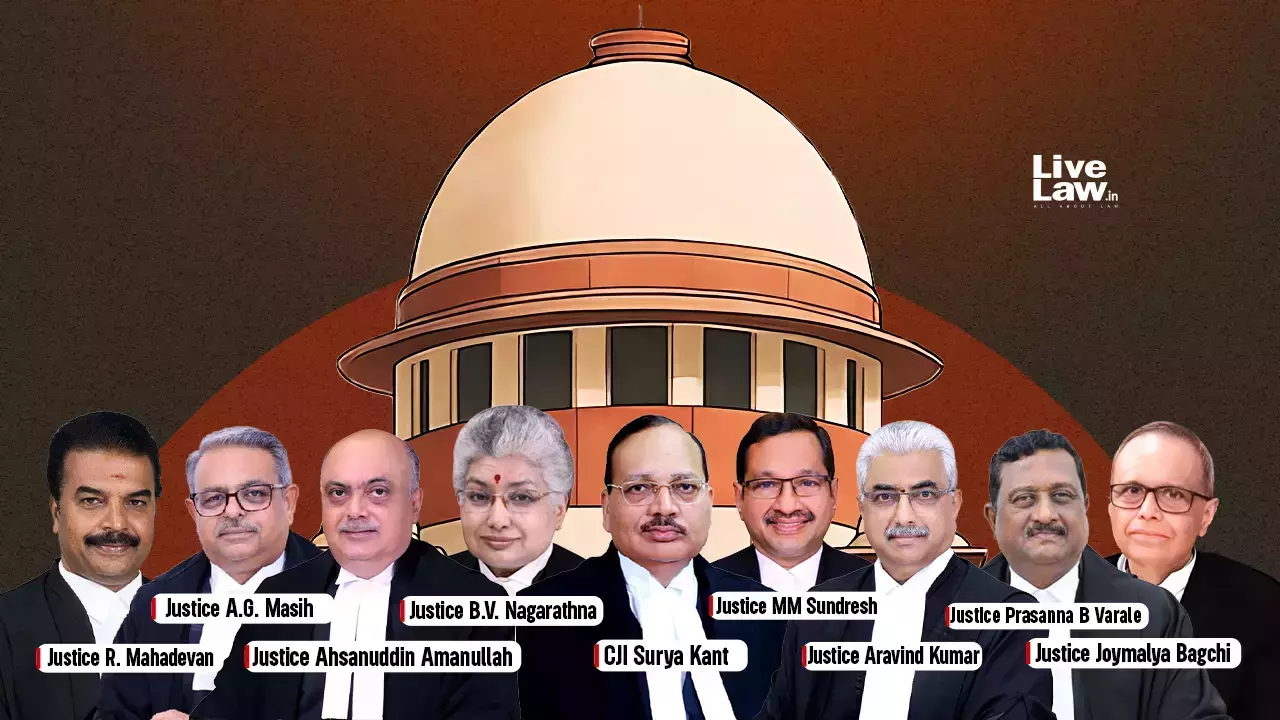
During the hearing of the Sabarimala reference on Wednesday, the Supreme Court orally observed that it cannot annihilate religion in the name of reform and that matters of belief and conscience cannot be subjected to judicial debate.On the tenth day of the hearing, the nine-judge Bench posed a series of questions to Senior Advocate Indira Jaising, who represents two women who entered...
This is a premium content
Available exclusively to
Our subscribers
Subscribe Premium 
INR 1099+GST
Your support helps us to bring you more content at
an affordable subscription scheme !!!
All payment options available
During the hearing of the Sabarimala reference on Wednesday, the Supreme Court orally observed that it cannot annihilate religion in the name of reform and that matters of belief and conscience cannot be subjected to judicial debate.
On the tenth day of the hearing, the nine-judge Bench posed a series of questions to Senior Advocate Indira Jaising, who represents two women who entered the Sabarimala temple pursuant to the 2018 judgment that set aside the ban on the entry of women aged between 10 and 50 years.
Jaising argued that the religious freedom guaranteed to individuals under Article 25(1) of the Constitution would prevail over the rights of religious denominations under Article 26. She emphasised that courts cannot adopt a complete "hands-off" approach in religious matters, as judicial review is an inherent constitutional power. According to her, the Constitution is a living document, and fundamental rights cannot be interpreted in isolation. She added that religions evolve and reform over time and are not static.
Clarifying the scope of the claim, Jaising submitted that the right asserted under Article 25(1) was limited to temple entry and did not seek to alter ceremonial rituals within the temple, which are protected under Article 26.
Justice Nagarathna, at this point, observed that Article 25(2)(b), which empowers the State to make law for social reform, is not a right in itself, and is only an enabling power. "In the name of reform, don't hollow out the religion," Justice Nagarathna said. "Let us not open rituals and ceremonies which are there for centuries," she added.
Jaising cautioned against discarding the Essential Religious Practice test altogether, stating that courts would still need to examine whether discontinuing a practice would affect the core of the religion.
Justice Sundresh however commented, "The courts will have to be circumspect when dealing with essentiality." Justice Amanullah also expressed the concern that the Courts will be assuming the role of theologians in such a scenario.
When Jaising said that the essentiality of the religion must be determined with reference to the religious doctrine itself, Justice Amanullah questioned how a court could determine the correct interpretation when multiple versions exist within the same religion.
"Everytime the court intervenes, there has to be a limit because then the whole constitutional protection will look illusory," the Judge said.
Justice Amanullah also said that in such a situation, the Court will have to "lift the veil" to see if the petitioner is a genuine believer. Jaising disagreed with the proposition that only a believer can go to the temple. She said that a person may go for introspection or understanding, and the only condition is that the visit must be done with 'reverence'.
"I need to go with reverence, Sharda, and not for the purpose of mischief. We go to temples even though we don't completely follow the deity," Jaising said.
Justice Amanulla probed whether a person can go to a deity by accepting only some aspects of the deity. The Judge asked whether a person can suddenly question customs which have been prevalent for long. "Over centuries, certain things which are custom and practice have crystallised and become an essential part-you can't forget history. With so much passage of time, it has been transformed into a basic element. Suddenly, after so many years, somebody comes up!" Justice Amanullah said.
Jaising asked what legal harm is caused by the entry of a woman to the temple. She clarified that if a woman does not want to go under the belief that the deity is a 'naishtika brahmachari', then she has the choice not to go. But it cannot be insisted that no woman should go.
"Whether custom prevails or one woman's desire," Justice Nagarathna asked.
"It's not desire, it's a freedom," Jaising replied.
"Is it reverence if you are upsetting the people there?" Justice Amanullah asked. Jaising that the feeling of sentiments being hurt will not qualify as a legal injury.
Justice Sundresh said that accepting this argument will create disorder, as each person will follow their own practices in the temple. "This will lead to dangerous consequences. Each one will go and say I don't want it in a particular way, it will be a disaster."
"It will be annihilating religion, which we don't want to be a part of. Matters of conscience cannot be a subject matter of debate in a secular court," Justice Nagarathna said.
Jaising asked if anybody else's practice is harming a woman's right, then what is the remedy? Justice Nagarathna said that it was the temple's custom that women in the age group of 10-50 years should not go there. Jaising claimed that there is no theological basis for such a custom.
The hearing is progressing. Live updates can be followed here.
Gursimran Kaur Bakshi
Gursimran is the Principal Correspondent with LiveLaw for the Supreme Court. She can be reached out at: simrankaurbakshi@livelaw.in

