



- Home
- /
- Top Stories
- /
- West Bengal SIR | Appellate...
West Bengal SIR | Appellate Tribunals Can Entertain Fresh Documents After Verifying Genuineness : Supreme Court
Debby Jain
1 April 2026 12:11 PM IST
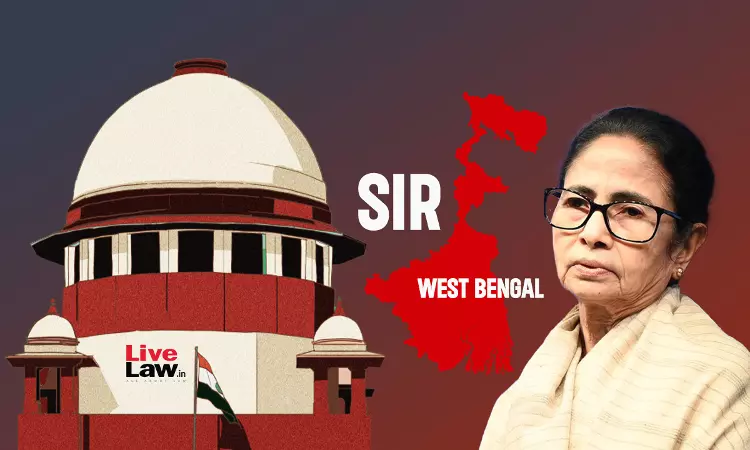
In the West Bengal SIR matter, the Supreme Court on Wednesday allowed the Appellate Tribunals, which are hearing appeals against exclusions from the electoral rolls, to entertain fresh documents subject to the verification of their authenticity.The Court initially ordered that the Appellate Tribunals should not entertain fresh/new documents which were not submitted before the...
This is a premium content
Available exclusively to
Our subscribers
Subscribe Premium 
INR 1099+GST
Your support helps us to bring you more content at
an affordable subscription scheme !!!
All payment options available
In the West Bengal SIR matter, the Supreme Court on Wednesday allowed the Appellate Tribunals, which are hearing appeals against exclusions from the electoral rolls, to entertain fresh documents subject to the verification of their authenticity.
The Court initially ordered that the Appellate Tribunals should not entertain fresh/new documents which were not submitted before the adjudicating officer. However, after the petitioners raised concerns, the Court modified its order to state, "The Appellate Tribunal will not entertain fresh documents without verifying the genuineness of such documents."
The bench comprising Chief Justice of India Surya Kant, Justice Joymalya Bagchi and Justice Vipul Pancholi was informed by the Election Commission of India that 19 Appellate Tribunals, headed by former High Court Chief Justices/Judges have been notified, and Dr Shyama Prasad Mukherjee National Institution of Water and Sanitation, Kolkata, has been chosen as the venue for the sitting of the Tribunals.
The bench was also informed that nearly 47 lakh out of 60 lakh claims have been disposed of by the judicial officers, who have been entrusted with the task of adjudicating the claims. The Chief Justice of the Calcutta High Court informed that the judicial officers, who are deciding nearly 2 lakh objections daily, will clear the pending claims by April 7.
In February, the Court had ordered the deployment of judicial officers from West Bengal and neighbouring states to adjudicate the claims and objections, in view of the dispute between the ECI and the State Government regarding the deputation of government officials for such purposes. Later, the Court directed the constitution of Appellate Tribunals comprising former High Court Judges.
Appellate Tribunals must have access to reasons
The Court also observed that the Appellate Tribunals must have access to the reasons recorded by the adjudicating officers. The Court observed that the reasons be supplied to the parties.
During the hearing, Justice Bagchi observed :
"The architecture of the software provides for a field for remarks, which are reasons given by the officers concerned while deciding whether the logical discprepancy was justified and therefore deletion was warranted or it was not justified and therefore inclusion is directed. In such cases, whenever an appeal is field by an aggrieved person, be it the representative of the ECI who feels that the inclusion is unjustified or be it the person who has been excluded, the reason shall be supplied to the person concerned."
Justice Bagchi also observed that incorrect inclusions/exclusions can be corrected by the Tribunals.
"Even if a person is excluded today, and is unable to vote in this particular election, but that exclusion appears to be unjustified to a Tribunal headed by a former Chief Justice, we see no reason why the decision cannot be altered and he can be included. And likewise, a person incorrectly included, and votes in this election, and your representative makes a report to the Tribunal, we see no reason why the entire cleaning exercise taken by you should not be taken to its logical conclusion"
During the hearing, petitioners raised concerns about bulk Form 6 applications (for registration as new voters) being filed. The Court said that it cannot merely act on oral submissions without anything being on record. The Court also orally observed that the voters included after the qualifying date set by the ECI cannot claim the right to vote.
Senior Advocates Kapil Sibal, Shyam Divan, Menaka Guruswamy, Gopal Sankaranarayanan, Kalyan Bandhopadhyaya, Bikash Ranjan Bhattacharya etc appeared for the petitioners. Senior Advocate Dama Seshadri Naidu appeared for the ECI.
A Bench comprising Chief Justice of India Surya Kant, Justice Joymalya Bagchi and Justice Vipul Pancholi was dealing with petitions, including one filed by West Bengal Chief Minister Mamata Banerjee, challenging aspects of the revision exercise and the characterization of certain voters in the “logical discrepancy” list.
On the last date, the CJI had orally observed that SIR of electoral rolls got conducted smoothly across the country except in West Bengal. He said that though there were equally complicated issues in other States, "by and large", SIR went on smoothly there. The Bench also indicated that the responsibility for managing logistical aspects of the process had been entrusted to the Chief Justice of the Calcutta High Court and advised parties to bring specific difficulties to the Court's attention if they persisted.
Case Title: MOSTARI BANU Versus THE ELECTION COMMISSION OF INDIA AND ORS., W.P.(C) No. 1089/2025 (and connected cases)
Debby Jain
Debby Jain is a Correspondent with LiveLaw, covering the Supreme Court of India

