'What Does Religion Have To Do With Firecrackers?' Asks Justice Joymalya Bagchi
Debby Jain
12 Oct 2026 1:21 PM IST
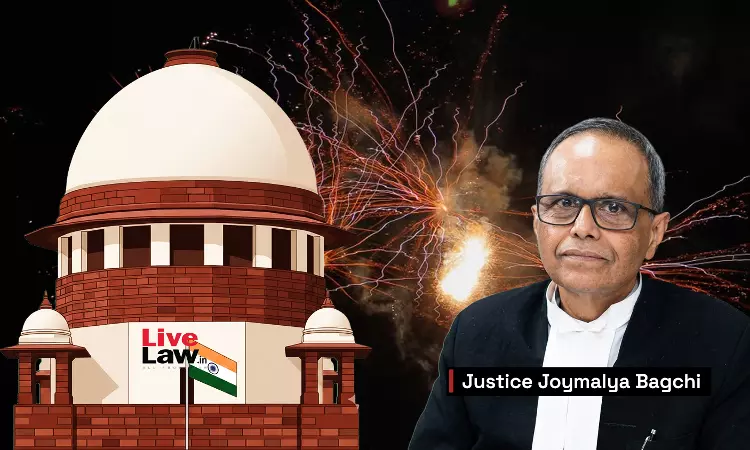
Justice Joymalya Bagchi of the Supreme Court on Monday questioned the linkage between religion and the use of firecrackers while hearing a suo motu matter on Delhi-NCR air pollution.
A bench comprising Chief Justice of India Surya Kant, Justice Joymalya Bagchi and Justice V Mohana was dealing with the issue of permission for firecrackers amid rising pollution worries ahead of the festive season.
Justice Bagchi asked: “What does religion have to do with firecrackers?”
Senior Advocate Aparajita Singh, the amicus curiae in the matter, responded that the argument that bursting firecrackers was a religious practice was advanced every time. “Gods would be aghast if they knew that children were suffering and getting sick in their name,” she said.
CJI Surya Kant observed that the court would not hurt religious sentiments. “We will not hurt religious sentiments. Best way forward is people should themselves [introspect]. You can take measures to make them aware,” he said.


Singh noted that while this was the ideal situation, “unfortunately, year after year, we see the same playbook getting repeated.”
Earlier in the hearing, Senior Advocate J Sai Deepak, appearing for a federation of firework traders, pointed to an ongoing ban. The CJI emphasised caution in passing orders, stating the best approach was to make people wiser and bring about awakening by informing them which crackers are harmful, promoting a culture of lighting only diyas, and persuading people towards it.
Singh highlighted implementation failures, saying stakeholders had a “carte blanche” and that “no one cares about implementation.”
The CJI suggested publishing material requesting minimal use of firecrackers during particular hours, ensuring only certain kinds are available in the market, and restricting the sale of harmful ones.
Additional Solicitor General Aishwarya Bhati informed the court that for Delhi, use had been permitted for two days within specific times. The CJI asked what the current problem was, noting that restrictive orders were often viewed as coercive. With sufficient time available, he said an appeal should be made to people to celebrate as they wish but restrict bursting to certain hours.
Justice Bagchi underlined the court's concern with health, asking what the pollution levels would be if a certain quantity of crackers were burst in a given period.
Singh urged that the matter be sent to the Commission for Air Quality Management (CAQM), stressing the impact on the health of children, the infirm and the elderly. She said time restrictions of one or two hours “sound nice” but are not implemented and will not be.
The bench posted the matter for October 15. The CJI reiterated that the court would not hurt religious sentiments and that awareness among the citizenry and civil society would be the best outcome, directing that suggestions be given to the CAQM.
Case : IN RE: CURBING AIR POLLUTION IN THE NATIONAL CAPITAL REGION - SOLID WASTE MANAGEMENT AND BURNING OF CROP RESIDUE AND FIRECRACKERS | SMW(C) No. 15/2026