



- Home
- /
- Top Stories
- /
- What Happens To Indian Civilisation...
What Happens To Indian Civilisation If Every Religious Practice Is Questioned In Courts? Supreme Court In Sabarimala Reference
Gursimran Kaur Bakshi
7 May 2026 12:51 PM IST
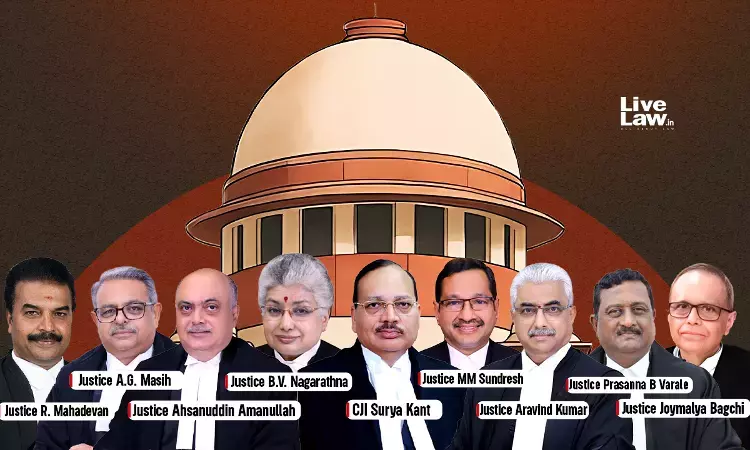
The Court observed that the intimate connection between the Indian civilisation & religion cannot be broken.
On the thirteenth day of the hearing in the Sabarimala reference, the Supreme Court expressed concerns about the breaking of India's civilisation if the judiciary starts interfering with religious disputes indiscriminately.The 9-judge bench was hearing the arguments of Senior Advocate Raju Ramachandran, who is representing the Central Board of Dawoodi Bohra Community, challenging the power of...
This is a premium content
Available exclusively to
Our subscribers
Subscribe Premium 
INR 1099+GST
Your support helps us to bring you more content at
an affordable subscription scheme !!!
All payment options available
On the thirteenth day of the hearing in the Sabarimala reference, the Supreme Court expressed concerns about the breaking of India's civilisation if the judiciary starts interfering with religious disputes indiscriminately.
The 9-judge bench was hearing the arguments of Senior Advocate Raju Ramachandran, who is representing the Central Board of Dawoodi Bohra Community, challenging the power of the Dai (religious head) of the Dawoodi Bohra community to excommunicate persons. Ramachandran argued that the excommunication power has been exercised arbitrarily in many instances, treating the believers as slaves, and this violated the fundamental rights of the believers.
During the course of the arguments, the bench asked if the power of excommunication is not protected under Article 26(b), as per which a religious denomination has the right to manage its own affairs. The senior counsel contended that Article 26(b) cannot be used to destroy the rights under Article 25(1), and that both the rights must be harmoniously interpreted.
Justice BV Nagarathna, part of the 9-judge bench, then observed, "Once everyone starts questioning certain religious practices or matters of religion before a constitutional court, then what happens to this civilization, where religion is so intimately connected with Indian society? There will be hundreds of petitions questioning this right, that right, closure of the temple, right? We are very, very conscious of this."
Echoing a similar view, Justice MM Sundresh expressed that "religions will break" if Courts go into all disputes related to religion. "Everybody will question everything. It's more like an in-house setup where you are saying what you are doing is wrong, and the other person will say it's absolutely obnoxious. How can court (intervene) when the legislature has been given a conscious right under Article 25(2)?"
Justice Nagarathna added, "What is unique about India? We are a civilisation, why are we a civilisation despite having so much plurality and diversity? One of the constants in our society is the relationship between humans, man woman and child, and religion; it is so intimate to everyone. Now, when a religious practice or a matter of religion is questioned, where it is questioned, why it is questioned, whether it can be questioned, whether the questioning has to come from within the denomination itself for reform, or whether the State has to do it, or whether you want the Court to adjudicate upon all these aspects, these are the things troubling us. See, what we lay down as a nine-judge Bench is for a civilization. That civilization is India. India has progressed despite all its developments, economy and everything else. There is still a constant within us. We cannot break that constant. That is what is troubling us."
The senior counsel replied, "We are a civilisation under a constitution, so nothing which goes against the grain of the constitution can be countenanced in a civilised society governed by a Constitution. It requires judicial statesmanship; it is the duty and responsibiity of the court to see whether there is a clear violation of fundamental rights which calls for the court's protection, or whether it is a mere difference between some members which does not require intervention. There cannot be a judicial hands off appraoch."
The bench also questioned the petitioner (Central Board of Dawoodi Bohra Community) for filing the writ petition in 1986 challenging the 1962 judgment in Sardar Syedna, which struck down the Bombay legislation prohibiting excommunication. The bench asked if a writ petition could be filed against a judgment. Ramachandran submitted that the grievance of the petitioner was essentially against the practice of excommunication, which he claimed was being carried out at the whims and fancies of the Dai. He submitted that there are instances of members being excommunicated for reasons such as reading a magazine. Most cases of excommunication were not related to violation of religious rites, and the religious head was interfering with the social and secular life of the members, he added. He pointed out that the writ petition remained pending for over three decades, and in 2023, a 5-judge bench referred the matter to the 9-judge bench considering the Sabarimala reference. He underscored that the 5-judge had raised prima facie doubts about the correctness of the 1962 judgment.
Ramachandran said that the 1962 judgment was premised on the reasoning that the religious head must have a right to discipline the members. While acknowledging that such a power should be there, Ramachandran submitted that excommunication is a drastic step, which virtually results in the 'civil death' of the member.
When the bench asked why such an excommunicated member cannot approach the civil court, Ramachandran submitted that since violation of fundamental rights are involved, the Constitutional courts must examine.
Justice Amanullah asked if the Court can decide whether an action taken by a religious head was proportionate or not. "When the triggering point is religion, who decides proportionality then? It has to be left to the discretion and we as a court can't..."
Ramachandran said that the impact of excommunication is on the dignity of an individual, and Article 21 is also being violated, apart from Article 25.
"Article 21 right has been taken away, because my life has been impacted," Ramachandran submitted.
Justice Nagarathna asked if a religious head approaches the Court challenging the prohibition of excommunication, and a believer comes to the Court challenging excommunication, whose right the Court should uphold. "The individual,", Ramachandran replied, asserting that an individual is the core of the Constitution.
Ramachandran argued that when excommunication impacts the social and secular activities of an individual, then it cannot be considered as a "matter of religion" protected under Article 26. According to him, the dissent expressed by Chief Justice BP Sinha in the 1962 Sardar Syedna decision must be accepted, as it was in tune with the concept of the living Constitution and its individual-centric interpretation.
A bench comprising Chief Justice of India Surya Kant, Justice BV Nagarathna, Justice MM Sundresh, Justice Ahsanuddin Amanullah, Justice Aravind Kumar, Justice Augustine George Masih, Justice Prasanna B Varale, Justice R Mahadevan and Justice Joymalya Bagchi is hearing the matter.
Live updates from the hearing can be followed here.
Tags
Gursimran Kaur Bakshi
Gursimran is the Principal Correspondent with LiveLaw for the Supreme Court. She can be reached out at: simrankaurbakshi@livelaw.in

