



What Should A Wearable Promise?
Justice K. Kannan
24 Nov 2026 10:45 AM IST
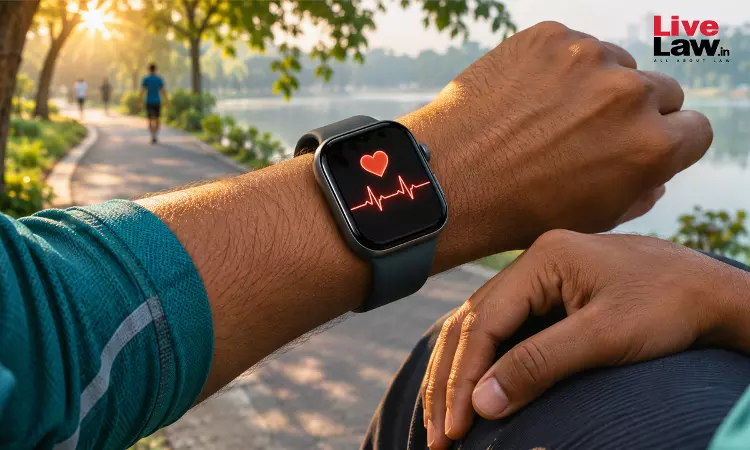
As technology moves health monitoring from the clinic to the consumer's wrist, the law must distinguish between measuring a bodily signal, predicting disease and promising a cure.
Imagine waking up in the morning, looking at your wristwatch and being told that your blood sugar is rising, your heart is showing signs of an abnormal rhythm, your sleep has been disturbed by an underlying neurological condition, or the blood supply to your brain has diminished. Imagine obtaining all this information without a blood test, a hospital visit or even a physical examination. A ring on your finger, a band around your wrist or a small device worn near your temple could become your personal health laboratory. The consumer technology industry is investing heavily in wearable devices that promise to monitor physiological functions continuously and unobtrusively.
The attraction is obvious. Medicine has traditionally depended on episodic encounters with the patient: a consultation, a clinical examination and investigations conducted in a laboratory. Wearable technology promises a different model. It seeks to convert health monitoring into a continuous, personalised and largely non-intrusive exercise. Instead of waiting for symptoms to appear, a consumer may be alerted to changes before they become clinically significant.


The promise is compelling, particularly in a country such as India, where access to preventive healthcare remains uneven and the burden of diabetes, cardiovascular disease and neurological disorders is substantial. But there is a fundamental question that must accompany this technological enthusiasm: what exactly is the device measuring, and how much of what it tells us can we safely believe?
The USA FDA Guidelines
Measuring a physiological signal is not the same as diagnosing a disease. Detecting a variation in a bodily function is not necessarily predicting its consequences. And an algorithmically generated score, however impressive its name, is not automatically a clinically established finding. The American experience offers a useful illustration of why regulatory scrutiny matters. The United States Food and Drug Administration (FDA), on February 21, 2024, issued a specific safety communication warning consumers against using smartwatches and smart rings that claim to measure blood glucose without piercing the skin. The FDA stated that it had not authorised, cleared or approved any smartwatch or smart ring intended to measure or estimate glucose values independently. The warning was not a rejection of wearable technology. It was a recognition that an inaccurate reading could lead a diabetic patient to take an inappropriate dose of insulin or other medication, with potentially dangerous consequences.
The FDA has also developed a regulatory distinction between low-risk general wellness products and products intended for medical purposes. Its January 2026 guidance on general wellness products clarifies that devices promoting healthy lifestyles may fall outside medical-device regulation when they are low-risk and their claims are unrelated to diagnosing, preventing, treating or managing disease. A device that merely helps a person understand sleep duration, physical activity or general patterns of wellness stands on a different footing from one that claims to identify a disease, provide a clinical warning or guide treatment. The regulatory question turns not merely on the hardware but on its intended purpose, functionality and the representations made to the consumer.
A recent tech device from India
This distinction assumes particular significance when one examines the emerging category of devices that claim to interpret brain activity and cerebral blood flow. One such example is the Temple wearable, marketed by entrepreneur Deepinder Goyal. Worn near the temple, the device is said to track changes in blood flow to the brain and heart outside conventional laboratory settings. It employs photoplethysmography, an optical technique related to that used in pulse oximeters. Light is directed into the skin, and the reflected signal is analysed to identify changes associated with blood volume in underlying tissue. The manufacturer has stated that Temple is not a medical device and has referred to studies that are still under way.
It is not yet established that the device directly measures cerebral blood flow. The researchers acknowledge that the sensor fundamentally detects changes in blood flow in the skin and underlying tissue. Nor do the studies establish that the proprietary index can predict dementia, cognitive decline or longevity. The biological significance and predictive value of the Entropy score remain to be demonstrated. Evidence that a device measures heart rate reliably cannot be treated as validation of every other parameter it generates.
There is no reason to discourage such experimentation. Scientific progress often begins with hypotheses that are not immediately capable of clinical application. But the consumer must not be made the unwitting participant in an experiment without being told what is established, what is provisional and what remains speculative.
How should Indian law approach this new category of products?
The Drugs and Magic Remedies (Objectionable Advertisements) Act, 1954, provides an interesting starting point. The definition of a 'drug' is wider than the ordinary understanding of a medicinal preparation. Section 2(b)(iii) includes an article, other than food, intended to affect or influence the structure or any organic function of the human body. In Zaffar Mohammad alias Z.M. Sarkar v. State of West Bengal (1976), the Supreme Court considered advertisements promising treatment through what were described as new machines of science and electric treatment. The Court held that a machine could constitute an article within the statutory definition where it was intended to influence organic functions of the body.
Sections 3 and 4 of the 1954 Act also merit attention. Section 3 prohibits advertisements relating to drugs which suggest their use for specified purposes, including diagnosis or treatment of diseases and disorders mentioned in the Schedule. Section 4 prohibits misleading advertisements relating to drugs. The precise statutory definition and the actual representations made by the manufacturer will therefore matter. A claim to provide information about cerebral circulation is not, without more, necessarily a claim to diagnose or treat a scheduled disease.
The Medical Devices Rules, 2017, framed under the Drugs and Cosmetics Act, 1940, provide another regulatory route. They cover devices intended for specified medical purposes, including diagnosis, monitoring, treatment or alleviation of disease or disorder, and investigation or modification of physiological processes. The manufacturer's stated intended use, reflected in its labelling, instructions and promotional material, assumes importance. A general wellness tracker may stand differently from a product promoted as monitoring a physiological condition for clinical purposes. Merely describing a product as non-medical cannot conclude the inquiry if its actual claims convey a medical purpose.
The Consumer Protection Act, 2019, offers a wider safeguard. Its provisions on misleading advertisements are not confined to medicines or medical devices. The Central Consumer Protection Authority has powers to act against false or misleading advertisements, and the 2022 Guidelines require claims to be truthful and adequately substantiated. Even if a wearable falls outside the definition of a drug or a medical device, its promotional claims may still attract scrutiny if they create an impression of established medical capability unsupported by evidence.
Limits of Wellness healthcare products
The future of preventive healthcare may well lie partly in the devices we wear rather than the hospitals we visit. But the convenience of continuous monitoring must not become a substitute for scientific reliability. A ring may measure a pulse; an algorithm may generate a score; a watch may alert us to an irregular rhythm. The distance between these functions and a diagnosis, however, remains considerable.
A huge responsibility falls on digital platforms and online marketplaces that sell these products to inform the consumer that no diagnosis can be made nor cure administered through these devices. The regulatory challenge increasingly concerns not just the manufacturer, but the entire chain through which a scientific claim reaches an unsuspecting consumer. Technology may promise to put a laboratory on our wrist. The law must ensure that what reaches the consumer is not merely a laboratory of promises.
Author Justice K. Kannan (Retd.) is a former Judge of the Punjab & Haryana High Court and Madras High Court. Views are personal.


