



- Home
- /
- Top Stories
- /
- When Can Medical Treatment Be...
When Can Medical Treatment Be Withdrawn In 'Best Interests Of Patient'? Supreme Court Explains Allowing First Passive Euthanasia
Gursimran Kaur Bakshi
11 March 2026 7:36 PM IST
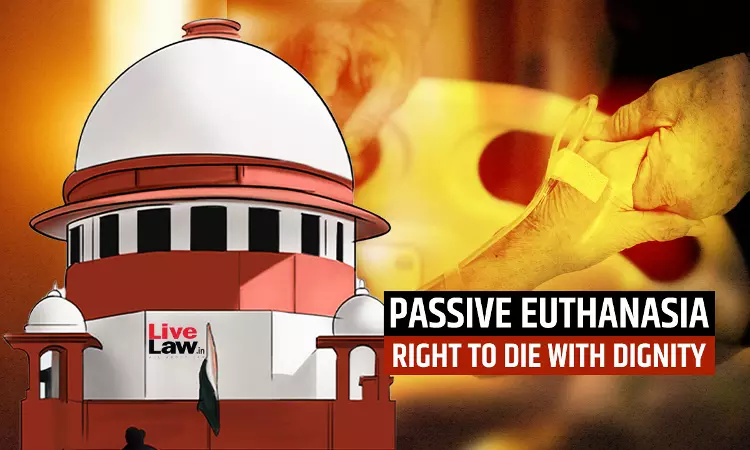
The Supreme Court today (March 11) stated that the best interests of the patient should be the primary consideration when deciding whether medical treatment may be withheld or withdrawn. The Court also laid down certain indicative factors which can help in judging whether withdrawal of life support was in the "best interests of the patient".If the medical treatment is futile, without giving...
This is a premium content
Available exclusively to
Our subscribers
Subscribe Premium 
INR 1099+GST
Your support helps us to bring you more content at
an affordable subscription scheme !!!
All payment options available
The Supreme Court today (March 11) stated that the best interests of the patient should be the primary consideration when deciding whether medical treatment may be withheld or withdrawn. The Court also laid down certain indicative factors which can help in judging whether withdrawal of life support was in the "best interests of the patient".
If the medical treatment is futile, without giving any therapeutic effect, and is only prolonging the suffering by extending the mere biological existence, it can be a decisive factor in favour of the withdrawal of medical treatment.
These aspects were discussed by the Court in its historic judgment, which allowed passive euthanasia in India for the first time. The Court permitted the withdrawal of life support of 32-year-old Harish Rana, who has been in a persistent vegetative state(PVS) for 13 years. A bench comprising Justice JB Pardiwala and Justice KV Viswanathan passed the judgment in terms of the Common Cause judgment(2018), which was modified in 2023.
In doing so, the Court stated that the best interests principle requires a holistic assessment of all relevant circumstances, both medical and non-medical. However, it is not a straight-jacket test. It said that the test of best interest is an objective standard.
It may include the following:
1. While deciding upon the withdrawal or withholding of medical treatment, the correct question should be whether it is in the patient's best interests that life should be prolonged by the continuance of the particular medical treatment in question
2. While answering such a question, the best interest principle cannot be construed in a narrow, rigid, straight-jacketed single test. The determination of the same requires due evaluation of all relevant circumstances and considerations, both medical and non-medical.
The Court added that non-medical consideration includes taking consent of the family members before the constitution of the Primary Medical Board for assessing whether life support should be withdrawn.
"This requirement of obtaining the consent of the patient's next of kin/next friend/guardian in writing before the primary medical board has the opportunity to certify or oppose the withdrawal or refusal of medical treatment comes with an inherent objective to save the derailment of the entire exercise that lies ahead. The objective of taking such consent is to allow the patient's next of kin/next friend/guardian to bring forth the non medical considerations after being informed of the medical considerations put forth by the primary medical board."
3. At the foundational level, the best interests inquiry is anchored in a strong presumption in favour of preserving life, reflecting the sanctity of life. This presumption is not absolute and may be displaced where continuation of medical treatment ceases to serve any therapeutic purpose, i.e., becomes futile, merely prolongs the suffering without the hope of recovery or causes indignity to the life of the patient.
4. The assessment of best interests must, therefore, necessarily encompass an evaluation of the futility of treatment, the absence of therapeutic purpose, the invasive and burdensome nature of continued medical intervention, and the indignity attendant upon artificially prolonging life in a state devoid of awareness, autonomy, or human interaction.
5. Further, while considering the best interests of the patient, decision-makers such as the patient's next of kin/next friend/guardian, the treating physician, the members of the medical boards, or the courts (if involved), as the case may be, must look at the patient's welfare in the widest sense, not just medical but also social and psychological
6. Decision-makers must try to put themselves in the place of the individual patient and ask what his wishes and attitude to the treatment are or would be likely to be; and they must consult others who are looking after him or interested in his welfare, in particular for their view of what the patient would have wanted
7. The best interests principle shall incorporate a strong element of the substituted judgment standard, requiring the decisionmaker to place himself, so far as possible, in the position of the patient and to consider in a patient-centric manner what that patient would have wanted if he had capacity to do so. However, substituted judgment would not operate as an autonomous or overriding standard. The ultimate inquiry remains what course of action serves the patient's best interest
8. The decision-makers, after identifying and collating necessary and ascertainable considerations, both medical or nonmedical, must engage in the balance sheet exercise, which would involve weighing the potential benefits of continued treatment against its burdens, including physical suffering, invasiveness, indignity, psychological distress, wishes and welfare of the patient, the impact upon the patient's lived experience and family life, and other like considerations.
The also clarified that the best interest of the doctor to withhold the treatment is not directed towards death but towards relieving the prolonged suffering.
"In this context, the decision of a doctor to withdraw or withhold medical treatment on the basis of the best interests of the patient is not one directed towards causing death, but towards relieving pain, suffering, and indignity in circumstances where continued treatment no longer serves any therapeutic purpose. A doctor's duty to provide treatment obliges until the provision of treatment is capable of conferring some therapeutic benefit upon the patient."
Where, however, the patient is in the terminal stage of illness or in a vegetative state with no reasonable prospect of recovery, and the continuation of treatment merely prolongs biological existence without any therapeutic benefit, that duty no longer mandates continuing with life-sustaining treatment. In determining whether or not such a stage has been reached, the best interests of the patient must be the driving force, the Court said.
In Common Cause, a three-judge bench held that the right to die with dignity forms an integral part of Article 21(right to life). The guidelines were then set out regarding the withdrawal and withholding of medical treatment where either an Advance Medical Directive (will) exist or does not exists.
Case Details: HARISH RANA Vs UNION OF INDIA|MA 2238/2025 in SLP(C) No. 18225/2024
Citation : 2026 LiveLaw (SC) 229

Gursimran Kaur Bakshi
Gursimran is the Principal Correspondent with LiveLaw for the Supreme Court. She can be reached out at: simrankaurbakshi@livelaw.in

