



- Home
- /
- Top Stories
- /
- 'Why Can't They Check Your Mobile?'...
'Why Can't They Check Your Mobile?' Supreme Court Refuses To Stay ED's Examination Of Seized Phone
Amisha Shrivastava
23 Jan 2026 4:53 PM IST
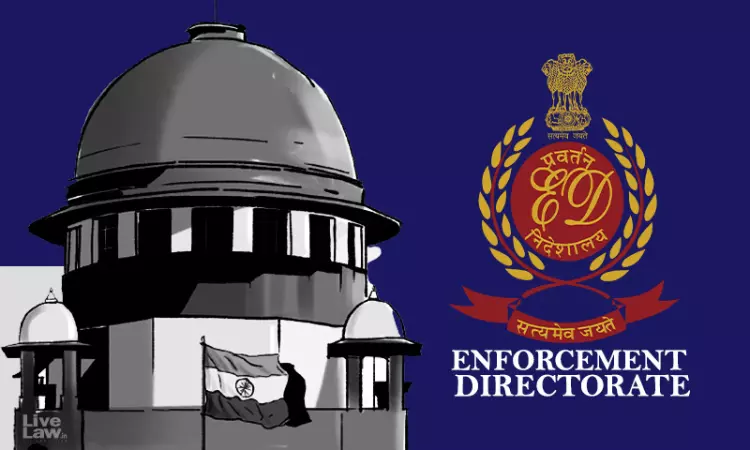
Where is the violation of privacy when there is a lawful investigation, the Court asked.
The Supreme Court on Thursday declined to grant interim protection to Kolkata businessman Jitendra Mehta from the Enforcement Directorate examining the contents of his seized mobile phone, rejecting his plea that unrestricted forensic examination of the device would violate his right to privacy under Article 21 of the Constitution.A bench of Chief Justice of India Surya Kant, Justice...
This is a premium content
Available exclusively to
Our subscribers
Subscribe Premium 
INR 1099+GST
Your support helps us to bring you more content at
an affordable subscription scheme !!!
All payment options available
The Supreme Court on Thursday declined to grant interim protection to Kolkata businessman Jitendra Mehta from the Enforcement Directorate examining the contents of his seized mobile phone, rejecting his plea that unrestricted forensic examination of the device would violate his right to privacy under Article 21 of the Constitution.
A bench of Chief Justice of India Surya Kant, Justice Joymalya Bagchi and Justice Vipul Pancholi issued notice on Mehta's plea against the seizure and summons issued to him by the ED.
“Where is the violation of privacy? Once the investigation is lawfully being done, an agency is entitled to hold an investigation. Why can't they find out from your mobile that what is information? Barring that some information lying in that mobile suppose, which has nothing to do with the with the alleged crime attributed to you, that data can't be disclosed to the public, can't be brought in public domain, cannot form part of the any report. So to that extent, you have privacy right”, Chief Justice Kant said.
He remarked that the Court was fully capable of protecting innocent citizens and could even do so suo motu, but such protection could not extend to those who were involved in wrongdoing.
“We know how to protect our innocent citizens. Suo moto also we can protect our innocent citizens. But those who are involved in any crime…”, he remarked.
Though the petitioner's counsel, Senior Advocate C Aryama Sundaram, objected, contending that the Court was proceeding on a presumption of guilt against the petitioner, the Court declined to grant interim relief.
Mehta has filed a writ petition challenging the seizure of his iPhone 15 Pro Max during a search conducted at his residence on January 08, 2026 by the ED. He has also challenged the summons dated January 12, 2026 issued under Section 50 of the Act, which directed him to remain present during forensic examination of the seized device.
The petition contends that unrestricted extraction of data from his phone violates his fundamental right to privacy under Article 21 in the absence of any statutory safeguards governing access to digital devices.
At the outset, Senior Advocate CA Sundaram for the petitioner submitted that the Court was already seized of several petitions raising the same issue, namely the absence of guidelines governing extraction of data from seized digital devices.
He argued that the petitioner's mobile phone had been seized even though no predicate offence had been registered against him. He contended that the summons issued to the petitioner stated that a forensic examination of the seized phone would be carried out, which amounted to unrestricted access to the entirety of the petitioner's personal data.
Justice Surya Kant questioned where the violation of privacy arose if the investigation was being conducted lawfully.
Sundaram responded that the concern was that there were no safeguards or methodology to ensure that only relevant material was accessed. He argued that the petitioner was not even accused of a predicate offence and that the phone had been taken on the assumption that it might reveal something about some other person.
He submitted that Section 17 of the PMLA required “reason to believe” and that the search and seizure could not turn into a roving or fishing inquiry. He relied on earlier interim orders passed by coordinate Benches in other cases in which protection had been granted against accessing or copying data from seized devices, including in cases where the persons concerned were accused.
Justice Surya Kant remarked that serious allegations involving large sums of money were under investigation and questioned whether even a mobile device could not be examined during such investigation. He also noted that the Court had granted protection on a case-to-case basis in other matters.
Justice Surya Kant observed that if the agency used any information unrelated to the offence attributed to the petitioner's associates, the petitioner could then claim that such information could not be divulged. He said the petitioner was a suspect associated with persons already under investigation.
When Sundaram emphasised that nothing in the summons disclosed any allegation against him, the bench responded that the stage to raise such claims was yet to come.
Justice Bagchi observed that unlike an arrest under Section 19 of the PMLA, there was no statutory requirement to communicate those reasons for a search to the person searched. He rejected the argument that the absence of an ECIR against the petitioner vitiated the search, observing that an ECIR related to an offence and not to an individual.
Sundaram argued that even if the agency was permitted to access the phone, it should be limited to specific keywords or parameters relevant to the investigation, as had been suggested in earlier proceedings. He contended that unrestricted access to the phone violated the petitioner's right to privacy under Article 21.
CJI Kant remarked that the agency had not come to the petitioner casually and that a mobile phone could be a strong piece of incriminating material.
Sundaram maintained that in his case there was not even a predicate offence and the petitioner was not getting his device back while the department retained full control over it. He submitted that once the phone was examined, the writ petition would become infructuous.
He sought a limited interim stay on the examination of the phone until the next date of hearing, stating that Mehta had been summoned by the Enforcement Directorate the following day and that the writ petition would become infructuous if the phone was accessed in the meantime. He urged the Court to at least restrain the authorities from opening the phone until they disclosed the basis on which it had been seized.
However, the Court was not persuaded and declined the request for interim protection. The Court issued notice returnable on next Tuesday and tagged the writ petition with other pending matters raising similar questions.
“Issue notice returnable on 27.01.2026 for the limited purpose to find out the nature of the allegations attributed to either the petitioner or his co accused, as the petition unfortunately has disclosed only very selective information”, the Court ordered.
The petition is filed through Advocate on Record Rohini Musa.
Case no. – W.P.(Crl.) No. 30/2026
Case Title – Jitendra Kumar Mehta v. Directorate of Enforcement and Ors.
Tags

Amisha Shrivastava
Amisha Shrivastava is a Senior Correspondent with LiveLaw, covering the Supreme Court of India. She can be reached at amisha@livelaw.in

