



- Home
- /
- Top Stories
- /
- Why Ultra-Processed Foods Grouped...
Why Ultra-Processed Foods Grouped With Other Packaged Foods Under Warning Label Regime? Supreme Court Asks FSSAI
Gursimran Kaur Bakshi
11 Sept 2026 3:04 PM IST
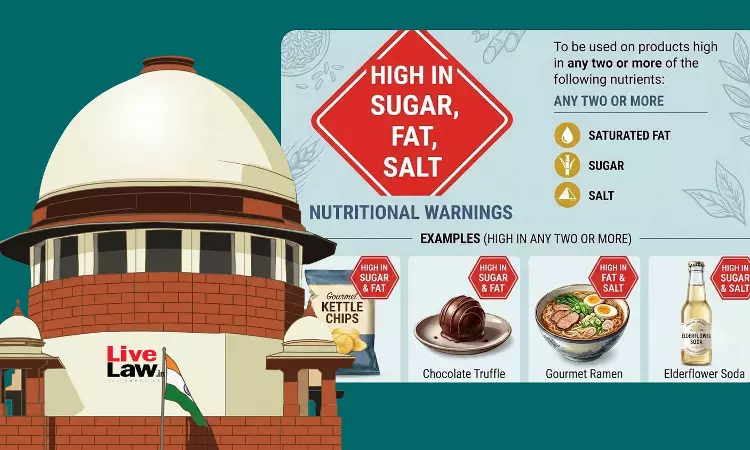
The Court posed 13 specific queries to the FSSAI seeking clarity on its FOPL system.
The Supreme Court has questioned whether ultra-processed foods (UPFs) should be subjected to the same front-of-pack warning-label thresholds as other packaged foods, observing that clubbing ultra-processed foods with minimally processed packaged foods could overlook the nutritional differences between them.A Bench of Justices JB Pardiwala and K Vinod Chandran has specifically asked the...
This is a premium content
Available exclusively to
Our subscribers
Subscribe Premium 
INR 1099+GST
Your support helps us to bring you more content at
an affordable subscription scheme !!!
All payment options available
The Supreme Court has questioned whether ultra-processed foods (UPFs) should be subjected to the same front-of-pack warning-label thresholds as other packaged foods, observing that clubbing ultra-processed foods with minimally processed packaged foods could overlook the nutritional differences between them.
A Bench of Justices JB Pardiwala and K Vinod Chandran has specifically asked the Food Safety and Standards Authority of India (FSSAI) whether, while calculating thresholds for nutrients of concern under its proposed Front-of-Pack Labelling (FoPL) regime, it proposes to account for the distinction between Food Group B [moderately processed foods with no additives] and Food Group C[excessively processed foods with additives]/
The Court noted that the food classification contained in the Dietary Guidelines for Indians, 2024, issued by ICMR-NIN, first divides foods according to their degree of processing into Group A (minimally processed, no additives), Group B (moderately processed, no additives) and Group C (excessively processed, with additives). These are then further divided into sub-categories 1, 2 and 3 according to calorific value.
The Court pointed out that A2, A3, B2, B3, C2 and C3 are identified as HFSS foods under the 2024 Guidelines. It said that if the proposed nutrient thresholds are applied without accounting for the distinctions between these categories, the difference between food categories 2 and 3 could effectively disappear.
The Bench suggested that one possible approach could be to target Category 3 foods first, followed by Category 2 foods, with progressively lower thresholds in subsequent phases. It noted that such a model had been adopted in Israel and could bring about a gradual change in the overall food environment.
More significantly, the Court said the distinction between Food Groups B and C “must also somehow be reflected” in the manner in which warning labels are designed. It recorded the submission that putting ultra-processed foods together with minimally processed packaged foods could ignore the nutritional benefits offered by minimally processed foods. The Court clarified that taking this aspect into account would not necessarily require abandoning the interpretive warning-label model and starting the FoPL framework afresh.
It further said that, if feasible, different nutrient thresholds could be fashioned depending upon the level of processing of the product. The Court also asked FSSAI to clarify what specific “sweetened beverages” it proposes to cover in Phase I and whether different thresholds would apply to them.
Total Sugar or Added Sugar? Supreme Court asks FSSAI if it has changed 2021 consensus
As a second significant issue, the Supreme Court has asked FSSAI to clarify whether the FoPL thresholds for sugar and fat will be calculated on the basis of “Total Sugar” and “Saturated Fat”, as agreed at a stakeholder consultation in 2021, or on some different basis.
The Court has specifically asked FSSAI whether there has been any change in its stance since the October 29, 2021 stakeholder meeting, where consensus was reached that Total Sugar, rather than Added Sugar, would be used for FoPL purposes. It has also asked how the concerns underlying that earlier consensus are now proposed to be addressed if FSSAI has changed its position.
The minutes of the 2021 consultation, reproduced in the order, recorded that although it is added sugar that is processed into food products, sugars in general beyond a certain limit are a health concern. The scientific members had therefore favoured displaying total sugar along with energy on the front of the pack. The meeting concluded that Total Sugar was the better option considering health concerns, international acceptability and ease of analytical testing. It also noted that energy calculations are based on total rather than added sugar.
The Court also noted that the same consultation arrived at a consensus in favour of Saturated Fat rather than Total Fat. However, it has now asked FSSAI to clarify whether the final FoPL will reflect both saturated fat and trans-fat levels or only saturated fat.
The Court's question assumes particular importance because the FSSAI proposal currently relies on thresholds derived from the 2024 Dietary Guidelines, where the threshold table refers to added sugar and added fat. For solid foods, the table specifies thresholds of 3 grams of added sugar and 4.2 grams of added fat per 100 grams, besides 625 mg of salt and 250 kcal of energy. For liquids, the corresponding thresholds are 2 grams of added sugar, 1.5 grams of added fat, 175 mg of salt and 70 kcal per 100 ml.
The Guidelines state that the sugar threshold for solid foods has been calculated at approximately 5% of energy from added sugar, while not exceeding 10% of energy from total sugar. For liquid foods, the corresponding figures are approximately 10% of energy from added sugar and not more than 30% from total sugar.
What is FSSAI's proposed FoPL?
The Court was considering an affidavit filed by FSSAI on August 28, 2026, pursuant to its earlier directions.
FSSAI has proposed a red-coloured hexagonal warning label on the front of packaged food products that are high in two or more specified nutrients of concern - added fat, added sugar and salt. The proposed warnings include “HIGH FAT”, “HIGH SUGAR”, “HIGH SALT” and “HIGHLY SWEETENED BEVERAGE”. The warning is proposed to be displayed in a font one point larger than that used in the nutrition information table at the back of the pack.
Single-ingredient food products and foods inherently rich in fat, sugar or salt - such as ghee, edible oil, salt, sugar, jaggery and honey - are proposed to be exempt, subject to other food-safety and labelling requirements.
FSSAI proposes to introduce the system in two phases. Phase I would cover products high in two or more of the specified nutrients, as well as specified sweetened beverages. Phase II would extend the warning requirement to products high in any one of the three nutrients. The stated objectives include consumer acceptability, giving industry time for reformulation and facilitating informed food choices, particularly for children and other vulnerable groups.
The Court, however, questioned the scientific basis for making “two or more” nutrients the trigger for Phase I.
Court questions “two-or-more” threshold
The petitioner, 3S and Our Health Society, has argued that excess sugar, salt and saturated fat are independently harmful, operating through different pathways - excess sugar being linked to diabetes and metabolic disease, excess salt to hypertension, and excess saturated fat to cardiovascular disease and adverse cholesterol.
The petitioner therefore contended that requiring two or more nutrients to cross their thresholds before a warning is triggered is not scientifically justified and would substantially narrow the products covered during Phase I.
The Court also found an apparent inconsistency between two government documents concerning what constitutes HFSS food. The 2024 Dietary Guidelines refer to foods prepared with excessive cooking oils/fats or more added sugar and salt, whereas the 2022 Draft Food Safety and Standards (Labelling & Display) Amendment Regulations defined HFSS food as a processed food product having high levels of saturated fat or total sugar or sodium.
The Court said the different use of “and” and “or” reflected some confusion which needed to be resolved before determining the basis of the phased FoPL strategy.
It may be recalled that in this public interest litigation, filed through Advocate Rajiv Shankar Dvivedi, FSSAI finally agreed to adopt FOPL, but in two phases. Phase I would carry a warning if the packaged food is high in two or more components, and in the second phase, food high in even a single component would carry a warning. However, the petitioner NGO has called this approach unscientific and, in a way, redefining the industry definition of HSSS.
In order to resolve this issue, the bench has said: "The use of the disjunctive or and the conjunctive and in a different manner in both these documents reflects some confusion. As a matter of priority, this needs to be resolved. Thereafter, the basis of the phased strategy must be approached in accordance with the consensus arrived at on the definition of the HFSS foods."
Further, as the petitioner highlighted the lack of binding timelines for when Phase II will be implemented, the Court called it concerning. The bench has asked the FSSAI to adopt a reasonable and scientifically justified timeline and reasoned that, without timelines, implementation of Phase II would take a backseat.
"Assessment of consumer acceptability or giving the industry adequate time for reformulation cannot be reason enough for this uncertainty in time. Therefore, a reasonable, scientifically justified and clearly defined timeline or transitionary period which divides the two phases must be indicated, for the approach of the FSSAI to be a workable one."
Court questions design of red hexagon
The Court has also raised a series of questions concerning the visibility and design of the proposed warning.
It noted that FSSAI's proposal is silent on the dimensions of the red hexagonal logo. The Bench wants to know whether its size would be standardised or made proportional to the front-of-pack area, and whether the font size should be related to the dimensions of the hexagon. The petitioner had pointed out that some countries use labels occupying around 15–20% of the principal display area.
The Court also wants clear rules on the placement and background of the FoPL so that the warning remains prominent, conspicuous and readily legible under normal conditions of purchase and use.
Another concern relates to FSSAI's proposed word-based warning system.
The Court noted that the proposal largely communicates the warning through words such as “High Fat”, “High Sugar” and “High Salt”. It said such a system assumes a certain level of comprehension, literacy and reading capability across different States, regions, vernaculars and age groups.
The Bench suggested that an inclusive FoPL could combine words with pictorial representations of the individual nutrients of concern, making the information more accessible to consumers with diverse levels of literacy and comprehension. It also noted that food purchasing is increasingly moving online, and that this reality should be considered while designing the labels.
The Court separately questioned why FSSAI proposes a single composite hexagon when a product is high in two or more nutrients, instead of separate hexagons for each nutrient.
For example, if a product is high in sugar and fat, FSSAI's proposal would put “High Sugar” and “High Fat” together in one hexagon. The Court asked why the two warnings could not instead be displayed in separate hexagons, which would make the individual risks more readily apparent from a distance.
Why red? Court flags possible confusion with non-vegetarian labels
The Bench has also asked FSSAI to reconsider its choice of red for the warning symbol.
The Court noted the apprehension that Indian consumers have become accustomed to associating green with vegetarian products and red with non-vegetarian ingredients, particularly in the context of food labels. It has therefore asked whether the colour choice should be revisited.
Court flags possible rise in additives
The Court has also identified a potential unintended consequence of an FoPL regime focused on fat, sugar and salt.
It noted that these ingredients perform several functional roles in packaged foods, including enhancing taste and palatability, providing texture and structure, contributing to shelf life and microbiological safety, and assisting heat transfer and processing stability.
Consequently, manufacturers seeking to reduce sugar, fat or salt could potentially increase their use of artificial preservatives, emulsifiers and other additives. The Court has asked FSSAI to account for this possibility while finalising thresholds and to consider corresponding regulations governing such additives.
Mandatory implementation and school-level nutritional literacy
The Court has also asked what would happen once the final FoPL regulations are notified.
It noted that the 2022 Draft Regulations had contemplated a 48-month voluntary compliance period before the regime became mandatory. The Court has asked FSSAI to respond to the petitioner's contention that the final FoPL should be mandatory from the outset and, if not, to specify a reasonable period after which compliance would become compulsory.
Finally, the Bench has asked the Union Government how it proposes to incorporate nutritional literacy at the school level, including through curriculum, initiatives and workshops, so that children learn how to interpret nutritional information and FoPL warnings on packaged foods.
The Bench has directed FSSAI to file an affidavit answering the questions within 10 days, with the petitioners to be given an opportunity to respond. The matter has been posted for further hearing on September 28, 2026.
Case Details: 3S AND OUR HEALTH SOCIETY v UNION OF INDIA AND ANR| MA 1177/2025 in W.P.(C) No. 437/2024
Citation : 2026 LiveLaw (SC) 926

Gursimran Kaur Bakshi
Gursimran is the Principal Correspondent with LiveLaw for the Supreme Court. She can be reached out at: simrankaurbakshi@livelaw.in

