



- Home
- /
- Top Stories
- /
- “Widen Law, Make It More...
“Widen Law, Make It More Intelligible”: CJI Urges Young Graduates To Keep Law Accessible
LIVELAW NEWS NETWORK
22 Feb 2026 11:08 AM IST
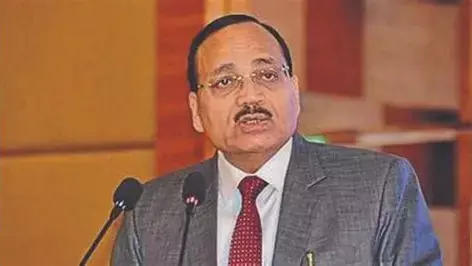
At the Eighteenth Convocation Ceremony of National Law University (NLU), Jodhpur on February 21, 2026, the Chief Justice of India urged graduating law students to ensure that the legal system becomes more accessible and understandable, cautioning against allowing law to become an exclusive domain guarded by complexity and jargon.Delivering the convocation address titled “From Fortress to...
This is a premium content
Available exclusively to
Our subscribers
Subscribe Premium 
INR 1099+GST
Your support helps us to bring you more content at
an affordable subscription scheme !!!
All payment options available
At the Eighteenth Convocation Ceremony of National Law University (NLU), Jodhpur on February 21, 2026, the Chief Justice of India urged graduating law students to ensure that the legal system becomes more accessible and understandable, cautioning against allowing law to become an exclusive domain guarded by complexity and jargon.
Delivering the convocation address titled “From Fortress to Forum – Law in an Unfinished Republic”, the Chief Justice said that lawyers must work towards widening the reach of law and making it intelligible to ordinary citizens.
“In every generation, there is a risk that the law, having once liberated, may begin to distance itself again – wrapped in complexity, guarded by jargon, accessible only to those who can afford its language,” the Chief Justice said.
Highlighting the role of young lawyers, he stressed that their responsibility was to prevent the law from becoming inaccessible.
“You must resist that drift. Your task is not to make law more arcane, but more intelligible; not to narrow the forum, but to widen it,” he said.
Law Must Evolve With Society
The Chief Justice emphasised that law should not be seen as a finished product but as an evolving system shaped by social change. He urged students to avoid the “illusion” that the law they studied was a complete and settled edifice.
Quoting Justice Oliver Wendell Holmes Jr., he noted that “the life of the law has not been logic; it has been experience,” adding that law evolves because society itself evolves.
He said that the Constitution was conceived as a living framework capable of growth, and that successive generations have interpreted its guarantees in light of contemporary realities, including personal liberty, privacy and substantive equality.
Using the example of Mehrangarh Fort overlooking Jodhpur, the Chief Justice described how early conceptions of law resembled a “fortress” designed to protect society from arbitrariness and disorder.
However, in a constitutional democracy, he said, law must function as a “forum” where differences are debated and power is reasoned with.
“A fortress may endure by closing itself off, but a forum endures by opening itself up,” he said.
Responsibility of Legal Professionals
The Chief Justice stressed that legal practice is a public trust and not merely a means of personal advancement.
“The law is not private capital to be leveraged for personal gain. It is a public trust. The credibility of our Courts depends as much on the Bar as on the Bench,” he said.
He warned that prioritising spectacle over substance and complexity over clarity would recreate the “fortress mentality” that democracy sought to transcend.
Praising NLU Jodhpur as one of India's leading law schools, the Chief Justice said institutions must ensure that excellence does not become exclusion.
“When a law school of this standing sends its graduates into the world, it does not merely export talent; it exports standards,” he said.
He concluded by urging the graduating class to become “architects of an open forum” and to work towards making law more accessible and responsive to society.
Tags


