



- Home
- /
- Top Stories
- /
- Woman's Choice Relevant; Can't...
Woman's Choice Relevant; Can't Force To Continue Unwanted Pregnancy Saying Child Can Be Given For Adoption : Supreme Court
Amisha Shrivastava
24 April 2026 11:35 AM IST
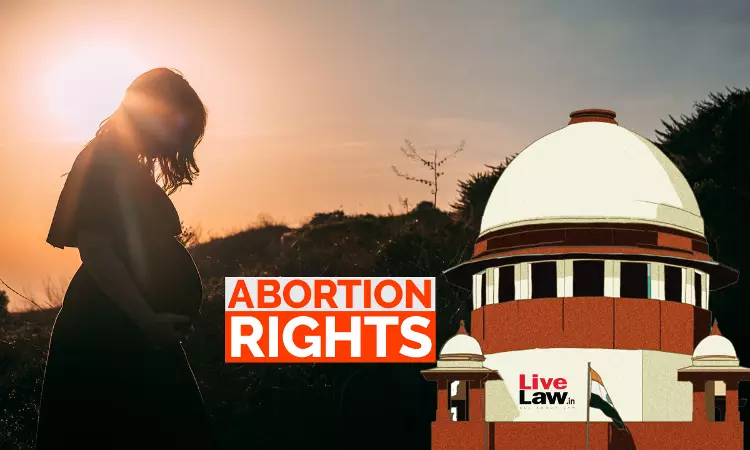
Forcing a minor to continue with unwanted pregnancy is an affront to her right to life, the Court stated.
The Supreme Court on Friday observed that a woman cannot be compelled to continue with an unwanted pregnancy merely on the ground that the child can be given up for adoption after birth, stressing that the choice of the pregnant woman must remain paramount.Allowing the medical termination of pregnancy of a 15-year-old girl who was over seven months pregnant, the Court observed."What is...
This is a premium content
Available exclusively to
Our subscribers
Subscribe Premium 
INR 1099+GST
Your support helps us to bring you more content at
an affordable subscription scheme !!!
All payment options available
The Supreme Court on Friday observed that a woman cannot be compelled to continue with an unwanted pregnancy merely on the ground that the child can be given up for adoption after birth, stressing that the choice of the pregnant woman must remain paramount.
Allowing the medical termination of pregnancy of a 15-year-old girl who was over seven months pregnant, the Court observed.
"What is relevant here is the choice of the pregnant woman rather than that of the child to be born. It is easy to say that if the pregnant woman is not interested in raising the child, she may give away the child in adoption and therefore she must give birth to the child.
That cannot be a consideration particularly in cases where the child to be born is unwanted. In such a situation, directing the pregnant woman to give birth to the child against her wishes and therefore continue her pregnancy would negate the welfare of the pregnant woman and make it subordinate to the child yet to be born."
A bench comprising Justice BV Nagarathna and Justice Ujjal Bhuyan observed that no court ought to compel a woman, particularly a minor, to carry a pregnancy to full term against her express will, as such compulsion would inflict grave mental, emotional and physical trauma.
"If she is forced to continue the pregnancy and give birth to a child, the consequence would be adverse. An unwanted pregnancy and the mindset of a pregnant woman has a bearing on the child to be born too.
The decision to not to continue her pregnancy and seek termination with all attendant medical risk must be respected rather than compelling such a pregnant woman to continue such a pregnancy. "
The Court was hearing a plea filed by the mother of the minor seeking permission for medical termination of pregnancy beyond the statutory period prescribed under the Medical Termination of Pregnancy Act.
During the hearing, Solicitor General Tushar Mehta, appearing for the State, submitted that the medical report indicated a threat to the life of both the mother and the child if termination was carried out at the advanced stage of pregnancy. He suggested that an adoption could be arranged through the Central Adoption Resource Authority in a manner that would protect the privacy and reputation of the girl and her family. The Solicitor General also offered to assist financially in the process.
Justice Nagarathna, however, questioned the approach of suggesting financial assistance or adoption as alternatives to termination. She remarked that the Court could not direct women seeking medical termination to depend on individual financial support and asked what would happen if the minor was unwilling to continue the pregnancy, noting that about ten weeks remained before delivery.
Counsel for the petitioner submitted that the pregnancy had already caused severe psychological distress to the minor and had affected her education, adding that every single day had been traumatic for the child and her family.
The bench expressed concern that if courts routinely declined permission in such cases, minors might resort to unsafe and illegal abortion methods. Justice Nagarathna observed that compelling continuation of pregnancy against the wishes of the girl could push her to seek clandestine procedures, resulting in permanent harm.
The Court also took note of the fact that the pregnancy arose from a consensual relationship between two minors and that the girl had unequivocally expressed her unwillingness to continue with the pregnancy. It recorded that the minor had already exhibited signs of psychological distress, including attempts to take her own life.
Forcing unwanted pregnancy to continue violates right to live with dignity
In its order, the Court held that forcing continuation of such an unwanted pregnancy would have long lasting repercussions on the minor's mental health, educational prospects, social standing and overall development. The bench emphasised that the best interests of the minor must be prioritised over procedural and statutory limitations while exercising jurisdiction under Articles 226 or 32 of the Constitution.
The Court underscored that reproductive autonomy is an integral facet of personal liberty and privacy under Article 21 and that the right to make decisions concerning one's body cannot be rendered ineffective by imposing unreasonable restrictions, particularly in cases involving minors and unwanted pregnancies.
Rejecting the argument that the child could be given up for adoption after birth, the Court observed that what is relevant in such cases is the choice of the pregnant woman rather than that of the child to be born, and that the availability of adoption cannot be used as a reason to compel childbirth.
Constitutional Courts have to see the matter from the lens of the woman, can't deny relief saying statutory remedies are barred
The Court observed that in cases of unwanted pregnancy, the decision to terminate is often taken at a stage when the statutory period prescribed under the Medical Termination of Pregnancy Act has already elapsed. It noted that it is precisely in such circumstances that constitutional courts are required to step in and weigh the facts from the standpoint of the welfare, dignity and autonomy of the pregnant woman, rather than from the perspective of the child to be born.
The bench emphasised that the constitutional court is approached when the statutory remedy is not available to a party, and that the absence of a statutory remedy cannot be a ground to deny constitutional relief. It stated that such an approach would be inconsistent with the role of constitutional courts in safeguarding fundamental rights.
The Court further observed that the constitutional court ought to assess all facts and circumstances from the lens of the woman who seeks termination and is willing to undertake the medical risks involved, rather than directing her to complete the pregnancy and give birth to an unwanted child.
It cautioned that compelling a woman to continue with an unwanted pregnancy would amount to a breach of her constitutional rights. The bench added that if courts insist that even an unwanted pregnancy must be continued, women may be driven to approach illegal abortion centres or undergo secret termination procedures, thereby exposing themselves to greater physical and psychological dangers.
The Court underscored that it is under such considerations that a constitutional court must determine what best serves the interests of the pregnant woman, particularly where the pregnancy is clearly unwanted.
The Court observed that what is relevant is whether the pregnant woman intends to give birth to the child or not. In the present case, she has clearly expressed her unwillingness to continue with the pregnancy.
Accordingly, the Court directed that she be permitted to undergo medical termination of pregnancy at AIIMS, New Delhi, subject to all necessary medical safeguards. The appellant, on behalf of the minor child, was directed to submit an undertaking consenting to the procedure.
Headnote
Medical Termination of Pregnancy Act, 1971 — Sections 3(2)(b)(i), 3(3), and 5 — Medical Termination of Pregnancy Rules, 2003 — Rule 3B(c) — Constitution of India — Articles 21, 32, and 226 — Late-Term Pregnancy of Minor — Reproductive Autonomy and Decisional Autonomy as Fundamental Rights — Lack of Statutory Remedy No Bar to Constitutional Remedy - The Supreme Court allowed the appeal, set aside the High Court's order, and permitted the medical termination of the pregnancy - The Court laid down the following key propositions: i. Reproductive Autonomy under Article 21 - The right to make decisions concerning one's body and reproduction is an integral facet of personal liberty and privacy under Article 21 of the Constitution of India - No court ought to compel any woman, especially a minor child, to carry an unwanted pregnancy to full term against her express will - The choice of the pregnant woman must be prioritized over the interest of an unborn child or suggestions of giving the child up for adoption; ii. Statutory Limitations vs. Constitutional Remedy - A lack of remedy under a statute (such as the MTP Act) does not bar a constitutional remedy under Article 32 or 226 - The statute merely codifies a part of the constitutional remedy - When statutory limits are exhausted, Constitutional Courts must view the case through the lens of the pregnant woman's welfare and fundamental rights rather than adopting a prohibitory approach, which inadvertently drives women toward unsafe, illegal abortion centers; iii. Foetal Normalcy and Passage of Time - The invocation of foetal normalcy or the advanced duration of a pregnancy cannot be used to deny termination - Subordinating a woman's fundamental rights to the pathology of a fetus instrumentalizes her into a mere conduit - the passage of time does not extinguish reproductive choices, as delays often stem from systemic barriers, irregular cycles, lack of awareness, financial constraints, or fear; iv. Assessment of Mental Health and Distress - The absence of a clinically diagnosed psychiatric disorder in a Medical Board report does not negate the presence of severe emotional trauma, distress, or anguish - The minor's two suicide attempts demonstrated acute mental suffering that the law cannot ignore - Since the Medical Board found the minor physically fit for the procedure and she consented through her mother, the request could not be denied. [Relied on X v. Health & Family Welfare Department, 2022 SCC OnLine SC 1321; A (Mother of X) v. State of Maharashtra & Others (Civil Appeal No. 827 of 2026); Paras 10-16]
Case : S v Union of India
Citation : 2026 LiveLaw (SC) 446

Amisha Shrivastava
Amisha Shrivastava is a Senior Correspondent with LiveLaw, covering the Supreme Court of India. She can be reached at amisha@livelaw.in

