


Arbitration

Arbitration Cases Monthly Round-up: July 2022
Supreme Court: Court Under Section 34,37 Arbitration Act Cannot Modify An Award ; It Can Only Remand: Supreme Court Case Title: National Highways Authority of India versus P. Nagaraju @ Cheluvaiah Citation: 2022 LiveLaw (SC) 584 The Supreme Court observed that, under Section 34 or 37 of Arbitration and Conciliation Act, a Court cannot modify the award passed by the...
Agreement Containing Arbitration Clause Not Signed By A Party; Parties Can Still Be Referred To Arbitration: Delhi High Court
The Delhi High Court has ruled that even if the Agreement containing an Arbitration Clause has not been signed by a party to the dispute, the parties can still be referred to Arbitration. The Single Bench of Justice Prateek Jalan held that it is not necessary for the written document to be signed by all the parties, as long as the existence of an arbitration agreement can be culled...

Existence Of Contingent Contract U/S 31 Of Contract Act Is A Dispute To Be Referred To Arbitration: Telangana High Court
Recently, the Telangana High Court observed that existence of a "Contingent Contract" cannot be decided in the limited jurisdiction of Courts under Section 11 of Arbitration Act. Justice K. Lakshman, placing reliance on Supreme Court decision in Vidya Drolia v. Durga Trading Corporation (2021) observed that the scope of interference by the Courts under Section 11 of Arbitration...
Clause "Every Effort" To Arbitrate; Must Be Referred To Arbitration: Calcutta High Court
The Calcutta High Court has ruled that it is the intention of the parties that has to be deciphered while determining whether or not the parties must be referred to arbitration. The Single Bench of Justice Shekhar B. Saraf held that where the arbitration clause between the parties provided that "every effort" should be made by them to settle the dispute by arbitration, the term...
If The Imposition Of LD Was Contingent On Extension Of Time, Recovery Of LD Is Not Time Barred: Delhi High Court
The High Court of Delhi has held that the arbitrator cannot reject the claim of a party for refund of Liquidated Damages (LD) as barred by time if it was inextricably linked to the issue of Extension of Time (EOT) on which the decision of the competent authority was pending. The Bench of Justice Vibhu Bakhru held that the period of limitation for the purpose of refund of LD would...
Notice Of Proceeding Under Section 11 Of The A&C Act Is A Mandatory Requirement: Madhya Pradesh High Court
The Madhya Pradesh High Court has held that it is mandatory for a High Court to issue notice of application under Section 11 of the A&C Act and non-compliance of which would vitiate the entire proceeding for appointment of arbitrator. The bench of Justice Anand Pathak was hearing a review petition against an order by which the application under Section 11(6) was allowed and...

Application Under Section 11 Of The A&C Act Is Maintainable Despite The Pendency Of Reference Before The MSME Council: Jharkhand High Court
The High Court of Jharkhand has held that merely because a reference on the same issue is pending before the MSME Council under Section 18 of the MSMED Act, the same is not a bar to the application under Section 11 of the A&C Act for the appointment of the arbitrator. The Bench of Justice Sujit Narayan Prasad has held that the High Court while exercising powers under Section 11...

Arbitration Cases Weekly Round-Up: 24 July To 30 July, 2022
Bombay High Court: Pendency Of Arbitration Is Not A Bar To The Maintainability Of An Admiralty Suit For Arrest Of The Ship: Bombay High Court Case Title: Vision Projects Technologies Pvt. Ltd. versus OSV Crest Mercury 1 Citation: 2022 LiveLaw (Bom) 270 The High Court of Bombay has held that the pendency of an arbitration proceeding between the parties on the same cause of action...

Pendency Of Arbitration Is Not A Bar To The Maintainability Of An Admiralty Suit For Arrest Of The Ship: Bombay High Court
The High Court of Bombay has held that the pendency of an arbitration proceeding between the parties on the same cause of action is not a bar to the institution of an admiralty suit. The Bench of Justice N.J. Jamadar held that merely because the vessel owner has instituted an arbitration against the charterer, the same would not preclude the charterer from filing an admiralty suit...
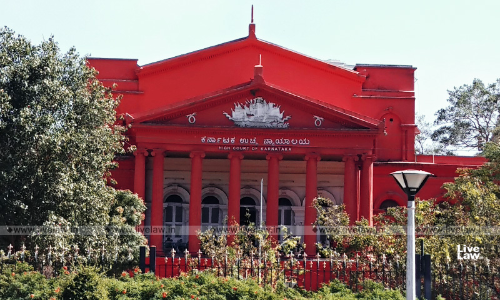
Mentioning Referral Of The Matter To Arbitral Institution Is Sufficient; Party Not Required To Name Arbitrator: Karnataka High Court
The Karnataka High Court has ruled that a notice issued by a party, stating that the matter would be referred to the Council of Architecture, is sufficient for the purpose of invocation of the Arbitration Clause, since the Council of Architecture is an arbitral institution within the meaning of Section 11 of the Arbitration and Conciliation Act, 1996. The Single Bench of Justice...
Order Of Facilitation Council, After Termination Of Conciliation Under MSMED Act, Not Executable: Delhi High Court
The Delhi High Court has ruled that an order passed by the Facilitation Council under Section 18 of the Micro, Small & Medium Enterprises Development Act, 2006 (MSMED Act) after the termination of conciliation proceedings, without taking the dispute up for arbitration or referring it to an institution or centre for arbitration, is a nullity and does not constitute an arbitral...
The Arbitrator Cannot Alter The Express Terms Of The Agreement Between The Parties By Applying The Business Efficacy Test: Delhi High Court
The High Court of Delhi has held that the arbitrator cannot alter the express terms of the agreement by applying the business efficacy test when there is no ambiguity as to the intention of the parties. The Bench of Justice Vibhu Bakhru held that Penta Test as propounded by the Supreme Court in Nabha Power Ltd v. Punjab State Power Corp. Ltd. is only for the purpose of determining...