


Articles

Whether Section 143-A Of The Negotiable Instruments Act, 1881 Has Retrospective Application Or Not ?
Preface: The party who commits default in payment can be sued by a payee in the civil court by filing suit for recovery of money. However, the special provision of Section 138 under the Negotiable Instruments Act, 1881 (hereinafter referred to as the NIA) was inserted with effect from 01.04.1989 vide the Banking Public Financial Institutions and Negotiable Instruments Laws (Amendment) Act, 1988. The object of the NIA is to enhance the acceptability of the cheques in settlement of liabilities by...
"Set Off" Under Section 428 Cr.P.C-In Reversal Of My Earlier View
INTRODUCTION I am changing my earlier opinion for the reasons to be indicated hereinafter. Section 428 of the Code of Criminal Procedure, 1973 (the "Cr.P.C" for short) enabling an accused person to set off against the sentence of imprisonment, the period of detention undergone by him at the pre-conviction stage is a new provision. There was no corresponding provision in the old Code i.e. the Code of Criminal Procedure, 1898. It was after noticing the...
We Cannot Allow Our Republic To Be Mortgaged By The Privileged Few
We the people gave to ourselves a "democratic republic". It is a republic if we can keep it(Benjamin Franklin). Have we been able to keep our republic? The answer is obviously no. Not the way framers of our Constitution would have wanted. Democracy is a government by the people and for the people. Therefore, a Democratic Republic revolves around this "public responsibility and trust." When we talk of the "republic", we pinpoint towards this responsibility and trust. This is the sole measuring...
Reservations In Promotions And The Idea Of Efficiency: B.K. Pavitra v Union Of India
A two-judge bench of the Supreme Court on Friday delivered a fascinating judgment in B.K. Pavitra v Union of India, concerning the relationship between reservations in promotions for Scheduled Castes and Scheduled Tribes [SCs/STs], and issues of seniority. The facts were as follows: in 2002, the state of Karnataka enacted a law stipulating – in effect – that consequential seniority would follow upon the promotions of SC/ST employees. To put it in simple language: if a reserved category employee...
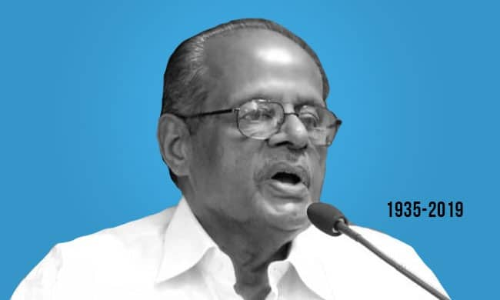
Remembering Prof. N. R. Madhava Menon: The Grand Patriarch Of Legal Education
The life of Prof. Madhava Menon is a great book of teachings: vision, values, dedication and integrity. Prophet and a pragmatist, architect and a mason. Historical narratives attempt to catalogue great teachers, those who spent their life as passionate social investments: investments for no material returns or offices. One indelible common characteristic of any of them is that they were drawn to changing the world, the specific world which they encountered. If biographies of such wonderful and...

Professor Madhava Menon On RTI And CIC
I requested Prof.N.R. Madhav Menon to speak at the tenth Annual Convention of CIC in 2015 addressing issues of character and duties of the Commissioners. He touched upon important aspects saying that 'time came to discuss how far the objectives of RTI Act were realized in making government transparent and accountable. If you are talking about digitalization of information, are you discarding the whole lot of rural population with no access to digitalized world and information? More encompassing...

Technology, Fears of Cultural Submergence, and Video Regulation in India
The practice of determining the legality of a publication based on its ownership and on the nature of its contents has existed for almost as long as recordable communication has existed. We are, of course, no longer confined to the basic forms of communication such as the written word, and content laws, once unabashedly censorship laws, now govern everything from books to videos and gifs. Most of these laws are not of recent vintage and, so, old laws have often been forced to contend with new...
No Institutional Credibility Without Fair Process: Women Lawyers Object To Clean Chit To CJI
On 20.04.2019, a complaint of sexual harassment was submitted against the Chief Justice of India by a woman who had been employed in the Supreme Court as a Junior Court Assistant. Her complaint contained detailed averments on a sworn affidavit along with corroborating materials including phone logs, video recordings, etc. that supported her allegations of sexual harassment, and asked for an external inquiry into the allegations by retired judges of the Supreme Court. What followed thereafter has...

The Lack Of Lemon Laws In India Is Really Squeezing The Juice Out Of The Automobile Owners!
NO, this is not a food column, the 'lemon' I am talking about is the 'car' you bought only to discover that what you now possess does not perform or meet your expectations, or the car that spends more time in the workshop than on the road. The year 2018 can rightly be attributed as 'the year of recalls' for the automobile industry, as according to the statistics revealed by Society of Indian Automobile Manufacturers (SIAM), total vehicles recalled by the automobile industry in between...