




Articles

The Dead Do Not Log Out: Juridical Recognition Of Digital Estates In India
On May 5, 2026, the Additional Senior Civil Judge, Gandhinagar, Gujarat granted Letters of Administration over a deceased man's iPhone and iCloud account to his daughter.[1] Her father had died intestate. The family approached Apple seeking access to the deceased's account. Apple, exercising its contractual prerogative and institutional caution, communicated to the family that access to the deceased's data could be facilitated provided the petitioners produced a court order formally appointing...
Taxing Entry: H-1B Surcharge And Constitutional Limits On Executive Revenue Power
On June 8, Judge Leo Sorokin of the U.S. District Court for Massachusetts[1] vacated Presidential Proclamation 10973, which had imposed a $100,000 surcharge on new H-1B petitions.[2] The ruling is analytically interesting less for what it decides and more for how specifically the doctrinal move the Court makes in calling the charge a tax rather than a regulatory fee, and why that judgment has consequences well beyond this case.The result gives employers immediate relief. However, the more...

Legality Of Regularisation: What Courts Say About Contract Employees
In India, we have millions of workers including but not limited to guest lecturers, ,pump operators, data entry assistants, special police officers who serve for decades in departments of the central government and different state governments performing functions that are not distinguishable from those of regular employees, yet these workers continue to hold the status of a “temporary” or “contractual” employee and they are perpetually denied pensions, increments, and social security benefits at...

Forensic Bedroom: How Ghost Of Section 497 Leaped From Court Files To OTT Screens
French novelist Honoré de Balzac poignantly noted that families are like secret societies, governed by their own hidden laws and private operations. However, when the Madras High Court recently granted a divorce to a Central Reserve Police Force (CRPF) constable on the grounds of adultery, it acknowledged a domestic reality long understood but very rarely put forth. Overturning a rigid family court order that had demanded direct, physical proof of an illicit relationship, the High Court observed...

DNA Tests, Privacy, And Paternity: Supreme Court Clarifies The Law
The Supreme Court, in a recent ruling, upheld the use of a DNA test for determining paternity and addressed a long-standing legal question: does an individual's right to privacy override the need to ascertain biological parentage? Prior to this decision, the Court had consistently maintained that DNA tests should be ordered sparingly and only in exceptional circumstances. However, there was no definitive answer regarding the precise situations in which such tests could be permitted.A paternity...
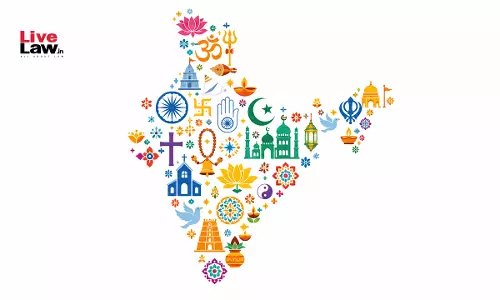
One Land, One Heart: How Faith And Freedom United My India
There is a huge difference between reading about India's "Unity in Diversity" in a school textbook and actually feeling it under your feet. Recently, my wife and I went on a quick two-day journey across Tamil Nadu. It wasn't a long trip in terms of miles, but it completely changed how we look at our country. In just forty-eight hours, we walked through the heart of India's spiritual diversity, discovering how a land of so many different faiths can live together under one shared culture. Our...

Forget Me, Or Forget Me Not? Implementing Right To Be Forgotten
The Right to Privacy, has over the years, been considered as one of the most important facets of Article 21 of the Constitution of India. The Courts across the Country have repeatedly held that the Right to Privacy being a crucial and intrinsic element of human dignity squarely falls under the ambit of Right to Life under Article 21 of the Constitution of India, however, the same is subject to reasonable restrictions.It is in this digital age, Right to be Forgotten has come to forefront. In...
Is The Supreme Court Overstepping On Its Draft AI Regulations, 2026?
Whether Draft AI Rules Apply To High Courts ?On 3 June the Supreme Court released a draft for public comment, titled, “Regulations for Use of Artificial Intelligence in Courts, 2026.” The instinct is sound since litigants, lawyers and Court already use AI and guardrails are long overdue. But the fine print presents a constitutional problem. The issue is that it is just not a set of housekeeping rules for the Court's own registry or administration as you may expect under Article 145. It is a...
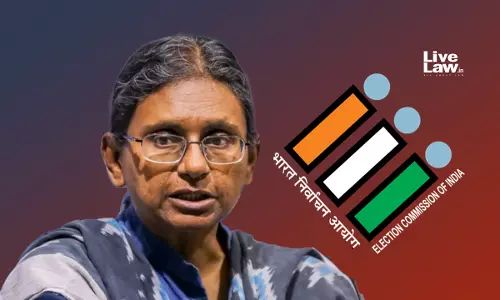
Meenakshi Natarajan Case : Was Rejection Of Nomination Valid? Law On Disclosure Of Criminal Antecedents Explained
Was Meenakshi Natarajan legally obliged to disclose the pending case in Hyderabad? Did the Returning Officer exceed jurisdiction by rejecting the nomination?

Need For Thermal And Ergonomic Mandates In India's New Labour Codes
Noida witnessed over 40,000 garment workers' protest in April, 2026. This was not just attributed to wages, but also over the physical impossibility to survive a 12-hour work shift in temperatures reaching 42 degrees celsius. India has now operationalised its four new labour codes, consolidating 29 statutes. At the centre of this transition is the Occupational Safety, Health and Working Conditions, Code, 2020, ('OSHWC Code') which remains vague on safeguards for workers working in thermal stress...
A Successful Resolution Applicant Cannot Escape Through A 'Conditional' Letter Of Intent
For some years, the position under the Insolvency and Bankruptcy Code, 2016 has been settled. A successful resolution applicant cannot withdraw or modify a resolution plan once the committee of creditors (CoC) has approved it and the plan has gone to the adjudicating authority. The Supreme Court said as much in Ebix Singapore (P) Ltd. v. Committee of Creditors of Educomp Solutions Ltd., 2021 LiveLaw (SC) 447, holding that the Code leaves a resolution applicant no way out and th at the NCLT...

Latent Bars To Justice: An Empirical Analysis Of Bail
Any member of a legally civilised society can reasonably make this presupposition that law is inherently just and that eventually justice will be served. The law is in a continuous pursuit of justice. The only impediment to the conclusion of this pursuit is the human element. Anthropogenic impediments like corruption, inordinate delays, etc., stain the law and stand in the way of achieving justice.But let's suppose humans were inherently devoid of malice and motivated to follow the law. What if...