


Articles

NHRC, Fall From 'A' Status And Its Fading Credibility
President of India on December 23, 2024 appointed retired Supreme Court Justice V. Ramasubramanian as the Chairperson of National Human Rights Commission. The post of NHRC chairperson was lying vacant since June 2024. At the inaugural session of the 13th ThinkEdu Conclave held on January 27, 2025 Justice V. Ramasubramanian raised strong objections to the Global Alliance of National Human Rights Institutions (GANHRI) for postponing its decision as to whether the National Human Rights Commission...
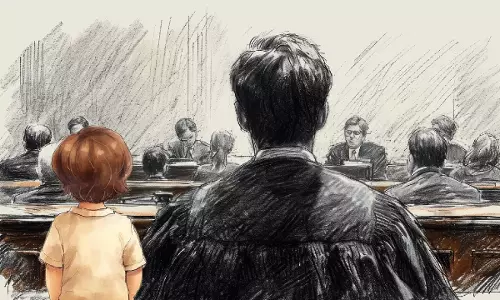
Evolving Standards Of Child Witness Testimony: A Comparative Analysis Of English And Indian Jurisprudence
Child witness testimony has been a fiercely debated legal issue for a long time. The latest Supreme Court ruling in the case of State of Madhya Pradesh v. Balveer Singh (2025 LiveLaw (SC) 243) makes this adjudication even more relevant, stressing that age cannot be a blanket reason to disallow consideration of the testimony of a child witness. This decision also takes head-on the historically cynical opposition to child witness testimonies, seeking to create a lot more subtle standard for...

Taxability On Transaction Of Vouchers
Recently, the domain of e-commerce has witnessed a remarkable and rapid expansion. E- commerce entails the exchange of goods and services through digital platforms. In light of the intense competition characterizing today's market, businesses are increasingly driven to outshine their counterparts by offering a diverse array of attractive and beneficial schemes to consumers. A notable component of e-commerce transactions is the issuance of gifts, vouchers, promotional codes, and similar...
Contestatory Federalism As A Means To Ensure Constitutional Stability
The fundamental theory of federalism was best explained by President James Madison, in his seminal work “The Federalist Papers”, published in 1787-1788. His philosophy was reflected in this pithy sentence- “Ambition must be made to counteract ambition”. He believed that one branch's desire for power is always checked by the other branch. Madison contemplated a system where the subnational units of the Government, say States, will be at constant contestation with the national unit, the Federal...

Which Jurisdictional Route Should 'Personal Guarantors' Take - NCLT Or DRT?
The excerpts from the famous poem by Robert Frost, The Road Not Taken,—“Two roads diverged in a yellow wood, And sorry I could not travel both…”—aptly illustrate the challenge of choosing the right forum or the 'Adjudicating Authority' for insolvency resolution process of personal guarantors under the Insolvency and Bankruptcy Code, 2016 (IBC/ the Code). While one way leads to the National Company Law Tribunal (NCLT); the other leads to the Debt Recovery Tribunal (DRT). Both roads are sometimes...

Stamping Out Arbitration: How Maharashtra's Stamp Duty Act Amendment Hampers Mumbai's Arbitration Aspirations
The Government of Maharashtra recently made radical amendments to the Maharashtra Stamp Duty Act, 1958, by enacting the Maharashtra Stamp Duty (Amendment) Act, 2024. One of the amendments was to increase the stamp duty payable on an arbitral award, which was earlier fixed at five hundred rupees. However, after the amendment, an arbitral award concerning immovable property is subject to the same stamp duty as would be levied on a conveyance document in respect of the same property. The stamp duty...
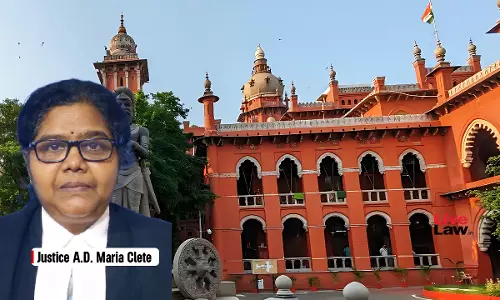
The Case For Commemorating The International Day Of Women Judges : Justice Maria Clete Writes
On March 10th each year, the world acknowledges the International Day of Women Judges (IDWJ)—a day established by the United Nations General Assembly to recognise and promote the role of women in the judiciary. The observance of this day is not merely symbolic; it serves as a reaffirmation of the principles of gender equality, judicial integrity, and inclusivity within the legal profession. Why IDWJ Matters Historically, the judiciary has been a male-dominated institution. Although...

Women's Day Special | Punjab & Haryana High Court's Landmark Rulings On Women Empowerment
Despite 77 years of independence, the harsh reality remains: women are still in need of transformative justice and societal upliftment. The progress we celebrate has yet to bridge the gap between equality and empowerment. The debate over whether women need positive discrimination to ensure equal rights as men cannot be deemed redundant, especially when considering that, the majority (67%) still reside in rural regions, where women continue to face discrimination and gender-based violence. Even...
The Carceral Seductions And The Unfinished Struggles Of Legal Feminism In India
Every March 8, legal feminists in India are reminded of their uneasy tryst with the law—a rendezvous filled with triumphs, betrayals, and lingering questions. The International Women's Day has become a tableau of state-sponsored empowerment rhetoric, one in which feminist struggles are neatly packaged as victories of progressive legal reform. The grammar of rights, codified into statutory provisions, is recited as a kind of constitutional catechism, where the very structures that once sought to...
A Dangerous Precedent For Denial Of Bail In Cases Involving Sexual Offences
In a recent case of 'X v. State of Rajasthan,'[2] the Supreme Court observed that courts should refrain from entertaining bail applications in serious offences such as rape, murder, dacoity once the trial has commenced.The case involved a petition filed by the prosecutrix challenging the High Court of Rajasthan's (“High Court”) decision to grant bail to the accused. The accused was charged under Section 376-D and Section 342 of the Indian Penal Code, 1860 (“IPC”). Relying on an earlier order...
The Law Of Dying Declarations In India: Bad In Law?
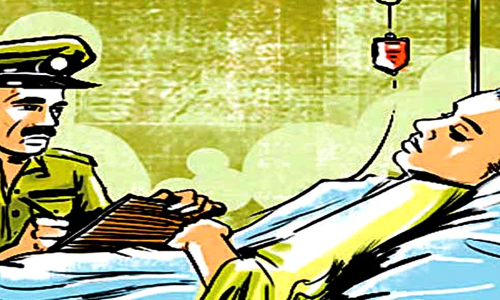
A dying declaration is an oral or written statement by a person on the point of death concerning the cause of his death according to the Oxford English dictionary. Dying declarations have lost relevance and admissibility in many common law countries, all except India. The law concerning dying declarations in India could earlier be found in Section 32(1) of the Indian Evidence Act which reads, “When it relates to cause of death. - When the statement is made by a person as to the cause of his...