


Articles
Doctrine Of 'Forum Non-Conveniens' And Tort Claims: A Comparative Analysis Between India And United States
Understanding the Doctrine of Forum Non ConveniensThe common law doctrine of 'forum non-conveniens' is a latin term for 'inconvenient forum'. In Black‟s Law Dictionary, forum conveniens has been defined as the court in which an action is most appropriately brought, considering the best interests and convenience of the parties and witnesses. The concept of forum conveniens fundamentally means that it is obligatory on the part of the court to see the convenience of all the parties before it. The...

A World Reimagined: Flipping Perspectives on What Disability Truly Means.
Have you ever wondered how hard it would be to exist in a world that wasn't designed for you ? Recently, we came across this thought-provoking video on disability sensitization. It was one of those rare narratives that stay with us with challenging perceptions and inspiring introspection. The video carried a powerful message, “disability is not about an individual's limitations but it arises when the world isn't designed for everyone.” This profound insight inspired us to translate the...
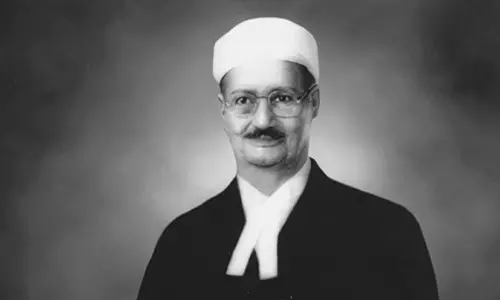
Jamshedji Kanga-A Sesquicentennial Tribute
Sir Jamshedji Behramji Kanga was one of the most outstanding members of the Bombay Bar, who was universally loved and respected. With his tall frame-he was six feet four inches in height and stood erect even in his nineties- black coat and white priestly turban, he was a notable and distinguished figure who by his sheer presence reduced all around him to less than life size. Said Nani Palkhivala, his illustrious junior, “If a man were to go by chance into the court and hear Sir Jamshedji Kanga...

Sanction For Prosecution Of Public Servants – The Shift In The BNSS
Public servants are treated under the law as a special category, with a view to protect them from frivolous, malicious and vexatious prosecutions. It is imperative to protect public servants from retaliatory, revengeful and frivolous prosecutions so that they could discharge their official duties honestly, fearlessly and efficiently. The principle of immunity protects all acts which a public servant has to perform in exercise of the functions of the State. However, there is an exception....

Same-Sex Marriage: Still A Pending Wish In 2025?
As New Year resolutions soar for many, homosexual individuals in India remain denied the basic right to marry. Despite constitutional guarantees of equality, judicial and legislative roadblocks continue to marginalize LGBTQIA+ individuals. The question lingers: is marriage equality still an unfulfilled promise in 2025?The Long Road to RecognitionIndia has made significant strides in recognizing LGBTQIA+ rights, but progress has been uneven. In 2018, the Supreme Court's landmark ruling in Navtej...

Clearing The Slate: Right To Be Forgotten After Acquittal In Digital Age
In an era dominated by digital platforms and the ubiquitous presence of the internet, the concept of the 'right to be forgotten' has emerged as a critical legal and ethical debate. This right, broadly defined as the ability of individuals to control the dissemination of personal information about themselves online, seeks to balance the preservation of privacy with the freedom of expression and public's right to information. In India, the jurisprudence surrounding the 'right to be forgotten' is...
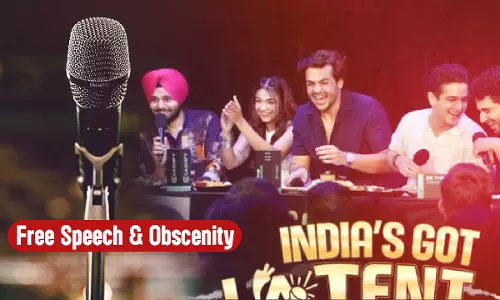
To Speak Or Not To Speak: Understanding TheThin Line Between Free Speech And Obscenity
The YouTube Show, India's Got Latent, has been embroiled in a major controversy because its host Samay Raina, podcaster Ranveer Allahbadia, and other fellow panellists have been booked by the Maharashtra Cyber Police for allegedly transmitting content which is putative to be vulgar and obscene. After the Assam police filed a complaint against the duo on February 10, this is the second FIR lodged against them since their clippings got viral. Allahbadia has now petitioned before the Supreme...

Time's Up For Hale's Ghost To Exit From India
The recent Chattisgarh High Court verdict in Gorakhnth Sharma v. State of Chhattisgarh acquitting a husband for committing the offence of unnatural sex and resultant death of the wife has once again brought to fore the need for criminalizing marital rape in India. The Honorable Court in this case arrived at the decision, relying on a combined reading of sections 375,376 and 377 of IPC. Most importantly, standing terra firma on Exception:2 to the section 375 aka the infamous Marital Rape...

Draft Digital Personal Data Protection Rules 2025: The Goal Remains Distant..?
The Digital Personal Data Protection Act (DPDP Act 2023) was passed on August 11, 2023, amidst growing concerns over the misuse of personal data and its potential commodification. However, in the absence of rules and regulations, the law remained largely ineffective. After sixteen months of enactment, on this January 3, 2025, the union government introduced the Draft Digital Personal Data Protection Rules ( DPDP Rules) for public consultation. While the Act and the draft rules...

The Tale Of Two Cases (And Platforms): The Brazilian Paradox
At present, the Brazilian Supreme Court finds itself in a unique position. In two separate matters, the highest court of Brazil is facing a question on the constitutionality of a provision, which may seemingly be a sure protection for freedom of speech and expression. Prima facie, it is fascinating to observe the unique task before the Court. However, the picture becomes clearer when examined closer.Background of the lawIn Brazil, the liability of internet intermediaries such as Google, more...
![allahabad high court, cheque dishonour, bank account closed, dishonour of cheque, section 138 of negotiable instruments act, Jatan Kumar Singh Vs. State Of U.P. And Another 2024 LiveLaw (AB) 119 [APPLICATION U/S 482 No. - 2965 of 2021], Justice Anish Kumar Gupta,](https://www.livelaw.in/h-upload/2023/06/08/500x300_475606-blank-cheque-leaf-triggers-section-139-of-ni-act-if-it-is-voluntarily-signed-and-given-with-intention-of-making-payment-kerala-high-court.webp "allahabad high court, cheque dishonour, bank account closed, dishonour of cheque, section 138 of negotiable instruments act, Jatan Kumar Singh Vs. State Of U.P. And Another 2024 LiveLaw (AB) 119 [APPLICATION U/S 482 No. - 2965 of 2021], Justice Anish Kumar Gupta,")
Does The First Proviso to Section 223(1) of the BNSS Apply to An offence Under Section 138 of the N.I. Act?
Sections 200 to 203 of the Code of Criminal Procedure, 1973 (for short 'the Code') deal with “Complaints to Magistrates”. These provisions now stand replaced by Sections 223 to 226 of the Bharatiya Nagarik Suraksha Sanhita, 2023 (for short 'BNSS').The controversial provisionSection 223(1) of the BNSS states that, a Magistrate having jurisdiction while taking cognizance of an offence on complaint shall examine upon oath the complainant and the witnesses present, if any, and the substance of such...
Rethinking American Citizenship: Why America Needs Doctrine Of Basic Structure
Since the recent second win of Donald Trump as the President of the United States of America, his reasons to be in the news are more than just a few. The American President, after the swearing ceremony issued an executive order to put an end to birthright citizenship as part of his long-committed anti-immigration policy.On January 20, 2025, immediately after being sworn in, President Donald Trump, during the course of his second term in the office, issued a series of executive orders, one of...