



Policing The Soul: Anti-Conversion Laws, Quiet Unravelling Of Constitutional Freedom
Kaushik Chowdhury
9 May 2026 4:11 PM IST
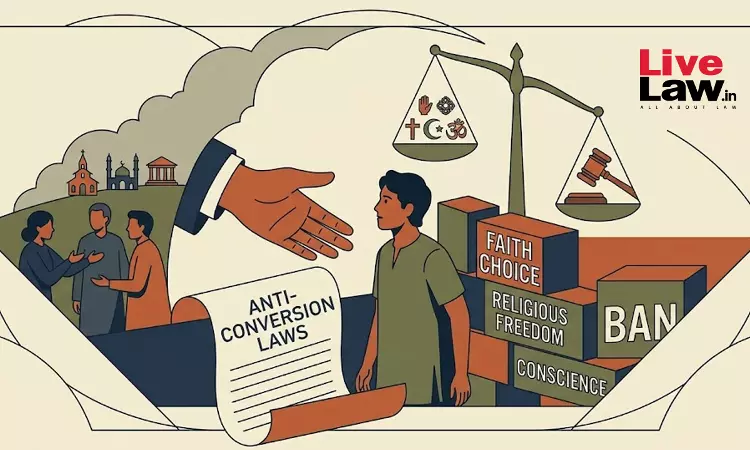
When the State begins to require permission for belief or affection, it no longer regulates conduct alone. It begins to intrude into the inner life of the individual.
Certain freedoms occupy a constitutional space so intimate that any regulatory oversight appears inherently disquieting. The freedom to think, to believe and love forms the core of human dignity. In contemporary India, these freedoms are increasingly subjected to legislative suspicion under the rubric of anti-conversion laws. The petitions presently before the Supreme Court, challenging such laws in Uttar Pradesh, Madhya Pradesh, Gujarat, and Uttarakhand, raise questions that go well beyond statutory validity. The real issue is whether the State can lawfully insert itself into the domain of conscience. At one level, the legislative objective appears unobjectionable. Preventing conversions induced by force, fraud, or allurement is a legitimate state interest. No constitutional order committed to liberty can tolerate coercion in matters of faith, particularly where vulnerable groups are involved. The constitutional difficulty arises in the design and operation of these laws. Anti-conversion statutes frequently extend beyond prohibiting coercion. Prior notice requirements, administrative scrutiny of conversion decisions and in certain cases de facto approval mechanisms convert a private act of conscience into a state-supervised event. Where marriage and conversion intersect, enforcement often proceeds on a presumption of illegality unless disproved. What emerges is not merely regulation of conduct, but a framework of surveillance over belief.
Article 25 of the Constitution guarantees to every person the freedom of conscience and the right to freely profess, practice, and propagate religion. The explicit placement of conscience at the threshold of this guarantee signals a constitutional commitment to an inner domain of belief that lies beyond ordinary state supervision. The decision in Rev. Stanislaus v. State of Madhya Pradesh has long structured judicial understanding in this area. The Court upheld prohibitions on conversion by force or fraud while clarifying that the right to propagate religion does not include a right to convert another person. That position, however, cannot be read in isolation from the evolution of constitutional jurisprudence.


The recognition of privacy as a fundamental right in Justice K.S. Puttaswamy v. Union of India marked a decisive shift towards decisional autonomy in intimate spheres of life. The Court located dignity in the ability of individuals to make personal choices free from unwarranted intrusion. This trajectory was reinforced in Shafin Jahan v. Asokan K.M., where the Court upheld the autonomy of an adult woman to choose her faith and partner, rejecting institutional and familial attempts to override her decision. In Navtej Singh Johar v. Union of India, the Court further constitutionalized dignity and identity in intimate associations while rejecting the imposition of majoritarian morality. Taken together, these decisions sharpen a constitutional tension with Stanislaus. A jurisprudence that protects autonomy in matters of belief, identity, and relationships sits uneasily with a regime that requires prior state scrutiny before a change of faith can take effect. The core question is whether the State may position itself as a gatekeeper to conscience.
The tension is not merely doctrinal. It is reflected in patterns of enforcement. Data from states with anti-conversion legislation indicate a significant rise in cases and arrests under such laws. Uttar Pradesh, in particular, has witnessed a sharp increase in prosecutions following the 2021 legislation. Conviction rates, however, remain low. This gap between initiation of criminal process and ultimate conviction is constitutionally significant. It suggests that individuals are subjected to arrest, investigation, and social stigma even where evidentiary thresholds for conviction are not met. Criminal law scholarship has long recognised this phenomenon as “process as punishment”, where the burden of procedure itself becomes punitive. The criminal process, in such cases, acquires a disciplinary function independent of final adjudication. Interfaith relationships illustrate this dynamic most clearly. Consensual relationships between adults often attract police scrutiny following complaints from families or local actors. Allegations of forced conversion operate as the jurisdictional trigger for state intervention into what would otherwise remain private conduct. The consequences are immediate and material. Police inquiry, repeated questioning, social pressure, and occasional arrest create a legal environment where personal autonomy is continuously subjected to suspicion. Families and community networks increasingly invoke the law as a means of contesting individual choice. In effect, anti-conversion laws extend beyond religious regulation. They begin to structure and police intimacy itself.
Historically, early post-independence statutes addressing conversion were framed in response to concerns about coercion and missionary activity. The focus was limited to preventing inducement through force or fraud. Over time, however, the discourse has shifted. Narratives of demographic anxiety and claims such as “love jihad” have increasingly shaped both legislative design and enforcement practices. Courts and investigative agencies have repeatedly found no substantiated evidence of organised conspiracies, yet the narrative persists in public and political discourse. That persistence has consequences. Legislative frameworks increasingly reflect assumptions of vulnerability and suspicion surrounding interfaith relationships and conversion. Statutory design reinforces this orientation. Prior notice requirements, executive involvement in assessing conversion, and shifting burdens of proof are not neutral procedural devices. They embody an underlying presumption that individual choice in matters of faith requires external validation. Such a presumption sits in tension with the constitutional understanding of the individual as an autonomous moral agent.
International human rights law similarly recognises the freedom to change religion as an essential component of freedom of thought and conscience. While permitting limited restrictions in the interests of public order, such frameworks treat prior restraint or state authorisation with considerable caution. Indian constitutional law need not mirror international models. However, its commitment to liberty, dignity, and pluralism requires serious engagement with comparable normative standards. At a structural level, the debate implicates the nature of Indian secularism. The Indian model, understood as principled equidistance, requires the State to maintain neutrality among religions while ensuring equal respect for all faiths. Anti-conversion laws, in their present form, stretch and strain this equilibrium. Enforcement patterns indicate disproportionate impact on minority communities. Dominant narratives embedded within the legislative discourse reflect majoritarian anxieties. Procedural mechanisms enabling intrusive oversight further complicate the principle of neutrality. None of this denies the legitimacy of addressing coercive conversion. The Constitution does not protect fraud or force. The critical question is one of proportionality and design.
A regulatory regime that broadly presumes suspicion, subjects voluntary acts of conscience to bureaucratic validation, and unevenly impacts specific communities, risks exceeding constitutional limits. The Supreme Court, in adjudicating these challenges, faces a question that is as structural as it is doctrinal. It must balance the prevention of coercion with the protection of autonomy, the demands of social order with the imperatives of liberty, and precedent with constitutional evolution. The deeper principle remains constant: constitutional governance is not defined only by the distribution of power, but by its restraint—especially when it touches the most intimate contours of human existence. For those directly affected, the question is not abstract. It concerns the ability to choose without surveillance, to form relationships without suspicion, and to hold beliefs without prior approval.
Ultimately, the question is a stark one: can the State, as a matter of routine, place itself between an individual and their conscience? The answer will do more than define the limits of regulation; it will reveal, in the most profound sense, the moral character of the Republic itself.
Author is an Assistant Professor of Law, LJD Law College Falta (University of Calcutta) and Doctoral Researcher at IIT Kharagpur. Views are personal.


