Can Deletion From Electoral Roll After SIR Be Ground To Deny Passport?
Manu Sebastian
29 Jun 2026 11:28 AM IST
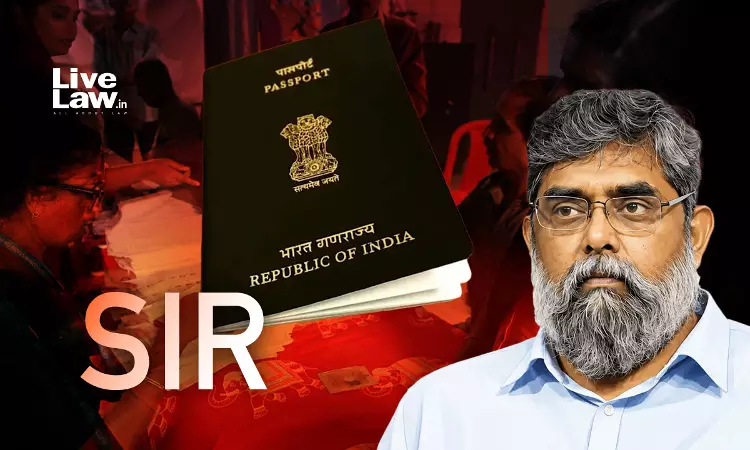
The revelation made by R Rajagopal, former Editor of the prominent daily The Telegraph, that his Passport is not being renewed due to the exclusion of his name from the electoral roll in West Bengal after the Special Intensive Revision has given rise to grave concerns. Rajagopal said that his name was deleted, citing "logical discrepancies" - the special category the Election Commission of India devised for West Bengal, which led to the deletion of over 27 lakh voters - as his name or his father's name could be traced to the 2002 voters' list.
There are various reported instances of genuine voters being deleted, citing 'logical discrepancies' over minor issues such as spelling mismatches or trivial anomalies. The Supreme Court itself, though it ultimately upheld the SIR process, raised concerns during the hearing over the 'logical discrepancy' process, asking why people should be put under the scanner for spelling mismatches when many local names can be spelt in different ways in English. The Court created Appellate Tribunals, which were tasked with the gargantuan task of hearing over 30 lakh appeals filed against SIR decisions. Some decisions given by the Appellate Tribunal show the abject arbitrariness in the process - the case of Congress candidate Mohtab Sheikh is illustrative. His name was deleted despite having a Passport, Aadhaar card, and a voter's card, over certain spelling mismatches in his father's name. The Tribunal, acting on the Supreme Court's direction to give priority hearing for his case, restored his name, after finding that the ECI could not furnish any reasons for his deletion, and Sheikh went on ultimately to not only contest the elections but also win it. But Sheikh was only among the few people whose cases got decided before the 2026 Assembly elections, and lakhs of other voters, like Rajagopal, are waiting for the Tribunal decision, probably taking the consolation offered by the Supreme Court during a hearing that they can vote in the next elections.


Deletion after the SIR exercise can deprive one of voting rights. That is understandable. But can it lead to other consequences, such as denial of Passport renewal? Rajagopal says even after 100 days of giving biometric data for Passport renewal, the process was kept on hold as the Kolkata police sent an adverse report stating that his name was deleted in the SIR. While this has sent him scurrying to trace documents related to his late father, he wondered if this is the fate of a known-name associated with a prominent newspaper, what would be the ordeal faced by the lakhs of marginalised citizens. There are also reports that the Bengal Government is moving to deny ration benefits to those excluded from the voters' list.
To deny Passport or welfare measures to citizens solely on the basis of exclusion from the voters' list after SIR is an illegitimate exercise. The Supreme Court, even when it upheld the ECI's SIR process, clarified that the deletion from the voters' list is not conclusive proof against citizenship. The Court recognised a limited role for the ECI to assess citizenship only for the purpose of inclusion in the voters' list, and clarified that this will not amount to a final determination. This is because the statute does not confer the power on the ECI to determine citizenship authoritatively.
The Court emphasised that the Commission's finding cannot extinguish or conclusively determine a person's citizenship status. The Court also clarified the consequence of deletion from the electoral roll: it is only that the person cannot vote and cannot have other rights flowing from citizenship status taken away.
As the Court observed :
"The consequence of such a citizenship determination is correspondingly limited. It affects the individual's entitlement to be included in the electoral rolls and thereby the right to participate in the electoral process. It does not, however, operate to divest the individual of claims to citizenship, nor does it foreclose adjudication of that question by the competent authority under the Citizenship Act."
To safeguard against the Election Commission assuming a final role in citizenship adjudication, the Court directed that where the Commission is not satisfied that a person fulfils the statutory conditions for inclusion in the electoral roll on citizenship grounds, it must refer the matter to the competent authority within the Central Government for adjudication in accordance with law.
“The Commission's determination, being confined to electoral purposes, cannot assume finality on the question of citizenship,” the Court held.
The Court was also quite specific in its direction to the ECI to forward to the Ministry of Home Affairs the deleted names for citizenship verification. Only those names, which are deleted on the ground of doubtful citizenship, are to be forwarded. So, until a determination by the competent authority under the Ministry of Home Affairs, a person's citizenship status cannot be denied solely based on deletion from the electoral roll. After all, citizenship is not dependent on the right to vote.