



Constitution Day-2026
V. Sudhish Pai, Senior Advocate
28 Nov 2026 12:00 PM IST
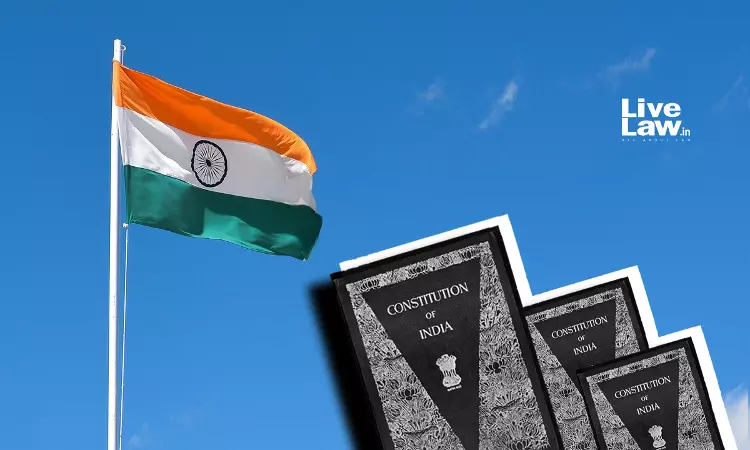
The Constitution was adopted on November 26, 1949. Some of the provisions came into effect that day itself. November 26 is now celebrated as Constitution Day. The majority of the provisions came into force on January 26, 1950 which is Republic Day.
The aspiration to make power impersonal and its exercise accountable has been the motivation for constitutions and constitutionalism. Men throughout history have longed for a higher standard by which their own man-made laws are tested. Constitutions are that higher standard. The belief that individuals have natural rights— inherent and inalienable—which are anterior to any written instrument like a constitution, that government acquires its authority from the people, and that the purpose of government is to promote common good is what conceives and conceptualizes a constitution made in the name of the people, defining the powers of the main institutions and delineating the relationship between various organs of government and between the government and the citizens. It is framed for ages to come and designed to approach immortality as nearly as human institutions can.
It is appropriate to recall that magnificent exercise of the making of our Constitution and pay homage to the founding fathers.
Making of our Constitution
The Constitution of India is one of the most comprehensive and well drafted in spite of its elephantine size. It is one of the finest creations of human ingenuity. The Constitution represents a high watermark of consensus in India's political history. It manifests the best in India's past, it provides a considered response to the needs and aspirations of the present and possesses sufficient resilience to cope with and weather the requirements of the future. It is 'an instrument drawn with such meticulous care' by a remarkably wise, articulate and erudite pantheon of persons of outstanding abilities and backgrounds who 'so well understood how to make language fit their thought and vision'[1].


The Assembly was composed of persons of the highest calibre drawn from different sections of society and representing various shades of opinion. The debates and discussions were of a very high order and profound, not marred by any narrow ideas or viewpoints. The deliberations reveal a very high level of political acumen and standard of debate. The presence and participation of such a vast, inclusive cross-section of the society imparted a non-partisan character to the deliberations, enhanced the Assembly's authority and facilitated the general acceptability of the Constitution.
The Constituent Assembly met for the first time on December 9, 1946. The inaugural session was presided over by Dr. Sachchidananda Sinha as Provisional Chairman. He was an eminent legal scholar as also a consummate advocate. He delivered an excellent inaugural address affirming his faith in the immortal destiny of India. In his inaugural address he quoted the memorable words of Joseph Story, a great jurist and former judge of the US Supreme Court. The Objectives Resolution articulating the basic values of the Constitution to be adopted was drafted and moved by Prime Minister Jawaharlal Nehru on December 13, 1946 and after a full-fledged debate it was adopted on January 22, 1947. This provided the basis and the inspiration for the Constitution.
The Assembly accommodated diverse points of view, debated with an open mind, considered and reconsidered ideas and proposals, reviewed and evaluated comparative experiences on the working of similar provisions and institutions in other countries, looked at the constitutional canvas in a futuristic perspective, aware of India's political history, culture, socio-economic dreams and objectives, judicial-legal attitudes and principles, conscious of India's wellsprings of strengths and recesses of weaknesses and helped to raise a magnificent temple of liberty based on the message of unity in the mosaic of diversities and forward looking national self-confidence.
Accommodation and concord characterize and underpin the Constitution. The deliberations continued till November 26, 1949, when the Constitution was adopted. The Assembly's sittings were spread over 1084 days—2 years, 11 months, 17 days. It held 11 sessions covering 165 days of which 114 days were devoted to the consideration of the Draft Constitution. The cost of the whole venture was Rs. 63, 96,729. Not less than 53,000 visitors were admitted to the Visitors' Gallery when the Constitution was under consideration. The Indian Independence Act, 1947 passed by the British Parliament was repealed underscoring the idea of the Constitution being wholly Indian.
This is the saga of the framing of our Constitution which according to Granville Austin was 'the greatest political venture since that originated in Philadelphia in 1787'.[2]
The Constitution is a dialogue between the people of India. The dialogue speaks to the past and draws sustenance from it, moulds and reshapes the present and endeavours to apply to and effectuate the future. The vigour and efficacy of the Constitution was captured by Granville Austin in his classic work describing it as an effort to bring about a social revolution through peaceful and democratic means.[3]
Apart from Dr. Ambedkar, who was the Chairman of the Drafting Committee and whose role in the making of the Constitution is too well known to require any recall, we need to gratefully remember and pay tribute to two other persons- Sir Benegal Narsing Rau, the Constitutional Adviser to the Constituent Assembly and Surendra Nath Mukherjee, the Joint Secretary, Constituent Assembly and the Chief Draftsman of the Constitution.
B.N. Rau brought to his work his brilliance, erudition and rich experience and prepared the first draft which was the basis for discussion. He also enabled the other members to perform their duties with thoroughness and intelligence by supplying them with the material on which they could work. All his work in the Constituent Assembly was honorary. So impressed was Justice Frankfurter with Rau that he remarked, “If the President of the USA were to ask me to recommend a judge for our Supreme Court on the strength of his knowledge of the history and working of the American Constitution, B.N. Rau would be the first on my list.”[4]
Mukherjee meticulously drafted the various provisions of the Constitution that was finally adopted. As Dr. Ambedkar said on the eve of adopting the Constitution, S.N. Mukherjee had the ability to put the most intricate proposals in the simplest and clearest legal form and without his help the Assembly would have taken many more years to finalize the Constitution.
The Constitution has, undoubtedly, drawn from many sources, it is a happy blend of many strains. In particular, the Government of India Act, 1935 is the edifice on which the Constitution has been raised. The framers of the Constitution drew profusely on the Constitutions of the US, Australia, Canada, Ireland, Japan and the UK. But there is nothing wrong in borrowing, in adopting ideas and adapting them. As Dr. Ambedkar said, “There is nothing to be ashamed of in borrowing, it involves no plagiarism. Nobody holds a patent right on the fundamental ideas of the Constitution.” As Voltaire put it profoundly, “Originality is nothing but judicious imitation. The most original writers have always borrowed one from the other.”
As M.K. Nambyar, the great Constitutional lawyer and visionary wrote in an unpublished article, The Contours of the Constitution, “Every system of government that is born of revolution, violent or non-violent, bears the indelible impress of the impulses of its being. It mirrors the struggles of the past in its provisions to ensure the security of the future. It represents the aspirations, achievements and ambitions of a people. No constitution is merely a collection of clauses or the handiwork of skilled draftsmanship. It is an organic growth springing from the forces of the natural vitality, and changing in colour and content in the process of time.”[5]
Key Features of the Constitution
There are two fundamental ideas which underpin the Constitution: The value of liberty- the idea that will and not force is the basis of government; and the value of justice- that right and not might is the basis of all political societies and of every system of political order. The Constitution is regarded as a social contract. John Locke's Social Contract Theory –that law is the expression of the will of the people- is reflected in the Constitution.
As with most of the modern constitutions, the opening words of the Preamble emphasize the ultimate authority of the people from whom the Constitution has emerged. The Constitution has established a sovereign, socialist, secular, democratic republic to secure to all citizens Justice, Liberty, Equality, and to promote among them all Fraternity assuring the dignity of the individual and the unity and integrity of the nation. Justice, Liberty, Equality, Fraternity are words of passion and power and may be said to be the spiritual pillars of the Constitution. These concepts along with constitutionalism, democracy and the rule of law are the bedrock on which a conflict-free society rests.
The Constitution has adopted a parliamentary system of government. It has set up a broad federal structure resilient enough to adjust according to the exigencies. The Constitution represents a charter of power granted by liberties and not a charter of liberty granted by power. Apart from providing a broad framework of government, it endeavours to protect liberties and secure justice. That is the constitutional vision and goal. Democracy is not just a legal, constitutional, formal concept. It is also a social idea. The Constitution is not merely a legal document, it is first a social testament as also a political instrument. It may be said to provide for stability without stagnation and growth without destruction of essential values. The core of this commitment lies in Parts III and IV. Part III contains the guaranteed rights called fundamental rights which are enforceable. The State has to obey the negative injunctions-not to interfere with the citizens' liberties and also fulfill the positive obligation to protect the citizens' rights from encroachment by society. Part IV –the Directive Principles of State Policy though not enforceable aim at making the people free in the positive sense, they are to guide and be applied in making laws-fons juris and are fundamental in the governance of the country. The justice provisions in Part IV are declared fundamental to the governance of the country and underlie all human development. These Parts together with Part IVA containing the fundamental duties of the citizens and the Preamble may be said to be the conscience of the Constitution; the judiciary is the conscience keeper. The Constitution's greatest gift has been an open society. The individual lies at the core of the constitutional focus and the ideals envisioned in the Preamble animate the vision of securing for him a dignified existence.
Rule of law is the subordination or subservience of the executive to the legislative will, i.e., every executive action must have the support or backing of law. The question is not just what legal authority government has for what it seeks to do. More significantly it is 'what legal powers ought the government to have.' The Constitution is meant to impart such a momentum to the living spirit of the rule of law that democracy and liberty may survive in India well beyond the present times. The rule of law in all its facets, ramifications and implications underpins the Constitution. But in countries with a written, justiciable constitution, the legislature is also subordinate to constitutional rights and values and limitations. That is the concept of the absolute reign of law: the legislative power too is subject to constitutional limitations. Thus, in India, we have not only the rule of law, but also the absolute reign of law.
Bill of Rights-Limitation on State Power
A written constitution with a Bill of Rights seeks to place certain human rights and fundamental freedoms beyond the reach of ordinary laws because these rights do not depend on the whims of an amoral majority or the outcome of any election. That is especially so as regards life and liberty. Such rights are not the gift of any law or the constitution. Instruments like Bills of Rights respond by recognising rather than creating or conferring them.
The case for guaranteed rights is simple and irrefragable. The limitations imposed by constitutional law on the actions of government are essential for the preservation of public and private rights, notwithstanding even the representative character of political institutions. The philosophy underlying bill of rights and judicial review is that constitutional limitations are the only way of ensuring the survival of basic human freedoms. When human rights are incorporated into the municipal law and guaranteed by a written constitution, they are justiciable and enforceable. Our courts have expounded new rights as emanations of the enumerated rights. This is one of the most fascinating sagas. Indeed, more than 25 rights have been read into the provisions of Article 21-the right to life and personal liberty- alone.
Limited Government
The Constitution being the supreme law, no organ or institution has unfettered powers, all derive their powers from the Constitution and have to function within those limits. In a constitutional democracy with a written constitution and an entrenched bill of rights and wedded to the rule of law what prevails is constitutional supremacy – all organs being controlled and regulated by the constitution and functioning within the confines of their power with the judiciary constituted the arbiter of the functions of all organs as grantees under the constitution.
None of the wings or units has a monopoly of wisdom and in the pattern of functional distribution of state power there is hardly any room for real supremacy. Limited government and judicial review constitute the essence of the indian constitutional system. it involves three main elements: (i) a written constitution setting up and limiting the various organs of government; (ii) the constitution functioning as a superior law or standard by which the conduct of all organs of government is to be judged; (iii) a sanction by means of which any violation of the superior law by any of the organs of government may be prevented or restrained and, if necessary, annulled. This sanction, in the modern constitutional world, is 'judicial review' which means that a court of competent jurisdiction has the power to invalidate the act of any governmental agency, including the legislature on the ground that it is repugnant to the constitution.
The Constitution has been framed on the theory that limitation should exist on the exercise of all power. It is to be so construed to apply to arbitrary exercise of power by any centre of power. The governing power wherever located is subject to the fundamental constitutional limitations.
Verily, the structure of the government under the constitutional scheme is so designed that each branch is a sentinel on the qui vive against the others, lest they become too powerful or autocratic. The court's fidelity to the constitution secures its own subordination, though it has the last word in the interpretation of the constitution, and it is the final judge of all acts purported to be done under the authority of the constitution. But fidelity and creativity are not necessarily opposed, with devoted insight they may enhance each other. the judiciary owes allegiance to nothing but the constitutional duty of reaching through reasoned debate the best attainable judgments in accordance with justice and law. This is its role in the democratic governance of the nation.
Living Constitution
The Constitution is a living organism. It is stable but not static. As the Supreme Court has observed: “It is not that with changing times the meaning changes but changing times illustrate and illuminate the meaning of the expressions used. The connotation of the expressions used takes its shape and colour in evolving dynamic situations.”[6] A constitution is living when it protects fundamental principles against transient public opinion and also adapts itself to meet from time to time the needs of a changing society with its shifting emphasis and differing needs. A living constitution, it is said, is one that evolves, changes over time, and adapts to new circumstances, without being formally amended. Living constitutionalism is the interpretation that helps and advances this.
Prof Laurence Tribe says in the Preface to the first edition of his American Constitutional Law, “…The Constitution is an intentionally incomplete, often deliberately indeterminate structure for the participatory evolution of political ideals and governmental practices. This process cannot be the special province of any single entity.”[7] A Constitution's authority is strengthened through the cultivation of tradition which is the silent bond between contemporary political actors and the regime's founders. Tradition is what conserves that which continues to work while discarding that which is no longer of practical value.
Aberrations- Duty to abide by and protect
There have been many aberrations. Many a time these are innocuous. But they eat into the vitals of our system and reduce it to a mockery. Dr Ambedkar had warned that the perversion of the Constitution could be achieved by merely changing the form of the administration, making it inconsistent with the Constitution while not changing the Constitution itself. Justice Douglas had cautioned: “Nightfall does not come at once, nor does oppression- in both instances there is a twilight when everything remains seemingly unchanged. It is in such twilight that we must all be aware of the change in the air-however slight- lest we become unwitting victims of the darkness.” This remark comes home with a strange poignancy. These are dangers we must be on our guard and resolutely set our face against. November 30 is the death anniversary of Sir B.N. Rau whose role in the making of our Constitution is stellar. The light should not go out of the Constitution on the anniversary of life ebbing out of Sir Benegal.
The Constitution matters: It protects rights and liberties, ensures justice, maintains the rule of law. It holds us together. It is essential that we, both the State and the people, are imbued with constitutional ideals and values and constrained by constitutional limitations so that constitutional democracy and the rule of law may survive and flourish in our land long after all of us are gone and the raucous voices of today are lost in the silence of the centuries. In the unforgettable words of Frankfurter, J: Democracy is always a beckoning goal, not a safe harbour; for. freedom is an unremitting endeavour, never a final achievement and no office in the land is more important than that of being a citizen. Therefore, it is that we must speak and act.
We evocatively recall Palkhivala's dedication of one of his books to the people of India: To my countrymen who gave unto themselves the Constitution but not the ability to keep it, who inherited a resplendent heritage but not the wisdom to cherish it, who suffer and endure in pain without the perception of their potential. Edmund Burke's saying resonates: “Nobody makes a greater mistake than he who soes nothing because he could do only a little.” Each one of us does matter.
See, United States v Sprague, 282 U.S.716 (1931) at 732. ↑
Granville Austin, The Indian Constitution: Cornerstone of a Nation, OUP (1966), First Indian Edition 1972, p.308 ↑
Granville Austin, The Indian Constitution: Cornerstone of a Nation, OUP (1972). ↑
B.N. Rau, India's Constitution in the Making, (Edited by B. Shiva Rau, Orient Longman, 1960,) p. xxiii ↑
K.K. Venugopal with Suhrith Parthasarathy & Suhasini Sen, M.K. Nambyar-A Constitutional Visionary, (Ebury Press, Penguin Random House India, 2023) pp. 53-54. ↑
Video Electronics (P) Ltd. v State of Punjab, (1990) 3 SCC 87 ↑
Laurence H. Tribe, American Constitutional Law (Mineola, New York, The Foundation Press, 1st Edn. 1978). ↑
Author is a Senior Advocate at Supreme Court of India and High Court of Karnataka. Views are personal.


