



The Last Crowd On The Lawns: Delhi, Protest And Theory Of Public Spaces
Tathagat Sharma
30 Oct 2026 10:05 AM IST
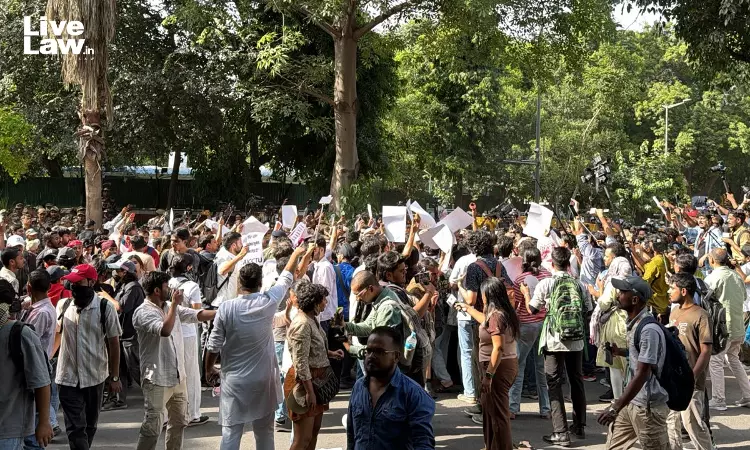
On the morning of 25 October 1988, the lawns of the Boat Club filled with farmers. They had come down from western Uttar Pradesh behind Mahendra Singh Tikait, and the estimates ran to five lakh. Tractors stood where staff cars usually park. Bullock carts were drawn up along the avenue. Cooking fires burned within sight of Parliament, and they burned for a week. On 1 November the farmers struck camp and went home, having extracted an understanding from the Rajiv Gandhi government.
They were the last crowd of that size to stand there.
What followed was not an announcement. There was no ban, no amendment, no debate in the House. The Delhi Police simply decided that demonstrations would no longer be permitted at the Boat Club, and the reason, recorded years afterwards in a judgment of the Delhi High Court, was that the agitation had blocked Rajpath, Rafi Marg and other arterial roads for days together. Jantar Mantar was offered in its place. Anything larger was sent to Ramlila Maidan. By 1993 the arrangement had hardened into habit, and a generation grew up assuming that Jantar Mantar was simply where protest happened.


It was a compromise, and a shrewd one. Jantar Mantar sits about a kilometre from Parliament. Far enough to be contained. Close enough to be heard.
That compromise ended on 11 October 2026. Standing Order L&O/48/2026, signed by the Commissioner of Police, removed Jantar Mantar from the list of designated protest venues. Three grounds were notified in its place: Ramlila Maidan, Burari Ground, and CBD Ground in east Delhi. The Union Home Ministry had constituted a committee, the committee had recommended, and the Commissioner had obliged.
Burari lies roughly fifteen kilometres from Parliament. Ramlila Maidan has to be booked in advance and paid for, by most accounts at upwards of a lakh a day, and its calendar is full well into December. CBD Ground is in Shahdara. The practical effect is that a demonstration demanding the resignation of the Chief Election Commissioner can now be held entirely lawfully, at a distance from which the Election Commission will neither see it nor hear it.
None of this was sudden. In May 2023, when the wrestlers announced that they would sit at India Gate, a police officer told PTI that India Gate is not a protest site and that they would not be permitted to protest there. The two alternatives offered that day were Ramlila Ground and Burari. So the 2026 order did not draw a new map of dissent. It only wrote down a practice the police had been following for three years.
The order bans nothing, and that is what makes it hard to argue with. Nobody has been forbidden to protest. The right survives on paper, and the government can point out, quite correctly, that there are three grounds today where there was one before. But the question has never really been whether a citizen may assemble. It is whether anybody in authority has to listen.
International law is fairly direct about this. General Comment No. 37 of the Human Rights Committee, interpreting Article 21 of the ICCPR which India ratified in 1979, says that assemblies should ordinarily be allowed within sight and sound of the audience they are aimed at. The logic is practical. A protest is a way of speaking to somebody. If you move the speaker far enough from the person being spoken to, what is left may still be a lawful gathering, but it is no longer an address.
Our own courts once took much the same view. In Himat Lal K. Shah v. Commissioner of Police, Ahmedabad, (1973) 1 SCC 227, Justice Mathew described the public street as a place that has always been associated with the exercise of free speech, and the Court struck down a rule that left the police with unguided discretion over public meetings. Nearly fifty years later, in Amit Sahni v. Commissioner of Police, (2020) 10 SCC 439, the Court held that demonstrations expressing dissent have to be in designated places alone. That single line settled a great deal without examining any of it. The Court did not ask who was to do the designating, under what power, or against what standard the choice could be tested.
The standing order supplies the answer the Court left open, and it is not a reassuring one. A standing order is an internal instruction that the police issue to themselves. Article 19(3) allows the right of assembly to be restricted only by law. In Kharak Singh v. State of U.P., AIR 1963 SC 1295 read with Bishamber Dayal Chand Mohan v. State of UP, (1982) 1 SCC 39, a police regulation that had no statutory basis behind it was struck down for precisely this reason. Nobody has so far pointed to the provision under which Jantar Mantar was taken off the list.
Other governments have dealt with the same problem in cruder ways. In Bahrain, protesters occupied the Pearl Roundabout in February 2011. On 18 March the government pulled down the Pearl Monument that stood at its centre, said the structure had been desecrated and needed cleansing, and renamed the junction. In Egypt, Tahrir Square was done up in August 2020 with an ancient obelisk in the middle, four sphinxes brought from Luxor, new lighting and private guards. The official explanation was beautification on European lines. The historian Khaled Fahmy read it differently, and said the message was that the square now belonged to the state rather than to the people. Whatever the intention was, a square with an obelisk in the middle of it is a square in which nobody can pitch a tent.
Bahrain used a bulldozer and Egypt used an obelisk. Delhi used a standing order, which costs less than either and draws far less attention, because it never requires anybody to be refused anything.
It is often said that the Arab uprisings succeeded because the roads were blocked and government was brought to a halt. That puts it too high. Hosni Mubarak fell because the army refused to fire on the crowds and because strikes spread across the country, not because of traffic. What those years did show governments everywhere was the importance of a staging ground. Tahrir worked as it did because of where it stood, a large open space where several main roads met, ringed by ministries, and far too close to the seat of power to be ignored. The governments that were watching learnt a lesson about location rather than about opinion.
The Supreme Court is now seized of the matter. In Swaty Singh v. Union of India, W.P. (C) No. 1357 of 2026, heard on 15 October, a bench of the Chief Justice and Justice Bagchi issued notice but did not restore the site in the meanwhile, and observed that it would examine whether the authority had applied its mind at all. Justice Bagchi added that the question ought to be looked at from the perspective of technology.
With respect, that is where this will be won or lost. A livestream is not presence. The farmers on the Boat Club lawns in 1988 were not filing a report. They were standing where they could not be ignored, which is the only thing a protest has ever been for.
Author is an Advocate at the Supreme Court
Views are Personal.


