



Where Are We Heading? Disturbing Events
V. Sudhish Pai, Senior Advocate
7 May 2026 10:11 AM IST
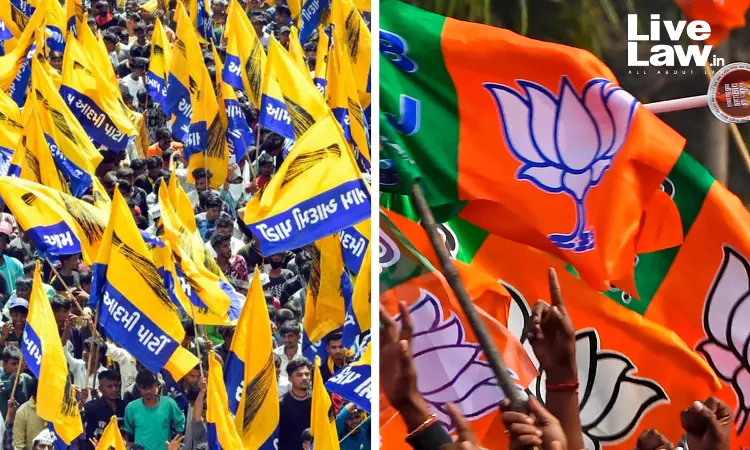
The defection of 7 AAP Rajya Sabha members and their joining the ruling BJP signals a dangerous portent for probity in public life.
Defections flout the people's mandate which is the very soul of democracy. Democracy is reduced to a mockery. It is to address this malady that the Anti-Defection law - Schedule X to the Constitution was brought in. While members/legislators who defect suffer disqualification, some exception is carved out -in paragraph 4- that it would not apply in case of merger. The defectors in the present case seem to have taken shelter under this and the Chairman of the Rajya Sabha has accepted that there has been a merger. All this bristles with unconstitutionality.
Two conditions need to be satisfied to come within the protection of paragraph 4 and escape the disqualification. In the first place the political party to which the defector/member belongs should merge with another political party and secondly at least two-thirds of the members of the legislature party of the political party should agree to such merger. There is a clear distinction between the political party and its legislature party. The Constitution advisedly maintains the distinction. This is also recognized in the Constitution Bench judgment in Subhash Desai v State of Maharashtra (2024) 2 SCC 719. It is the political parties who are the players and game changers in the theatre of democracy. The legislature party owes its birth and sustenance to the political party.


There has been no merger of the political party-AAP with the other political party-BJP. It is only when that happens that at least two-thirds of the legislature party members can agree to it and save themselves from the Anti-Defection law. The role of the Chairman really comes in only when questions of disqualification are to be decided. Therefore, to contend that the seven MPs would not be disqualified because there has been a merger runs in the teeth of the express language of Sch X and is clearly unsupportable. It is a death blow to clean, principled politics and democracy itself. Even if the letter of the law is satisfied, its spirit is buried six fathoms deep.
That apart, it is to be realized that constitutional morality is no less essential than constitutional legality for the survival and success of the democratic polity. Constitutional morality is a sentiment to be cultivated among the people, it is more of a mandate to them and their representatives, rather than an additional source of power for the court. We cannot go only by the letter and forget the reasons and the spirit behind the law. Defections are recognized and can be valid only because of the member's freedom of conscience and expression. That has necessarily to be on ideological grounds and a principled basis. But presently all these defections are wholly grounded in expediency. It may be advisable now to do away with the exceptions. But the law cannot provide a remedy to all the ills that flesh is heir to.
A constitutional democracy can work only under institutional safeguards. A cultivated respect for law and its processes, and enduring institutions are important. An unfailing index of a mature democracy is the degree of its respect for unwritten conventions. What is left unsaid in a constitution is as important as what is said; and the constitutional equilibrium can be preserved only by obedience to the unenforceable both by the citizens and the government. Beyond the sphere of what is legally enforceable, there is a vast range of significant behaviour in which the law does not and ought not to intervene. This feeling of obedience to the unenforceable is the very opposite of the attitude that whatever is technically possible is allowable. This power of self-discipline is the very opposite of the fatal arrogance which asserts, whether in government or personal behaviour, that whatever is technically possible is licit. All through history, men have needed it to preserve them from the temper which hardens the heart and perverts the understanding.
We recall the sagacious words of Frankfurter, J. that 'constitutionality and wisdom or what is right are not synonymous. Our preoccupation with the constitutionality of legislation, rather than with its wisdom, tends to preoccupation with a false value. The ultimate reliance for the deepest needs and precious interests of civilization must be found outside their vindication in courts of law.' Only a persistent, positive translation of the faith of an incorruptible and principled society into the convictions, habits and actions of the community is the real protection against unprincipled and amoral actions of men in public life. 'The contemplation and judgment of fellowmen', to adopt the words of Derbyshire, CJ in R.C. Pollard v Satya Gopal Mazumdar, AIR 1943 Cal 594 should be vigilant and strong enough to drive the unworthy out of public office and ensure that only the deserving and irreproachable occupy public office.
It is necessary to build, nurture and cherish a constitutional culture which is not merely regard for and adherence to form but a commitment to substance: that is respect for the rule of law which is the tribute paid by power to reason, disciplining the exercise of all power and subjecting it to constitutional limitations. This indeed is constitutional morality. This is what Babasaheb Ambedkar also wanted us to cultivate, nurture and cherish. Otherwise, it would be a sad day for our democracy. It is conventions, the weight of public opinion and, even more, national character that will have to prevent any perversion of the system.
The right to vote, even if it may not be a fundamental right, is certainly very fundamental in a democracy. It is one of the most prized possessions of a citizen. It is his participation in the governance of the country. While there can be no objection to revising the voters' list and removing ineligible voters from the list, the process has to be reasonable, fair and just and based on some objective criteria. The exercise which saw lakhs of voters being disenfranchised, particularly in West Bengal, cannot be said to pass muster. It was done in haste, leaving no time for any remedial steps to be taken. The percentage of appeals allowed against the deletion of names by the Election Commission speaks volumes about the untenability and deficiency of the exercise. Against that background, the Supreme Court did not rise to the occasion to ensure free and fair elections. The Court should have allowed all those who were in the list and had voted on the earlier occasion to vote this time. The revision can then be done reasonably; or it should have been undertaken well in advance of the polls. The present exercise did not instill confidence.
When millions face exclusion and the Court says, “we will examine later,” it is abdication of the Court's function and responsibility. The Court said the “right to remain on rolls” is more valuable—yet it offered no immediate protection before the vote. That right means nothing if it cannot be exercised when it matters. A right to vote is meaningful only if it can be exercised on the polling day; and not restored after the poll is over and the result is declared. When institutions move slower than the violation itself, the consequence is the same as denial. This is not about which party gains or loses. It is about whether constitutional guarantees are enforced, and enforced in time, or deferred until they become irrelevant. While the identity of the victor is immaterial, the identity of the loser is all important and, to adapt the language of Justice Stevens in Bush v Gore, is perfectly clear: It is our democracy and the confidence in the Court as an impartial guardian of our rights and the rule of law.
The Supreme Court created history by hearing a habeas corpus petition for over five months. A habeas corpus case where a person's liberty is at stake is entitled to the most expeditious hearing and disposal. The right to life and personal liberty is at the top of the scale of constitutional rights and values. As Lord Denning said in the first Hamlyn Lecture, Freedom under the Law, if a counsel mentions a case where the liberty of any person is jeopardized, then the Court keeps aside all work and takes up that matter. The hearing of the petition challenging Sonam Wangchuk's preventive detention was spread from October 2025 when the case was filed till March 2026. On March 14, the preventive detention was revoked and on the 17th the matter was disposed of as infructuous. Challenge to infringement of liberty can never become infructuous. Even when the detention is revoked and the person set free, it is necessary to examine whether the detention was lawful, otherwise the person will be entitled to compensation/damages. Where a person's constitutional rights are invaded, 'the invasion may not be washed away or wished away by his being set free', as the Supreme Court has consistently held. The Court will have to award damages for public tort. All this was overlooked. The Court which is the last bastion of our rights and liberties showed itself up as a lost bastion.
All this does not augur well for our constitutional democracy. As the Supreme Court so perceptively observed, “..in the last analysis, the people for whom the Constitution is meant, should not turn their faces away from it in disillusionment for fear that justice is a will -o'-the wisp.”
Author is a Senior Advocate, Supreme Court of India. Views are personal.


