Propriety Questions Emerge As Son Of Justice SC Sharma, Who Heard ECI & Medha Roopam Cases, Is Election Commission's Lawyer
Manu Sebastian
25 Sept 2026 3:44 PM IST
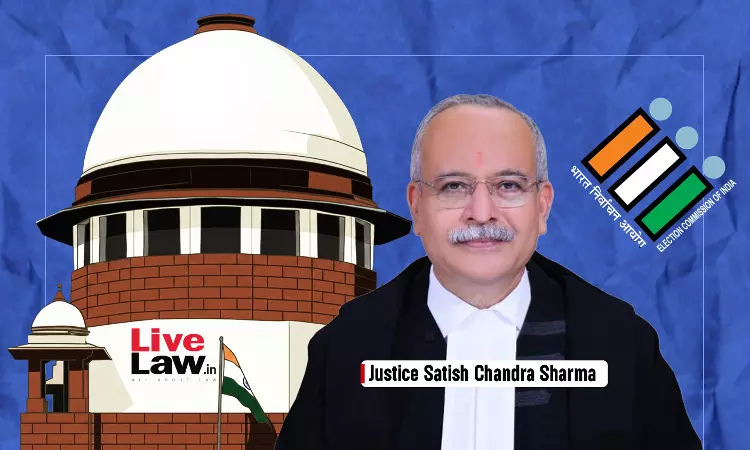
Certain serious questions concerning judicial propriety have arisen in the light of newly surfaced information that the son of Justice Satish Chandra Sharma of the Supreme Court is the standing counsel of the Election Commission of India in the Madhya Pradesh High Court.
This assumes significance as Justice Sharma was part of the two-judge bench which heard the petitions challenging the 2023 law governing the appointment process for the Chief Election Commissioner and the Election Commissioners. On September 23, because of Justice Sharma's view that the matter must be heard by a Constitution Bench, the case ultimately had to be referred to the CB, despite the contrary opinion expressed by Justice Dipankar Datta. The practical effect is that the hearing of this matter, which is integrally connected to the survival of Indian democracy, will be further delayed.
Coincidentally, on the same day, another bench led by Justice Sharma heard the petition filed by Noida District Magistrate Medha Roopam challenging the Allahabad High Court's order which criticised her for ordering the detention of a student under the National Security Act in connection with the April labour protest. The High Court had awarded Rs 5 Lakh compensation to the student, which was to be recovered from Roopam's salary. Justice Sharma's bench granted interim relief to Roopam by staying the High Court's strictures against her and the order for recovery.


The circumstances acquire a curious dimension given the fact that Medha Roopam is the daughter of Chief Election Commissioner Gyanesh Kumar.
The listing of Medha Roopam's matter before Justice Sharma's bench has already generated strong questions, since Justice Sharma's bench did not have the regular roster for hearing the subject matter. Also, another bench, led by Justice Nagarathna, was already hearing the connected matters. Hence, the special assignment of this matter to Justice Sharma's bench contrary to the prevailing roster has created doubts in the minds of several persons.
Now, coupled with that, the newly discovered fact that Justice Sharma's son has a professional connection with the ECI has compounded the propriety concerns.
It is not clear if Justice Sharma has disclosed this professional connection to the parties in the ECI law case and the Medha Roopam case.
The Madhya Pradesh High Court's website records that Justice Sharma's son, who enrolled in 2017, is the standing counsel for the Election Commission of India. He is also the standing counsel for the Central Board of Direct Taxes and the Income Tax Department. His younger son, enrolled in 2020, is the standing counsel for the MP Public Service Commission.
Can a Judge be expected to decide against an entity if his child's professional growth is dependent on that very entity? The question is not whether Justice Sharma's decisions were actually influenced by this association; the matter is also about perception. As it is often said, “Justice must not only be done, but also be seen to be done”.
When a Judge's son is empanelled as counsel for the ECI, a dispassionate observer is certainly entitled to question whether the Judge's adjudication in a challenge to the law governing the appointment of Election Commissioners, as well as in a petition involving the CEC's daughter, can be entirely free from a potential conflict of interest.