



- Home
- /
- Top Stories
- /
- Supreme Court Refers Pleas...
Supreme Court Refers Pleas Challenging Election Commissioners' Law To Constitution Bench; Justice Datta Questions Selection Process
Amisha Shrivastava
23 Sept 2026 2:39 PM IST
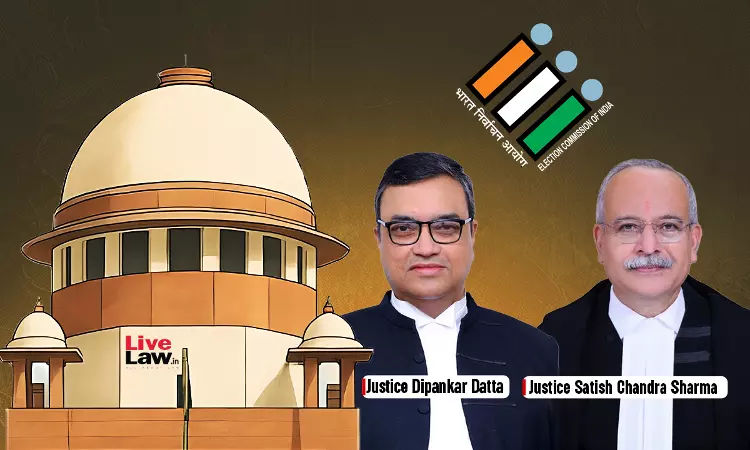
Justice Datta prima facie doubted whether the present appointment process for Election Commissioners was independent.
The Supreme Court on Wednesday referred the petitions challenging the 2023 law governing the appointment process for the Chief Election Commissioners and Election Commissioners to a larger bench. Even though a two-judge bench of Justice Dipankar Datta and Justice Satish Chandra Sharma disagreed on whether the matter should be referred, they ultimately ordered that the matter be placed...
This is a premium content
Available exclusively to
Our subscribers
Subscribe Premium 
INR 1099+GST
Your support helps us to bring you more content at
an affordable subscription scheme !!!
All payment options available
The Supreme Court on Wednesday referred the petitions challenging the 2023 law governing the appointment process for the Chief Election Commissioners and Election Commissioners to a larger bench.
Even though a two-judge bench of Justice Dipankar Datta and Justice Satish Chandra Sharma disagreed on whether the matter should be referred, they ultimately ordered that the matter be placed before the CJI for the constitution of a Constitution Bench of appropriate strength, to avoid further delay. The bench observed that referring the matter to a 3-judge bench on the preliminary point of reference would be a time-consuming exercise.
While Justice Datta opined the Union's demand for a larger bench reference was unwarranted, Justice Sharma held otherwise.
Justice Datta doubts whether the 2023 Act ensures an independent process
Justice Datta prima facie questioned whether the 2023 law governing the appointment of the Chief Election Commissioner and Election Commissioners provides an independent selection process.
Justice Datta observed that the 2023 Act, prima facie, appeared to confer a veto on the Executive, since the appointment process, by a committee comprising the PM, Union Minister and the Leader of Opposition, fails the "perception trust."
Justice Datta observed that a nominee of the Prime Minister cannot be expected to vote against the Prime Minister.
"Free and fair elections depend on a truly independent ECI. It is not enough for the ECI to be independent; it must appear to be independent. The member nominated by the Prime Minister cannot be expected to defy the Prime Minister," Justice Datta observed.
The Minister nominated by the Prime Minister to function as the third member of the selection committee, chaired by the Prime Minister, cannot be expected to defy his own nominator and risk his continuation as such nominated member on the committee for all practical purposes. Even otherwise, the collective responsibility doctrine would preclude the Minister to oppose his Prime Minister, Justice Datta said.
He further questioned whether the inclusion of Cabinet Ministers in the selection committee provided an independent counterweight to the executive.
"In such a circumstance, the inclusion of a Cabinet Minister in the selection committee fails to provide the independent counterweight that a neutral selector could, and the Cabinet Minister would merely echo the voice of his leader, and consequently, the presence of the Leader of the Opposition in the selection committee becomes largely ornamental, without furthering the purpose of his inclusion," Justice Datta observed.
Justice Datta also invoked a Cricket analogy. An umpire selected by a batting team, even if he gives the correct decision, will always be under a shadow of doubt as he will be perceived to be loyal to the team.
The bottom line of the argument runs thus: it would not be a fallacious metaphor if it is said that since the umpire is picked by the captain of one side in a cricket match and his team wins, even if the decisions taken by such umpire are correct, it has the patina of suspicion, for at the end of the day the umpire has effectively been chosen by the winning captain. These are very emphatic and appealing submissions.
Justice Datta observed that there was no need for a larger bench reference, since the Constitutional principle that the ECI appointments must be free of executive influence is well settled by the 5-judge bench in Anoop Baranwal(2023).
Even though the mechanism proposed by the Anoop Baranwal judgment - to select ECs by a committee comprising the PM, the CJI and the LoP - was only meant to be an interim arrangement till the Parliament enacted a law, the principle laid down in the judgment has not been unsettled, Justice Datta noted, opining that a reference was unnecessary.
Justice Sharma however observed that the issue has to be authoritatively determined by a Constitution Bench in terms of Article 145(3) of the Constitution since a substantial question of interpretation of the Constitution has arisen.
Even though there was a difference of opinion on the issue whether the matter should be heard by a Constitution Bench, the two-judge bench ultimately directed that the matter be placed before the CJI to constitute a Constitution Bench, in order to avoid delay.
"A decision by a three-judge bench on which of the two opinions is correct would be of little worth and only delay at the decision on the significant issues that are raised," the bench observed in its unanimous order.
The bench also recorded its concerns over the delay in the hearing of Constitution Bench matters, and proposed the establishment of a permanent Constitution Bench.
Justice Datta also expressed concerns about the executive interference in the judges appointment process, while rejecting the Union's argument that the executive-laden body can pick ECs like the judges appoint judges.
The Court had in July reserved its judgment on whether the issue of constitutional validity of the law governing the appointment of the Chief Election Commissioner and Election Commissioners should be referred to a Constitution Bench.
The Court pronounced its judgment in a batch of petitions challenging the Chief Election Commissioner and Other Election Commissioners (Appointment, Conditions of Service and Term of Office) Act, 2023. The petitions challenge the mechanism under which the Chief Election Commissioner (CEC) and Election Commissioners (ECs) are appointed.
Background
The pleas challenge Section 7 of the Act, under which the Selection Committee comprises the Prime Minister, a Union Cabinet Minister nominated by the Prime Minister and the Leader of Opposition. The petitioners contend that the arrangement gives the executive a two-to-one majority and undermines the independence of the Election Commission.
The Centre sought a reference to a larger Bench, arguing that the challenge raises substantial questions concerning the interpretation of Article 324 and the scope of Parliament's power to prescribe the appointment mechanism for Election Commissioners.
The Union also argued that the Court needs to authoritatively determine the effect of the Constitution Bench's 2023 judgment in Anoop Baranwal v. Union of India after Parliament enacted the Chief Election Commissioner and Other Election Commissioners (Appointment, Conditions of Service and Term of Office) Act, 2023.
The petitioners opposed the reference, contending that the constitutional principles governing the independence of the Election Commission have already been settled by the Constitution Bench in Anoop Baranwal and that no fresh question of constitutional interpretation arises merely because Parliament subsequently enacted the 2023 Act
On merits, the petitioners relied extensively on the Constitution Bench judgment in Anoop Baranwal v. Union of India. In that case, the Supreme Court had directed that the CEC and ECs be appointed by a committee comprising the Prime Minister, the Leader of Opposition and the Chief Justice of India until Parliament enacted a law on the subject. The petitioners contended that while Parliament was free to enact a law, it could not create a mechanism that allows the executive to dominate the appointment process.
Senior Advocate Vijay Hansaria argued that the issue was not whether the Chief Justice of India must necessarily be part of the Selection Committee, but whether the ruling executive could have control over the appointments.
Senior Advocates Gopal Sankaranarayanan and Shadan Farasat, as well as Advocate Prashant Bhushan, also argued that the constitutional principle of an independent Election Commission recognised in Anoop Baranwal prevents Parliament from adopting a mechanism dominated by the executive. They relied on Articles 14 and 19 and the basic structure doctrine, contending that free and fair elections require an independent Election Commission.
The Union government, represented by Attorney General R Venkataramani and Solicitor General Tushar Mehta, defended the Act. The Centre contended that Article 324 leaves it to Parliament to prescribe the appointment mechanism and the Anoop Baranwal judgment only created an interim arrangement to fill a legislative vacuum.
The Attorney General argued that the Anoop Baranwal judgment could not be treated as imposing binding restrictions on Parliament's legislative choices after Parliament had enacted the 2023 law. The Centre also urged that the petitions be referred to a Constitution Bench under Article 145(3), contending that they raise substantial questions concerning the interpretation of Article 324 and Parliament's legislative power.
The Solicitor General argued that the Court could not begin with an assumption that the Prime Minister or the executive would act against democratic principles merely because the executive has a numerical majority on the Selection Committee.
The Court also examined the scope of the Constitution Bench judgment in Anoop Baranwal.. Justice Datta observed that the Court would have to distinguish between the binding direction in Anoop Baranwal and observations in the judgment explaining why the Chief Justice was included in the interim selection panel.
During the hearings, the Court also questioned the rationale for having a Union Cabinet Minister nominated by the Prime Minister as the third member of the Selection Committee, observing that the Election Commission must not only be independent but also appear to be independent.
Senior Advocates Gopal Sankaranarayanan, Shadan Farasat, Vijay Hansaria, Advocates Prashant Bhushan, Varun Thakur etc argued for the petitioners.
Attorney General for India R Venkataramani and Solicitor General of India Tushar Mehta appeared for the Union.
Case no. - W.P.(C) No. 14/2024 Diary No. 146 / 2024 and connected cases
Case Title - Dr. Jaya Thakur v. Union of India and connected cases
Citation : 2026 LiveLaw (SC) 976
Tags

Amisha Shrivastava
Amisha Shrivastava is a Senior Correspondent with LiveLaw, covering the Supreme Court of India. She can be reached at amisha@livelaw.in

