Supreme Court's Judgment In Umar Khalid Case Is A Disturbing Precedent
Manu Sebastian
7 Jan 2026 10:15 AM IST
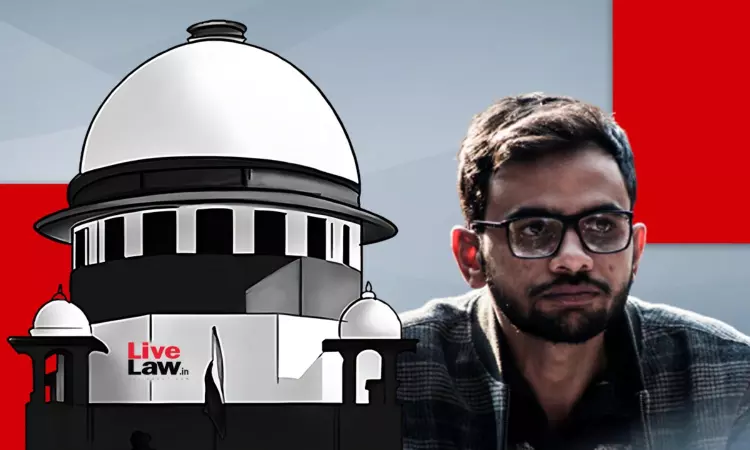
By criminalising plans to mobilise “chakka jams” as “terrorist acts”, the judgment casts a chilling shadow on political dissent.
"If we are guilty, why not give us a trial?” -The Trial of Chicago 7
The Supreme Court's judgment denying bail to Umar Khalid and Sharjeel Imam in the Delhi riots conspiracy case sets a deeply troubling precedent, legitimising the use of the Unlawful Activities (Prevention) Act to criminalise political dissent and consign the organisers of mass protests to years of incarceration without trial.
The UAPA is draconian enough, with its vague and wide definitions of offences, and a high threshold for the grant of bail. To make it worse, the bench comprising Justice Aravind Kumar and Justice NV Anjaria has now applied an even wider and looser interpretation by characterising plans to organise chakka jam protests as 'terrorist acts'.
The prosecution allegations, even accepted to the hilt, show that Khalid and Imam conceived, articulated, and mobilised protests in the form of chakka jams or road blockades against the Citizenship Amendment Act to paralyse government administration.
Some observations in the judgment about Sharjeel Imam are as follows :
“The prosecution case is of a chain comprising: (i) creation and administration of mobilisation platforms; (ii) dissemination of written material intended to galvanise participation; (iii) meetings and coordination; and (iv)public exhortations articulating a strategy of disruption.”


According to the Court, the fact that Sharjeel Imam was under custody since January 28, 2020 - almost a month before the Delhi riots broke out on February 22/23- is immaterial since the conspiracy commenced in December 2019 with his mobilisation of the anti-CAA protests.
As regards Umar Khalid, the judgment places much emphasis on the statement of a protected witness that Khalid had, in a meeting held in December 2019, explained the difference between “chakka jam” and “dharna”.
Some observations regarding Khalid are as follows :
“The role attributed to Umar Khalid is not of a late entrant nor of a peripheral sympathiser. It is that of an organiser and coordinator who, according to the prosecution, supplied the “method”, the “timing”, and the “linkage” between dispersed sites and actors.
The factual record placed by the prosecution repeatedly returns to a distinction that is central to the case: the differentiation between a conventional dharna and a chakka jam. A dharna may be expressive; a chakka jam, as alleged, is disruptive by design. The prosecution case is that the sustained choking of arterial roads, replication of blockade sites, and the movement of crowds from minority clusters into mixed- population areas were not accidental expressions of dissent, but calibrated acts meant to generate confrontation, overwhelm law enforcement, and create conditions for violence.”
It is to be noted that the Court has not taken into consideration the defence arguments, saying that at the bail stage, it cannot weigh the defence, and can only look at the prosecution case to ascertain if the allegations are prima facie believable.
These allegations, even when fully accepted, describe political mobilisation and protest planning. They do not, by any stretch, describe terrorism. However, the Court held that the planning of widespread disruptive protests falls within the definition of a “terrorist act” under Section 15 of the UAPA since they are likely to disrupt essential supplies or services. The Court discounted the absence of overt violence by Khalid and Imam by relying on the phrase “any other means of whatever nature” in Section 15, saying that the provision is not confined to conventional violence.
Chakka jams and road blocks may be illegal. They may warrant prosecution under ordinary criminal law. But to criminalise them as 'terrorist act' is a giant leap of logic. If organising road blockades with the intent to pressure the government is to be treated as a “terrorist act”, then a wide swathe of India's protest history stands criminalised. As constitutional scholar Gautam Bhatia argued in his blog, even the civil disobedience movements during India's freedom struggle would be classified as 'terrorist acts'. Farmers' agitations that blocked highways, protests that halted rail traffic, and countless labour and civil society movements that employed road roko and rail roko as instruments of protest would all risk falling within the same net.
The missing link between protests and riots
In recording the prosecution case, the judgment repeatedly uses the expression that the appellants played a significant role in organising and implementing the protests, which “ultimately culminated in violence.” At one place in the judgment, it is stated that the appellants are accused of conspiring to "create conditions for violence." What remains unclear is whether the violence was an accidental or spontaneous outcome triggered by intervening events, or whether violence itself was the object of the alleged conspiracy. The judgment does not offer a clear answer. The invocation of Section 15 rests instead on the premise that chakka jams were intended to disrupt essential supplies.
The prosecution narrative, as reflected in the order, speaks of speeches, meetings, and mobilisation. What it does not convincingly establish is the causal bridge between these acts and the riots themselves. There is looseness and ambiguity in the Court's language on this crucial question, blurring the distinction between calling for protests and orchestrating violence. Instead of offering clarity, the verbose language of the judgment obscures and confounds. To criminalise calls for protests without establishing a proximate nexus with and clear intent for violence is constitutionally impermissible.
The Court reiterates that, at the stage of bail under the UAPA, it is required to look only at the prosecution case and not the defence. Previous decisions of the Court, including in Vernon and Shoma Sen, emphasised that even within the constraints of the UAPA, courts must undertake a meaningful judicial exercise. True, the Court is not expected to conduct a mini-trial at the bail stage; but neither the Court must rubber stamp the prosecution's allegations. “Graver the offence, the greater should be the care taken to see that the offence would fall within the four corners of the Act(UAPA),” the Supreme Court observed in the Vernon case. Such a greater scrutiny seems to be missing in this judgment, which reads like a mechanical one-sided recital of the prosecution's story.
Most striking is the Court's failure to engage with its own jurisprudence on personal liberty and speedy trial, as expounded in Javed Gulam Nabi Shaikh v. State of Maharashtra and Sheikh Javed Iqbal v. State of Uttar Pradesh, which arose out of UAPA cases. These judgments affirmed that the presumption of innocence and the right to speedy trial are not lost even in UAPA cases.
In Javed Gulam Nabi Shaikh, a coordinate bench held :
"If the State or any prosecuting agency including the court concerned has no wherewithal to provide or protect the fundamental right of an accused to have a speedy trial as enshrined under Article 21 of the Constitution then the State or any other prosecuting agency should not oppose the plea for bail on the ground that the crime committed is serious. Article 21 of the Constitution applies irrespective of the nature of the crime”. The judgment in Sheikh Javed Iqbal held that the stringency of UAPA was not a justification to deny bail to an accused undertrial suffering long incarceration with no end in sight of the criminal trial”. In Jalaluddin Khan v. Union of India, the Supreme Court held that the rule 'bail is the rule and jail is the exception' applies even in UAPA cases.
The judgment, unfortunately, does not make any reference to these precedents. It says that delay in trial is not a “trump card” to automatically grant bail. What is troubling is that the Court makes no effort to assess when the trial is likely to conclude or how many witnesses are to be examined. Here, even the stage of framing charges has not been reached. The Court trivialised the pre-trial custody of over five years by saying that the “continued detention has crossed the threshold of constitutional impermissibility so as to override the statutory embargo.” It seemed as if suggesting that the appellants have not suffered enough. The partial consolation offered by the judgment is that five co-accused, who have also been undergoing custody for over five years, were granted bail.
Beyond the immediate case, the judgment carries a chilling message and a deeply disappointing moment for those who looked up to the Court to perform its constitutional role as the sentinel on the qui vive of personal liberty.
The author is the Managing Editor of LiveLaw. He can be reached at manu@livelaw.in