



The Dead Have Complaints Too : 'Memoirs Of Unseen' Book Review
Shaileshwar Yadav
7 Nov 2026 11:50 AM IST
A Death That Refuses to Be Forgotten
Inspector Rathi has had twelve years to think about Payal's death. She was found hanging in her room. Her family called it suicide, though there were indications that she might have been poisoned before the hanging. When Mohan, a university student, comes asking questions, Rathi retrieves photographs, witness statements and toxicology notes from an old envelope. He remembers his doubts. He also tells Mohan that nobody wants to reopen dead cases. Coming from the officer who investigated her death, that is quite a statement.
Mohan had rented a room in Delhi's Qutab Institutional Area. Every night at 1.17, he hears furniture being dragged in the adjoining room, which remains locked. His landlord, Munjal, eventually tells him that his daughter Payal died there after the family opposed her relationship with a man from another caste. He dismisses the disturbances as her attempts to attract attention. Twelve years after her death, he still seems sure he knows what she wants.


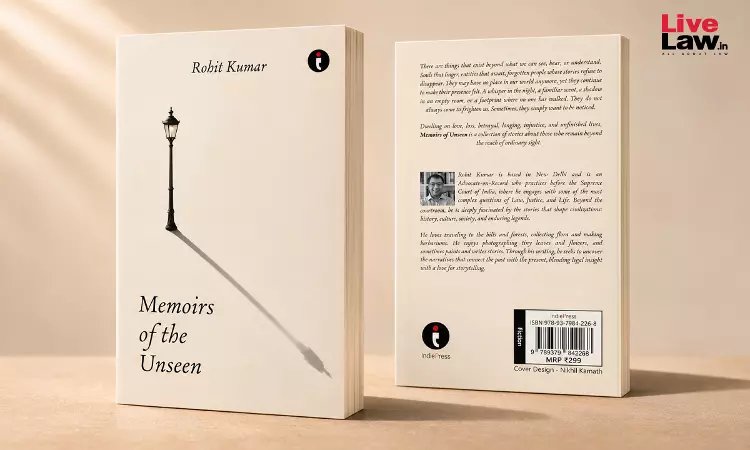
The Tenant is one of twenty short stories in Rohit Kumar's Memoirs of the Unseen, published by IndiePress. Kumar, himself an advocate, has written about ghosts who continue to trouble the living over matters left unresolved. There are familiar Delhi settings, rented rooms, court proceedings, public projects and people unable to leave their old lives behind.
Payal's story is uncomfortable enough without the ghost. In Shakti Vahini v. Union of India, the Supreme Court affirmed the freedom of consenting adults to choose their partners without family approval and issued directions against honour-based violence. Opposition to Payal's relationship cannot by itself establish murder. The story leaves that suspicion unresolved. However, let us not ignore that the investigating officer had material warranting further examination, and twelve years later it was still in his envelope.
A Divorce That Survives Death
In Mira and Hosbeth, a woman discovers that the divorce she believed she had obtained was based on fraudulent papers. The decree had never been presented to a court. After failing before the Bombay High Court, she approaches a lawyer to take the matter to the Supreme Court. The lawyer then finds her death certificate. It is genuine. Mira has been dead for years, though she has carried on pursuing her divorce.
There is a rather good story waiting in that predicament. The Supreme Court eventually recognises Mira's claim and her spirit finds release, but the hearing is dealt with almost in passing. The judge is moved by the truth and grants relief. What was the Court deciding, though? The marriage would ordinarily have ended upon death. Kumar hurries past what could have been some intriguing arguments from the lawyer or, better still, the Bench grilling him over the maintainability of a divorce petition.
The Problem of Hasty Endings
There are places where the stories seem to end a little too soon. Take Wilson, for instance. An engineer working on a Delhi Metro project has all the necessary approvals, but construction keeps failing. It turns out that Abdul, the guardian of the graveyard beneath the station, has some objections of his own.
The two eventually strike a deal allowing passengers with “valid permission” to get off and meet the dead. Even the dead, it seems, cannot escape Delhi's obsession with permissions. The arrangement is amusing, although the conversation between Wilson and Abdul is over rather quickly. There could have been some interesting bargaining here.
Chakrata leaves a different uneasiness. Juyal continues offering rooms in a hotel that no longer exists, his property having been acquired and demolished for road widening. He had approached officials and even the courts, apparently without success. One is reminded of Kolkata Municipal Corporation v. Bimal Kumar Shah, where the Supreme Court recognised procedural safeguards under Article 300A. But Juyal's misfortune takes an ugly turn. He kills his wife and daughters before taking his own life. The story gives us enough to understand his suffering, but very little about the women who suffered at his hands. They had lost their home too, and eventually their lives.
Of course, these are short stories, and there is only so much one can expect them to accommodate. Leaving things unsaid is sometimes what makes them enjoyable. Still, a longer exchange between Wilson and Abdul would have been fun, while a little more about Juyal's family might have changed how one reads his tragedy.
When the Ghost Needs No Explanation
Amma is perhaps the sweetest of the lot. Suraj, a young teacher posted near Ajmer, rents a room from an elderly woman who cooks for him, tells him stories and eventually comes to live with him in Delhi. Years later, he discovers that she had died shortly after he left the village. He returns home to find her waiting as usual, asking why he is late.
And Kumar leaves it there. Quite rightly. There is something lovely about a ghost whose only concern is whether someone has returned home on time. No revenge, no unfinished litigation, nothing to settle.
A Little Colour Among the Robes
Cold winds, flickering lamps and mysterious whispers appear often enough for some revelations to become predictable. At places, the stories explain a little more than they need to. Still, there is a charm to these encounters, somewhat reminiscent of Ruskin Bond, with his hill towns, passing strangers and the occasional strange incident during an otherwise ordinary journey.
Memoirs of the Unseen is Kumar's debut, and it would be unfair to burden it with tall literary expectations. There is something refreshing about an advocate finding time, amid the usual business of law, to write ghost stories. In a profession buried under pleadings, affidavits and judgments, the book is rather like a bright-coloured sock peeping out from beneath black-and-white robes. It may look a little out of place, but then, there is no reason why the profession should be denied some colour.
The author is an advocate practicing before the Supreme Court and Delhi High Court. Views Are Personal


