




Civil Law
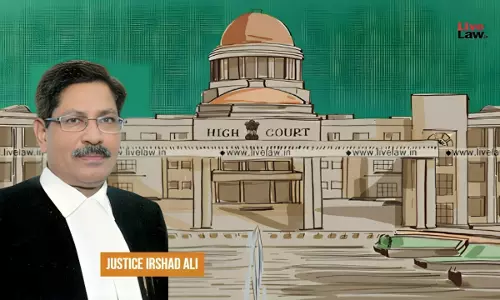
Revisional Authority Can't Set Aside Final Order Passed By Coordinate Revisional Authority In Separate Revision: Allahabad High Court
The Allahabad High Court has held that a revisional authority deciding a revision under Section 219 of the U.P. Land Revenue Act, 1901 has no jurisdiction to set aside a final judgment already rendered by another revisional authority of coordinate jurisdiction in a separate revision arising out of the same appellate order.Section 219(1) of the Act allows the specified revenue authorities to...
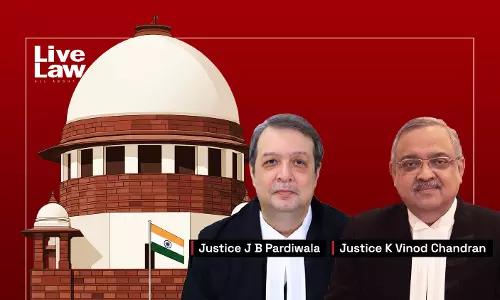
Solatium & Interest For Land Acquisition Under National Highways Act To Be Computed As Per 1894 Act For Pre-2015 Awards : Supreme Court
The Supreme Court on Tuesday (08.09.2026)held that when the Competent Authority under the National Highways Act, 1956 (NH Act) determines compensation before 01.01.2015, the solatium, interest, and interest on solatium payable to the landowner must be computed under the Land Acquisition Act, 1894, and not under the Right to Fair Compensation and Transparency in Land Acquisition,...
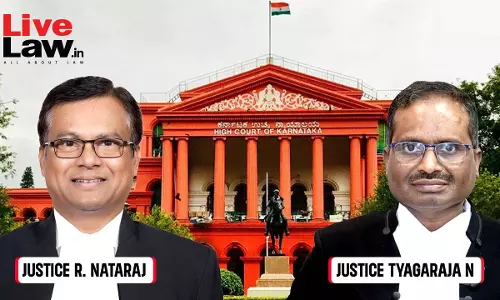
Offerings By Devotees To Hereditary Temple Priest In Arati Tray Is His Personal Income, Not Joint Family Property: Karnataka High Court
The Kalaburgi Bench of the Karnataka High Court has held that the offerings made by devotees to a hereditary archak (temple priest) in the mangalarathi (prayer ritual) plate constitute his individual income saved under Section 3 of the Hindu Gains of Learning Act, 1930, and do not form part of a joint family nucleus.“The offerings made by the devotees to the archak is the remuneration that...

Order Refusing Recusal Of Judge Is Interlocutory, Not Revisable Under Section 115 CPC: Sikkim High Court
The Sikkim High Court has held that an order refusing a Judge's recusal is interlocutory in nature and cannot be challenged by invoking the revisional jurisdiction of the High Court under Section 115 of the Code of Civil Procedure, 1908. The Court observed that even if the recusal request were allowed, it would merely result in a change of the Presiding Officer and would not finally dispose...
UP Ceiling Act | Land Transfer During Pending Proceedings Is Void, Can't Be Saved By Tenure-Holder's 'Right Of Choice': Allahabad High Court
The Allahabad High Court has held that a transfer of land made during the continuance of proceedings for determination of surplus land is void under Section 5(8) of the U.P. Imposition of Ceiling on Land Holdings Act, 1960. It held that the Prescribed Authority cannot validate such a transfer by accepting the choice exercised by the tenure-holder under Section 12-A of the Act.Section 5(6) of...

Plaintiff In Specific Performance Suit Must First Debunk Suspicious Circumstances : Supreme Court
The Supreme Court recently held that where a plaintiff seeks specific performance of an agreement to sell whose genuineness is clouded by suspicious circumstances, the plaintiff must first explain those circumstances satisfactorily before the evidentiary burden can shift to the defendant.A bench of Justice JB Pardiwala and Justice K Vinod Chandran set aside the concurrent findings of the...

Granddaughter Undergoing Studies Availing Loan Can't Be Expected To Maintain Pension-Drawing Grandmother: Kerala High Court
Kerala High Court recently held that a granddaughter, who is undergoing studies after availing a student loan, cannot be expected to maintain her pension-drawing grandmother. [2026 LiveLaw (Ker) 487]Justice Harisankar V. Menon dismissed an octogenarian's plea against her daughter-in-law and granddaughter seeking maintenance from them as per the Maintenance and Welfare of Parents and...

Divorced Daughter Cannot Be Denied Family Pension Merely Because Divorce Occurred After Father's Death: Tripura High Court
The Tripura High Court has held that a divorced daughter cannot be denied family pension merely on the ground that she was not divorced on the date of her pensioner-father's death. The Court remarked that the requirement that a daughter must have been divorced during the lifetime of the pensioner was not contained in the applicable pension rules. The Court also criticised the Agartala...
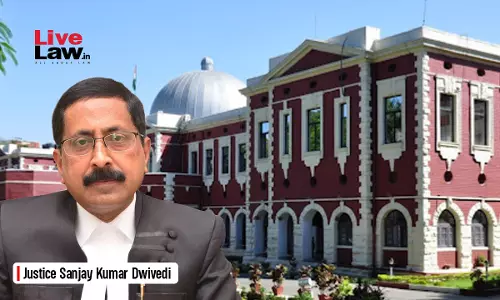
Compromise Decree Obtained Through Fraud Or Collusion Cannot Validate Transfer Of Tribal Land Under Chotanagpur Tenancy Act: Jharkhand High Court
The Jharkhand High Court has held that a transfer of land governed by the Chotanagpur Tenancy Act, 1908 cannot be sustained merely on the basis of a compromise decree where such transfer is in violation of the statutory provisions. The Court observed that “transfer by any fraudulent method including decrees obtained in a suit by fraud and collusion cannot be allowed to be continued.”A...

Suspension Of Food Business Licence Must End On Rectifying Deficiencies, Can't Force Them Into Litigation: High Court To Maharashtra FDA
After noting a pattern of the Maharashtra Food & Drugs Administration (FDA) in dealing with cases of licence suspensions of establishments, the Bombay High Court recently made it clear that once an establishment, whose licence has been suspended by the authority, rectifies the deficiencies and an autogenerated report indicates compliance, the authority must revoke the suspension. A...
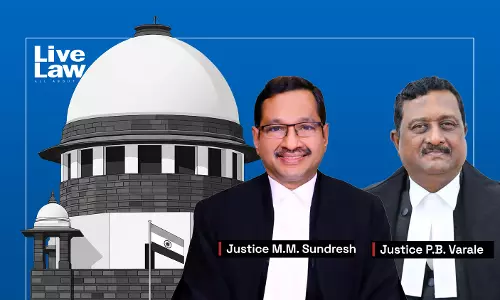
Defendant Need Not Enter Witness Box To Prove Admitted Document : Supreme Court
The Supreme Court has held that a defendant is not required to step into the witness box when the defence is based on an undisputed document already placed on record.A bench of Justice M.M. Sundresh and Justice Prasanna B. Varale heard the case where the Appellant-plaintiff filed a suit seeking a mandatory injunction and possession against a Respondent-tenant claiming him to be the owner of...
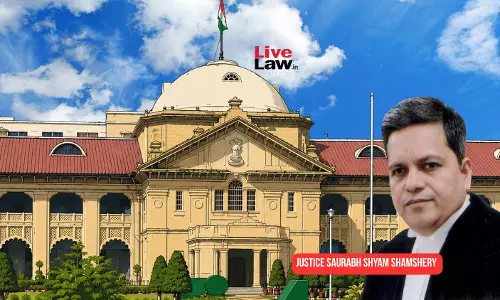
Authority Sanctioning Building Plan Can't Decide Private Title Dispute: Allahabad High Court Sets Aside Rejection Of Map Sanction
The Allahabad High Court has held that an authority deciding an application for sanction of a building map has no jurisdiction to hold that ownership of the land is disputed, except where the land belongs to the government or the Gaon Sabha or is the subject matter of proceedings. It held that where the dispute is private, the only question is whether an injunction is in force.Justice...