




Civil Law
Gujarat High Court Upholds Refusal To Entertain Plea Seeking Rejection Of Plaint At 'Fag End' Of Trial; Imposes ₹10,000 Costs
The Gujarat High Court has upheld a trial court order dismissing an Order 7 Rule 11 CPC application seeking rejection of the plaint, observing that the application was filed at the "fag end of the trial" when the suit had reached the stage of final arguments. [2026 LiveLaw (Guj) 238]The court was hearing a revision plea challenging an order passed by Principal Senior Civil Judge, Valsad...
Civil Court Can't Determine Agricultural Land Boundary Based On Advocate Commissioner's Report: Allahabad High Court
The Allahabad High Court has held that where the real controversy in a suit for injunction is the boundary between two adjoining agricultural holdings, the Civil Court cannot settle that boundary on a map prepared by an Advocate Commissioner. It held that Section 24 of the U.P. Revenue Code, 2006 provides a statutory mechanism of survey and demarcation before the competent...
'Trees Are The Lungs': Jharkhand High Court Stays Bypass Road Construction Requiring Felling Of 13,681 Full-Grown Trees
The Jharkhand High Court has stayed construction of a bypass road connecting Chatra town with NH-99 (New NH-22) and NH-100 (New NH-522) after noting that 13,681 full-grown trees identified for the project would have to be felled. The Court observed that “these huge chunk of trees are not merely a canopy, but are the lungs, which cannot be allowed to be destroyed by cutting them...
Husband Not Liable For Wife's Dues From Her Tenure As Sarpanch Without Proof Of His Involvement: Rajasthan High Court
The Rajasthan High Court has held that husband and wife were separate entities, and neither could be held liable for the misconduct or disgraceful act of the other, done in the capacity of a public representative, unless they have also indulged in the same. The bench of Justice Anoop Kumar Dhand opined, a spouse of an erstwhile public representative, could not be asked to pay dues owed by...
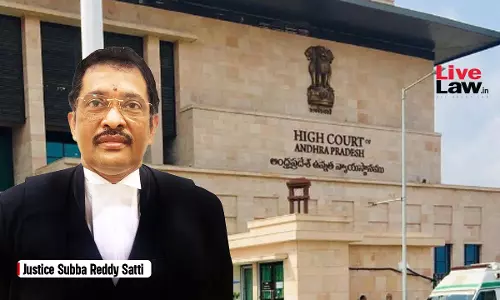
Declaration Of Title In Immovable Property Suits Governed By Article 65 Limitation Act, Not Article 58: AP High Court
The Andhra Pradesh High Court has held that a claim for declaration of title concerning immovable property is governed by Article 65 of the Limitation Act, and not the three-year limitation period under Article 58, where the suit is not one seeking declaration simpliciter. [2026 LiveLaw (AP) 205]In doing so, the Court upheld the order permitting the plaintiff to amend a pending suit...
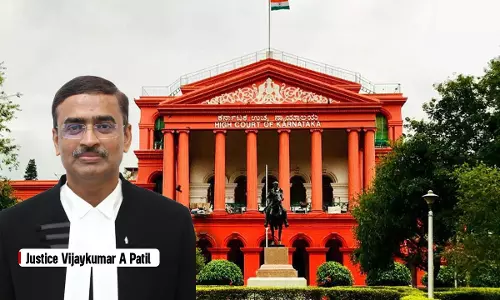
Karnataka High Court Upholds 3-Month Jail Term Of Newspaper Staff For Violating Order In Defamation Case, Says Tendering Apology Not Enough
The Karnataka High Court has upheld 3-month civil imprisonment against the editor, managing director and director of Karavali Ale newspaper for violating a temporary injunction order, holding that the trial court could not have have directed them to tender an apology instead of imposing a punishment under Order 39 Rule 2A CPC.The Court accordingly dismissed the writ petition seeking to quash...
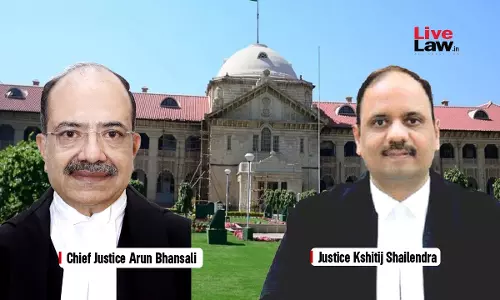
UP Panchayat Raj Act | Inquiry Against Gram Pradhan For Fund Misuse Not Wiped Out Merely Because Her Tenure Ended: Allahabad High Court
The Allahabad High Court has held that a pending inquiry under Section 95(1)(g) of the U.P. Panchayat Raj Act, 1947 against a Gram Pradhan cannot be treated as infructuous, or allowed to be stalled, merely because her tenure in office has since come to an end. The Court held that such proceedings must be carried to their logical conclusion, given the consequences that survive the end of...
Revenue Entry Not Set Aside By Competent Authority Can't Be Treated As Forged Merely On Allegation: Allahabad High Court
The Allahabad High Court has held that a revenue entry which has not been cancelled, corrected or set aside by a competent revenue authority or court, cannot be treated as forged merely because the opposite party alleges forgery. It held that though such an entry does not by itself create title, its evidentiary effect cannot be ignored altogether, and a party relying on its falsity must...
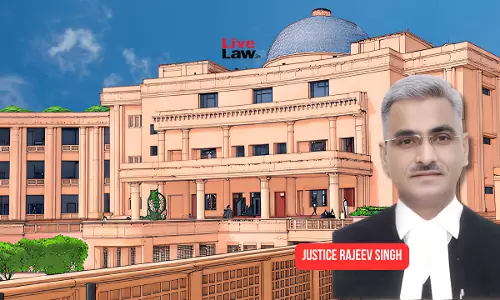
Appointments Can't Be Cancelled By Appointing Authority Merely On Direction Of State Govt: Allahabad High Court
The Allahabad High Court has held that an appointing authority cannot cancel appointments merely on the direction of the State Government, without applying its own mind. It set aside the termination of Assistant Managers of the U.P. Cooperative Bank whose appointments were cancelled in 2019 after the Principal Secretary, Cooperative, directed that they be cancelled.Justice Rajeev...
Jharkhand High Court Upholds Appointment Of Receiver To Monitor Joint Hotel Business; Says Direction Ensured Preservation Of Records
The Jharkhand High Court has upheld the appointment of a receiver for a jointly claimed hotel business, observing that the trial court had not restrained the appellant from running the business or maintaining the premises. The Court held that the order only sought a report regarding the business, including its physical condition, mode of operation, account books, GST records, licences,...
'False Allegations': Gujarat High Court Fines PIL Litigant ₹1 Lakh For Seeking Closure Of Industry Over Environmental Violations
The Gujarat High Court dimissed a PIL seeking closure of an industry making paper products over allegations of noise, air and water pollution, further imposing cost of Rs. 1 Lakh after noting that the allegations made in the petition were vague and frivolous as the industry was meeting all environmental standards. [2026 LiveLaw (Guj) 237]In doing so the court observed PIL was filed by person...
'Deaf And Dumb' Person Not Necessarily Of Unsound Mind: Himachal Pradesh High Court Rejects Challenge To Partition Proceedings
The Himachal Pradesh High Court has held that merely because a person is deaf and dumb, it cannot be presumed that he is of unsound mind so as to necessitate appointment of a guardian under Order XXXII Rule 3 of the Code of Civil Procedure (CPC).The Court observed that such a requirement would arise only where it is established that the person is incapable of protecting his interests in...