




Corporate
Conditional Deposit Won't Stop Interest If Award-Holder Can't Freely Withdraw It: Supreme Court
A deposit pending appeal is not synonymous with payment to the award-holder, the Court stated.
Litigant Mustn't Suffer When Delay Is Due To E-Filing Technical Glitch : Supreme Court Restores NCLAT Appeal
The Supreme Court has recently held that a litigant cannot be shown the door merely because an appeal was e-filed a day beyond the statutorily condonable period, where the delay was caused solely by a technical glitch in the tribunal's own e-filing portal.A bench of Justice Dipankar Datta and Justice Sheel Nagu held so while setting aside an order of the National Company Law Appellate...
Supreme Court Asks RBI To Issue Directions To Prevent Forcible Repossession Of Vehicles By Banks, NBFCs
The Supreme Court on Wednesday (16.09.2026) has directed the Reserve Bank of India (RBI) to take effective steps to secure genuine compliance by Non-Banking Financial Companies (NBFC) and Scheduled Commercial Banks with the Guidelines, Master Circulars, and Clarifications it has issued over the years on recovery practices, observing that such instruments “have existed only on paper, and...

Income Tax | AO Cannot Reopen Assessment Settled By Settlement Commission : Supreme Court
The Supreme Court on Wednesday (September 16) held that once an Income Tax Settlement Commission passes an order determining the net taxable income, it is impermissible for the Assessing Officer to issue a reassessment notice against the assessee under the Income Tax Act. “If the jurisdiction of the AO under Sections 143(2), 148, 154, etc., is made independent and available for...
SARFAESI Proceedings Can Be Invoked Despite Earlier Decree Passed In DRT OA For Same Debt : Supreme Court
The Supreme Court has recently dismissed a writ petition filed under Article 32 of the Indian Constitution challenging the invocation of the Securitisation and Reconstruction of Financial Assets and Enforcement of Security Interest Act, 2002 (SARFAESI Act) by an Asset Reconstruction Company (respondent), holding that the overriding effect of Section 35 of the SARFAESI Act permits such...
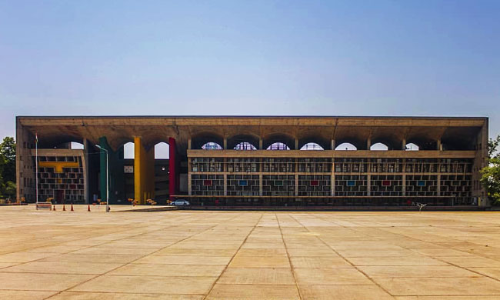
Punjab & Haryana High Court Strikes Down Section 147A Income Tax Act As Unconstitutional
The Punjab & Haryana High Court struck down the newly inserted Section 147A of the Income Tax Act, 1961, which retrospectively clarifies the role of the Jurisdictional Assessing Officer (JAO) in reassessment proceedings.The bench of Justice Deepak Sibal and Justice Rupinderjit Chahal pronounced the decision today. A detailed order is awaited.Section 147A was introduced with...
Release Of Escrow Under SEBI Buyback Regulations Does Not Bar Separate Fraud Inquiry : Supreme Court In Vedanta Case
The Supreme Court on Wednesday (09.09.2026) has held that release of the cash escrow deposited by a company under Regulation 15B(8) of the Securities and Exchange Board of India (Buyback of Securities) Regulations, 1998 (Buyback Regulations), does not operate as a bar to a separate and independent inquiry into fraud under the SEBI (Prohibition of Fraudulent and Unfair Trade Practices relating...
Partnership Act | Outgoing Partner's Share Must Be Valued On Date Of Assessment, Not Date Of Dissolution : Supreme Court
The Supreme Court on Wednesday (September 9) held that, upon dissolution of a partnership at will, an outgoing partner's right to receive his share in the residue of the partnership assets is not frozen as of the date of dissolution. Instead, the partner is entitled to have his share determined based on the value of the partnership assets as on the date of their actual valuation. A bench...
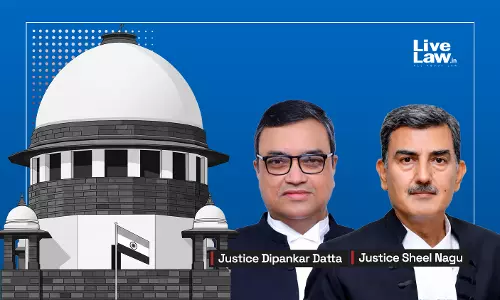
Indian Stamp Act | Is Fraudulent Intent Necessary To Invoke S.47A Over Undervalued Deed? Supreme Court Refers To Larger Bench
The Court doubted the precedents which held that fradulent intent was necessary to invoke Section 47A of the Indian Stamp Act.
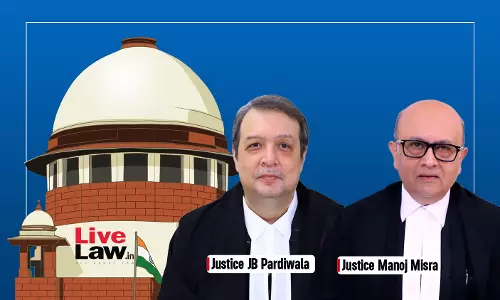
How To Attribute Mens Rea To Company? Supreme Court Explains Three-Stage Inquiry
The Supreme Court has held that criminal proceedings against a company accused of an offence cannot be quashed merely on the ground that no individual director, officer, or employee has been identified or arraigned as a co-accused, even where the offence charged requires proof of mens rea. A bench of Justice JB Pardiwala and Justice Manoj Misra held so while hearing an appeal filed by...
Companies Can Be Prosecuted Even Without Naming Individual Officers : Supreme Court
The Court also laid down a three-stage framework to attribute the individual's conduct and mens rea to the company.
RBI Can Supersede Multi-State Co-operative Bank Board Beyond Six-Months; Consultation With State Not Needed : Supreme Court
Observing that the Banking Regulation Act applies to multi-state co-operative banks, the Supreme Court on Thursday (September 3) held that the Reserve Bank of India's power to supersede the Board of Directors of a multi-state co-operative bank extends beyond the six-month limit prescribed under Article 243ZL(1) of the Constitution. “…the power of RBI to supersede BoD of a...