




Corporate
Futures & Options Segment Investors Cannot Seek Reimbursement Of Losses From Professional Clearing Members : Supreme Court
Highlighting the speculative nature of the Futures and Options (F&O) segment and the substantial losses suffered by investors despite the inherent risks involved, the Supreme Court on Wednesday (September 2) held that F&O investors cannot seek reimbursement of their financial losses from Professional Clearing Members (PCMs), whose role is just to facilitate the clearing and settlement...
Banks Can Invoke SARFAESI For Loans Acquired From NBFCs Not Covered Under Act : Supreme Court
In a significant ruling, the Supreme Court on Wednesday (September 2) held that banks can take recourse to the SARFAESI Act, 2002, to recover debts assigned to them by NBFCs, notwithstanding that such NBFCs were not covered under the Act at the time the debt was created. “…when the institution (bank) is one to which the SARFAESI Act is already applicable, acquisition of a...

Mere Delay In Depositing Foreign Travel Tax Not Same As 'Failure To Pay' : Supreme Court Sets Aside Penalty On Saudi Airlines
The Supreme Court has today (01.09.2026) held that mere delay in depositing Foreign Travel Tax (FTT) collected from passengers cannot be equated with failure to pay the tax, and hence, does not attract the penalty prescribed under Section 38(3) of the Finance Act, 1979. The Court also held that imposition of penalty under the provision is not automatic merely because there has been a breach...
Clarificatory Statement Does Not Qualify As Binding Undertaking For Contempt: Supreme Court
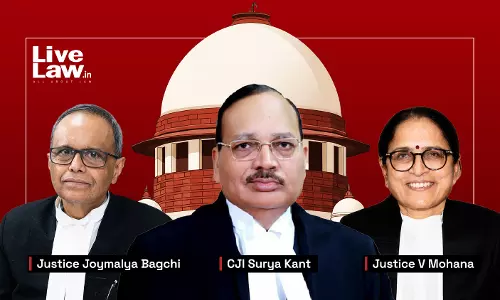
The Supreme Court on Tuesday (September 1) held that a clarificatory statement made before a court cannot be treated as an unconditional undertaking for the purpose of contempt proceedings unless it constitutes a solemn, express and unequivocal commitment intended to be acted upon by the court. A bench of Chief Justice Surya Kant, Justice Joymalya Bagchi and Justice V. Mohana upheld...
S. 74 CGST Act | General Allegations Of Fraud/Suppression Won't Extend Limitation; SCN Must Specify Foundational Facts : Supreme Court
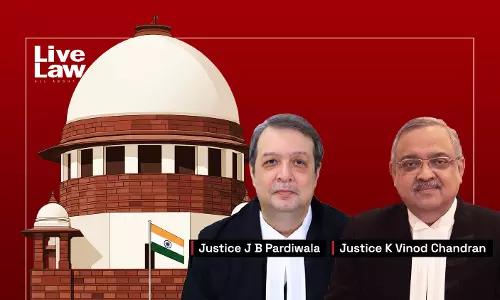
The Supreme Court on Tuesday (August 25) quashed the GST show-cause notice issued to Tata Steel Ltd. under Section 74 of the Central Goods and Services Tax Act, 2017, for alleged short payment of tax due to suppression of facts. A bench of Justice JB Pardiwala and Justice K Vinod Chandran called the department's invocation of Section 74 of the Act, rather than the ordinary mechanism...
SARFAESI | Earnest Money Deposit Shortfall Doesn't Vitiate Sale If 25% Sale Price Paid On Auction Day : Supreme Court
The Supreme Court has held that an auction sale under the Securitisation and Reconstruction of Financial Assets and Enforcement of Security Interest Act, 2002 cannot be set aside merely due to a shortfall in depositing of an earnest money deposit. The Court said that once the auction purchaser complies with the statutory mandate to deposit 25% mark of the sale price on the same day of...
Referral Charges Received By Auto Dealers For Bank & Insurance Promotion Subject To Service Tax : Supreme Court
The Supreme Court on Wednesday (August 19) held that the referral charges received by automobile dealers from banks and insurance companies for facilitating vehicle loans and insurance policies are taxable as “Business Auxiliary Service” under the Finance Act, 1994. “The assessee is promoting the business of the banks and the insurance company for which they receive an amount as...

From Risk Management To Business Strategy: Evolution Of Corporate Legal In India
For a long time, corporate legal departments were viewed as cost centres that were valued more for preventing issues than for producing results. That view is changing quickly. As businesses invest more in internal competence than in outside counsel, general counsel now sit alongside CEOs and boards as strategic decision-makers, evaluated on business performance measures rather than lawsuit results.What is causing this? Rapid technological innovation, the professionalization of legal operations...
Judicial Interference In Tender Process At Advanced Stage Not Warranted, Challenge Must Be Prompt : Supreme Court
Fence-sitters and unscrupulous litigants cannot disrupt ongoing tender process, the court said.
Supreme Court Flags Anomalies In Fixing Consumer Fora Jurisdiction Based On Consideration Paid, Seeks Centre's Response
The Supreme Court has flagged certain anomalies which can arise from the provisions of the Consumer Protection Act, 2019, if the pecuniary jurisdiction of the consumer fora is determined as per the value of consideration paid by the consumer for goods or services, and sought the response of the Union Government.Unlike the repealed 1986 Act, where the pecuniary jurisdiction of consumer...
Can Pre-Deposit Be Mandated To Invoke Arbitration? Supreme Court Refers To Larger Bench, Doubts 2009 Precedent
The Supreme Court on Monday (August 17) referred the question to a larger Bench as to whether pre-deposit conditions in arbitration clauses, requiring contractors to deposit a percentage of the claim amount before invoking arbitration, are valid. A bench of Justice Manoj Misra and Justice Manmohan expressed doubt about the binding nature of the three-judge Bench decision in S.K. Jain v....