



- Home
- /
- High Courts
- /
- Allahabad High Court
- /
- Hijab Not Essential Part Of Islamic...
Hijab Not Essential Part Of Islamic Faith: Allahabad High Court Dismisses Muslim Girl's Plea To Wear It With School Uniform
Sparsh Upadhyay
24 Aug 2026 9:48 PM IST
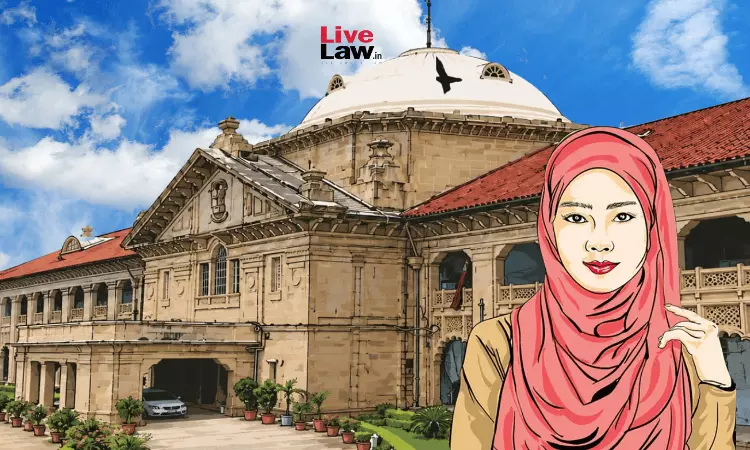
The Allahabad High Court last week dismissed a minor Muslim student's plea seeking permission to wear a Hijab (headscarf) with her school uniform, observing that the petitioner had failed to place sufficient material to establish that wearing a headscarf was an essential religious practice of the Islamic faith. A Bench of Justice JJ Munir and Justice Indrajeet Shukla also held that a...
This is a premium content
Available exclusively to
Our subscribers
Subscribe Premium 
INR 1099+GST
Your support helps us to bring you more content at
an affordable subscription scheme !!!
All payment options available
The Allahabad High Court last week dismissed a minor Muslim student's plea seeking permission to wear a Hijab (headscarf) with her school uniform, observing that the petitioner had failed to place sufficient material to establish that wearing a headscarf was an essential religious practice of the Islamic faith.
A Bench of Justice JJ Munir and Justice Indrajeet Shukla also held that a student cannot insist upon modifying a prescribed dress code where it is "uniform, bona fide, nondiscriminatory and intended to maintain discipline and institutional identity".
Importantly, the Court observed that it had "no reason" to take a different view from the Karnataka High Court's 2022 Full Bench judgment, which held that wearing hijab by Muslim women does not constitute an essential religious practice in the Islamic faith.
The Allahabad HC described the Karnataka Full Bench judgment as "persuasive authority of great value", while noting that it was subsequently considered by the Supreme Court in Aishat Shifa, where the Top Court delivered a split verdict.
The Bench noted that there is no authoritative Supreme Court pronouncement finally settling the issue.
Case in brief
The petitioner (Sukaina Rizvi) is a minor student at a private, unaided CBSE school named Tagore Public School in Attarsuiya, Prayagraj. She had passed Class X and sought admission to Class XI in the same school.
She moved the High Court through her mother, seeking a mandamus directing the school authorities to permit her to wear a headscarf "in addition to the uniform prescribed by the School for all their students”.
The girl claimed that she had studied in the school from Class VI to Class X and had worn a headscarf throughout that period without objection from the school. However, she alleged that the school was now refusing her admission to Class XI because she insisted on continuing to wear the headscarf.
It was her case that the donning of a scarf was an “essential religious practice” of her faith and precluding her from wearing it as part of her attire, was violative of her fundamental rights guaranteed under Articles 14 and 19(1)(a) of the Constitution.
The school, on the other hand, maintained that it was a private unaided, co-educational institution affiliated to the CBSE, with a uniform dress code applicable to all students.
It was the stance of the School's principal that other girls belonging to the same religious community were following the prescribed dress code and that granting the petitioner an exemption could affect the school's administration and discipline.
The State's counsel argued that prescription of a uniform is essentially a matter within the policy of the School administration, the purpose whereof is to uphold uniformity amongst students attending their institution.
High Court's observations
At the outset, the High Court rejected the argument that the petitioner's having worn a headscarf in earlier classes created an enforceable right to continue doing so.
"In the past, the School might not have raised objection to the petitioner wearing a headscarf when she was reading in the lower classes, either due to lethargy, inaction, lack of will, nonenforcement of the uniform policy, even courtesy or hesitation, but that would not give rise to an estoppel against the School when they decide to enforce a uniform policy, enforcing their dress code".
The Court clarified that the school had not even changed its uniform. Rather, the issue was the petitioner's insistence on adding a headscarf to the prescribed uniform. It held:
"…so long as the dress code is uniform, bona fide, nondiscriminatory and intended to maintain discipline and institutional identity, the choice of the prescribed uniform primarily lies within the domain of the School".
The Bench said a prescribed uniform serves several purposes, including discipline, equality amongst children, institutional identity and avoidance of distinctions within the classroom.
It further observed that a uniform applicable to students of different faiths promotes a “religion neutral atmosphere”.
On the argument that wearing a headscarf was an essential religious practice, the Court found the petitioner's case to be a "bare assertion", noting that there was no sufficient pleading or authoritative religious material establishing that wearing a scarf inside the classroom was obligatory upon the petitioner or that its non-observance would "alter the fundamental character of her faith".
Considering the verdicts of the various High Courts on this issue, the Bench further observed thus:
"Wherever this issue has arisen, the High Courts have been unanimous in opinion that wearing a headscarf is not essential part of the Islamic faith for a women to don, in the absence of which, faith would be jeopardized".
In particular, the Bench considered the Kerala High Court's decision in Fathima Thasneem (Minor) v. State of Kerala and the Bombay High Court's ruling in Fathema Hussain Sayed v. Bharat Education Society, both concerning students seeking to wear headscarves contrary to prescribed school uniforms.
It also considered, in detail, the Karnataka High Court's Full Bench judgment in Resham v. State of Karnataka, which had held that wearing hijab by Muslim women does not form part of an essential religious practice in Islam.
The Allahabad HC noted that Resham was subsequently considered by the Supreme Court in Aishat Shifa (Hijab Case-2 J.) v. State of Karnataka, wherein a split verdict was delivered.
The HC noted that the matter was consequently required to be placed before the Chief Justice for constitution of an appropriate Bench, however, as of now, no authoritative Supreme Court pronouncement has settled the issue.
The High Court nevertheless described the Karnataka Full Bench judgment as "persuasive authority of great value" and said that "there is no reason for us to take a different view".
The Court also considered a 2024 Bombay High Court ruling in Zainab Abdul Qayyum Choudhary & Ors. v. Chembur Trombay Education Society's NG Acharya and DK Marathe College and Ors.
It noted that the Supreme Court had subsequently passed an interim order staying the clause prohibiting Hijab, Cap or Badge in that case, but stressed that an interim order without reasons “is not a binding precedent” and is provisional in nature.
"The interim order of the Supreme Court does not give any reasons and is provisional in nature. Therefore, we are of opinion that the consistent, preponderant and reasoned opinion, coming from different High Courts in the country, would have precedential value albeit persuasive", the Division bench said.
The Court also noted that the photographs placed on record showed that, except for the petitioner, no other girl student, including those belonging to the same religious community, was wearing a headscarf.
The Bench observed that allowing individual students to depart from the prescribed uniform on subjective grounds would “militate against the idea of a uniform” and transfer the authority to determine school discipline from the institution to individual students.
The writ petition was ultimately dismissed.
Case title - Sukaina Rizvi vs. State of U.P. and others 2026 LiveLaw (AB) 618
Case Citation: 2026 LiveLaw (AB) 618
Tags

Sparsh Upadhyay
Sparsh Upadhyay is an Associate Editor with LiveLaw.

