



Allahabad High Court Sets Aside BJP MLA's Election From Nehtaur Over Defects In Nomination Affidavit
LIVELAW NEWS NETWORK
28 Nov 2026 5:43 PM IST
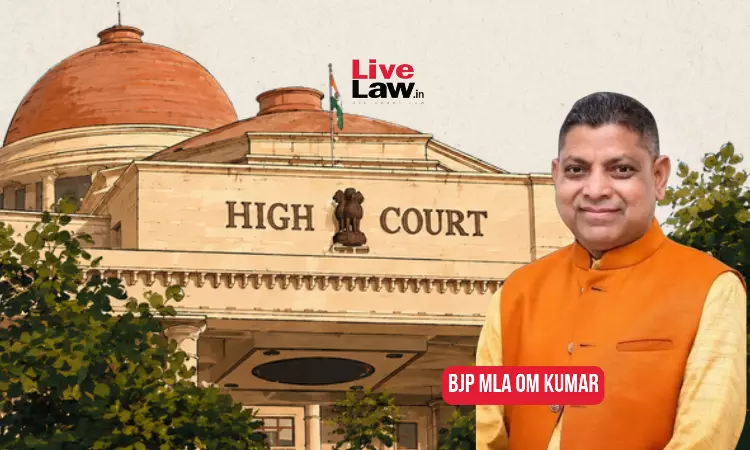
HC holds omission of four years' income details in Form 26 a substantial defect warranting rejection of nomination.
The Allahabad High Court has set aside the election of Bharatiya Janata Party (BJP) MLA Om Kumar from Uttar Pradesh's Nehtaur (Reserved-Scheduled Caste) Assembly Constituency, holding that his failure to disclose income shown in his income tax returns for four of the five financial years sought in Form 26 constituted a defect of substantial character.
Justice Salil Kumar Rai held that the omission required rejection of Kumar's nomination paper under Section 36(2) read with Section 36(4) of the Representation of the People Act, 1951.
The Court observed that a candidate's disclosure of assets and sources of income does not satisfy the separate statutory requirement to furnish income figures for five financial years.
The election petition was filed by Munshi Ram, the Rashtriya Lok Dal candidate who had lost to Kumar by 258 votes in the 2022 Assembly election. Kumar secured 77,935 votes against Ram's 77,677.
The petitioner challenged the acceptance of Kumar's nomination, alleging several omissions in his Form 26 affidavit. The returned candidate had disclosed his income for 2021-22 as ₹1,45,81,059 but left blank the columns requiring income details for the preceding four financial years, 2017-18 to 2020-21.


Form 26 is the affidavit required to be submitted along with a candidate's nomination paper under Section 33A(2) of the Act read with Rule 4-A of the Conduct of Elections Rules, 1961.
Rejecting the argument that Form 26 and the nomination paper are separate documents and that a defect in the affidavit could not invite rejection of the nomination, the Court held that Form 26 forms part of the statutory election framework.
Relying on the Supreme Court's decision in Kisan Shankar Kathore v. Arun Dattatray Sawant, the Court held that a nomination may be rejected under Section 36(2) for a defect of substantial character in Form 26, including where prescribed columns are left blank.
It also rejected the argument that the petitioner could not challenge the nomination because he had not raised an objection during scrutiny. The Court observed that Section 36(2) empowers the Returning Officer to reject a nomination on his own motion, and the legality of accepting a nomination cannot depend on whether an opposing candidate raised an objection.
The Court held that disclosure of income for the latest financial year could not amount to substantial compliance with the requirement to disclose income for all five financial years.
It observed:
"Thus, the requirement to furnish income particulars for five financial years is not an empty formality. Information concerning the income declared by a candidate in his income tax returns over a period of time, his assets and his sources of income is necessary to enable the voter to form an opinion as to how to exercise his franchise".
The Court added that disclosure of assets and sources of income could not substitute for specific income figures, as each requirement served a different objective.
It also rejected the argument that the missing particulars could be gathered from documents produced during the election trial, observing:
"Subsequent disclosure during trial cannot substitute for the statutory mandate of pre-election transparency, which exists to empower voters and uphold their right under Article 19(1)(a)."
The Court further held that a checklist issued by the Returning Officer certifying that the nomination papers were complete could not validate the acceptance of a nomination suffering from a substantial defect.
It observed that the obligation to furnish the prescribed information rested on the candidate and could not be made dependent on whether the Returning Officer noticed an omission.
"The right of voters under Article 19(1)(a) cannot be made dependent upon the action or inaction of the Returning Officer", the Court said, adding that an administrative checklist could not confer upon the Returning Officer the power to dispense with statutory disclosure requirements.
The Court also examined alleged defects in the affidavits of five other candidates. It held that the affidavits filed by two candidates did not suffer from defects of substantial character. However, the affidavits of three others, including omissions and failure to sign the prescribed pages, contained substantial defects requiring rejection of their nomination papers.
In particular, the Court observed that an unsigned affidavit was no affidavit, holding that the failure to sign every page rendered the affidavits nugatory.
However, it found that the improper acceptance of those three candidates' nominations had not been proved to have materially affected the election result.
Relying on the Supreme Court's decision in Madiraju Venkata Ramana Raju v. Peddireddigari Ramachandra Reddy, the High Court held that the improper acceptance of Kumar's own nomination materially affected the election result. It distinguished this situation from defects in the nominations of other candidates, whose impact on the result had to be independently established.
The Court rejected the petitioner's allegations of irregularities in the counting of VVPAT slips, postal ballots and electronically transmitted postal ballots, finding that they had not been established by cogent evidence.
It also declined to declare Munshi Ram elected in Kumar's place, holding that merely setting aside the returned candidate's election did not entitle the candidate who secured the second-highest votes to be declared elected.
Accordingly, the election petition was partly allowed and Kumar's election from the 21-Nehtaur Assembly Constituency was declared void and set aside. The prayers for recounting and for declaring the petitioner elected were rejected.


