



- Home
- /
- Top Stories
- /
- Surprising That NHRC Orders Inquiry...
Surprising That NHRC Orders Inquiry Into UP Madrasas But No Suo-Moto Action On Lynchings, Vigilantism: Allahabad HC's Justice Atul Sreedharan
Sparsh Upadhyay
29 April 2026 12:30 PM IST
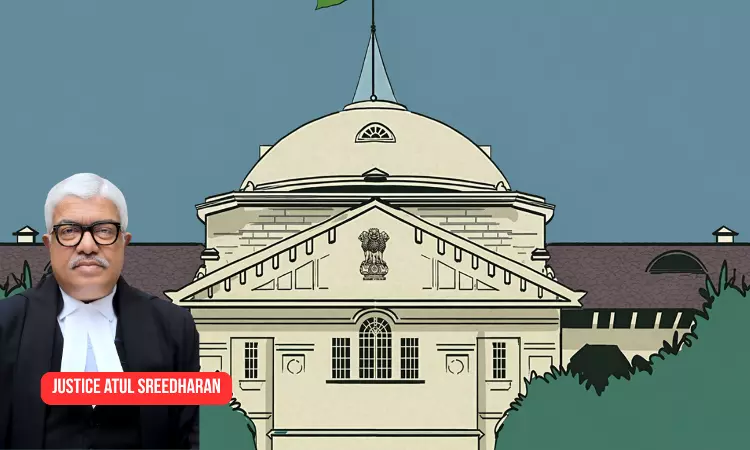
Justice Atul Sreedharan of the Allahabad High Court has strongly criticised the National Human Rights Commission (NHRC) for prima facie stepping outside its jurisdiction by directing an inquiry into allegations made against 558 aided Madrasas in the State of UP. Justice Vivek Saran, who was also part of the bench, however, disagreed with Justice Sreedharan's remark.For context, Justice...
This is a premium content
Available exclusively to
Our subscribers
Subscribe Premium 
INR 1099+GST
Your support helps us to bring you more content at
an affordable subscription scheme !!!
All payment options available
Justice Atul Sreedharan of the Allahabad High Court has strongly criticised the National Human Rights Commission (NHRC) for prima facie stepping outside its jurisdiction by directing an inquiry into allegations made against 558 aided Madrasas in the State of UP. Justice Vivek Saran, who was also part of the bench, however, disagreed with Justice Sreedharan's remark.
For context, Justice Sreedharan expressed surprise that while NHRC intervened in such a matter, it takes no suo-motu action in cases where the members of the muslim community are attacked or lynched and where cases are not registered against perpetrators or not investigated properly.
Observing that the 'National Human Rights Commission' and 'Uttar Pradesh Human Rights Commission' are 'dabbling' in matters that prima facie do not concern them, he had remarked thus:
"This Court is not aware of the NHRC taking suo-motu cognizance in situations where vigilantes take the law in their own hands and harass the ordinary citizens of this country or, harass individuals on account of the nature of relationship between persons of different communities or where even having a cup of coffee at a public place with the person of different religion becomes a fearful act".
#JustIn #AllahabadHighCourt criticizes @India_NHRC for directing #EOW to conduct an inquiry into 550+ aided Madrasas in UP while failing to take suo-motu cognizance of cases where members of the Muslim community are attacked or lynched. pic.twitter.com/laCQ9yNDEd
— Live Law (@LiveLawIndia) April 29, 2026
However, Justice Vivek Saran differed from this remark, observing that the NHRC was not represented before the Court, and the order was passed even when the petitioner was not arguing the case and had sought an adjournment.
"I am strictly of the opinion that if any order touching on the merits of the case or even touching on the role of the NHRC had to be passed, then all parties concerned ought to have been heard," he said.
Furthermore, he also added that while a writ court can pass an order even in the absence of any particular party, but in the instant case, when definite observations were being made, it would have been in the fitness of things that parties were properly represented in the Court.
"In the absence of the parties, no adverse observations were required," Justice Saran noted as he expressed disagreement with the views of Justice Sreedharan.
Contextually, the Court was dealing with a writ petition filed by the Teachers Association Madaris Arabia, which challenged the orders passed by the NHRC in February 2025, directing the EOW to inquire into allegations against 558 aided Madrasas in the State of UP.
In the complaint before the NHRC, it was alleged that the Madarsas were operating in collusion with officers of the Minority Welfare Department and were receiving government grants without meeting the required standards.
It was also alleged that uneducated teachers were being recruited through bribes and commissions offered to State authorities.
The petitioner before the HC contended that the Commission is not empowered to order an inquiry into alleged human rights violations more than 1 year after the alleged incident.
Notably, in September last year, the HC stayed the NHRC order.
Now, on Monday, when the matter was again taken up, the bench examined the order of the NHRC and stated that it was prima facie 'astounded' by the Commission's actions.
Perusing Section 2(1)(d) of the Protection of Human Rights Act, 1993, the bench said that the NHRC and State Human Rights Commissions must realize they are not tribunals under the law which can try cases.
Justice Sreedharan added that while they can become complainants before a competent court or get an FIR registered if they feel intervention is necessary to protect citizens, it was doubtful whether such directions could be passed to executive officers in cases where human rights are not involved.
Consequently, Justice Sreedharan categorically expressed 'surprise' that the Human Rights Commissions in the country are trying to indulge in matters which should otherwise have been agitated before the High Court under Article 226 by way of PIL, if need be, for appropriate orders.
"Instead of taking suo-motu cognizance in which members of the muslim community are attacked and at times lynched in some cases, and where cases are not registered against perpetrators or not investigated properly, the Human Rights Commissions are seen dabbling in matters that prima facie do not concern them...In such cases, no instance has been placed before this Court whether the State Human Rights Commission or the National Human Rights Commission took suo-motu cognizance. But instead it has the time to entertain matters which would fall within the precincts of the High Court under Article 226 and which could be effectively render justice," the bench observed.
Justice Sreedharan was also of the prima facie view that the NHRC had gone ahead and accepted the complaint in a case where no human rights violation was involved. The bench further issued notice to the NHRC and extended the interim order passed earlier (staying the impugned order of NHRC).
The matter has now been posted for a final hearing on May 11, 2026, along with connected cases.
Click Here To Read Download Justice Sreedharan's Observations
Tags

Sparsh Upadhyay
Sparsh Upadhyay is an Associate Editor with LiveLaw.

