



- Home
- /
- High Courts
- /
- Allahabad High Court
- /
- Registration Act | Writ Court Can't...
Registration Act | Writ Court Can't Conduct Full-Fledged Trial To Decide Fraud Allegations Over Land Agreement: Allahabad High Court
Upasna Agrawal
23 Oct 2026 3:15 PM IST
The Allahabad High Court has held that allegations of fraud and fabrication, however serious, do not permit a writ court under Article 226 of the Constitution of India to act as a court of first instance by recording oral evidence, testing the credibility of witnesses and deciding disputed questions of fact. It held that where a statutory authority has reached its conclusion on the...
This is a premium content
Available exclusively to
Our subscribers
Subscribe Premium 
INR 1099+GST
Your support helps us to bring you more content at
an affordable subscription scheme !!!
All payment options available
The Allahabad High Court has held that allegations of fraud and fabrication, however serious, do not permit a writ court under Article 226 of the Constitution of India to act as a court of first instance by recording oral evidence, testing the credibility of witnesses and deciding disputed questions of fact.
It held that where a statutory authority has reached its conclusion on the material before it and the substantive rights of the parties are already pending before a civil court, interference must be exercised with restraint.
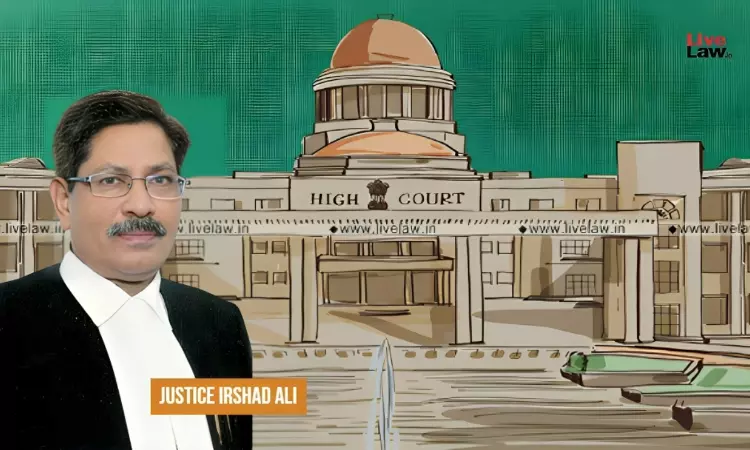
Justice Irshad Ali held,
“The Court is conscious that the petitioners have made serious allegations of fraud, fabrication and misuse of signatures. Such allegations are undoubtedly serious. However, the seriousness of an allegation does not, by itself, convert the writ court into a court of first instance for recording oral evidence, testing the credibility of witnesses and deciding disputed questions of fact. Where the statutory authority has recorded its conclusion on the basis of material placed before it and the substantive rights of the parties are also pending consideration before the Civil Court, interference under Article 226 must be exercised with restraint.”
Petitioners' father, late Chotey Lal, held land near the Faizabad-Allahabad road at Gram Pure Husain Khan, Tehsil and District Faizabad. Their case was that when he needed money he took a loan of Rs. 40,000/- from opposite party no.5, who obtained his signatures on stamp papers without disclosing their purpose. The papers, it was pleaded, were never returned after the loan was repaid and were converted into an agreement to sell dated 30.04.1989 in favour of opposite party no.4, a trust, covering fourteen plots of a consolidated area of 5-11-07.
The Sub-Registrar refused registration on 24.01.1990. The trust appealed to the District Registrar under Section 72 of the Registration Act, 1908 in Case No.1 of 1990. Chotey Lal objected that Section 72 was unavailable because registration had been refused on his denial of execution, and that he had never executed any agreement. He died on 20.09.1995 and his heirs were substituted on 12.01.1998. By order dated 30.03.2017 the District Registrar held execution proved and directed registration of the document on its presentation.
Before the High Court the petitioners argued that the appeal lay under Section 73 and not Section 72, and that the registering authority had decided disputed execution as if it were a civil court. They also complained that the order had come while the proceedings were at the stage of evidence.
Respondent nos.4 and 5 submitted that the finding on execution did not rest on the document alone. The marginal witnesses, Jagdamba Prasad Pandey and Ram Jas, had supported execution and a handwriting expert, by opinion dated 05.02.2004, had found the disputed signature to be that of Chotey Lal. They also relied on permission for sale obtained by Chotey Lal after the agreement and on a registered declaration dated 30.08.2016 by one of his sons acknowledging execution.
The Court declined to accept the objection to maintainability in the absolute terms in which it was pressed, holding that Sections 71 to 75 had to be read as a whole along with the substance of the proceedings and the jurisdiction actually exercised.
“Even assuming that there was some defect in the description or reference to the statutory provision under which the proceedings were initially instituted, such defect by itself would not render the ultimate order void unless the petitioners establish that the authority lacked substantive jurisdiction to entertain the dispute arising from the refusal of registration or that the petitioners suffered substantial prejudice on account of the alleged procedural error.”
On the authority entering upon the question of execution, the Court held,
“There can be no quarrel with the proposition that registration proceedings cannot be converted into a plenary adjudication of complicated questions of title, ownership or ultimate enforceability of an agreement. However, in the facts of the present case, the question of execution of the document was directly relevant to the statutory issue of registration and the authority could not have decided the appeal without examining the material bearing upon such execution.”
The Court held that it was not ordinarily required to re-weigh evidence as if sitting in appeal over a statutory authority's factual findings, and that interference was not warranted merely because another view was possible. The petitioners had not shown the expert opinion or the marginal witnesses' evidence to be irrelevant or inadmissible, and the missing photograph on the document and the allegedly interested character of the witnesses went to evidentiary weight alone, held the Court.
Rejecting the plea of breach of natural justice, the Court noted that the parties had participated over a prolonged period, objections had been filed and evidence brought on record, and the petitioners had not identified what material they were prevented from placing before the authority.
“It is settled that principles of natural justice are intended to secure a fair opportunity and not to create an endless procedural process. The right of hearing does not include a right to insist that the authority must accept the version of the party heard.”
Accordingly, the writ petition was dismissed and the order dated 30.03.2017 affirmed, the Court accepting that registration does not by itself adjudicate title or grant specific performance. The Court clarified that this was not a final adjudication on the validity, enforceability or specific performance of the agreement or on the title of the parties, which the civil court would decide on its own merits.
The interim order of status quo dated 22.05.2017 was vacated. Regular Suit No.646 of 2017, for specific performance, was expected to be concluded preferably within eight months of the appearance of the parties and production of a certified copy of the order.
The Court also clarified that nothing in the judgment would affect the independent claim of the intervenor, who asserted title to 9 biswa of Gata No.367 Minjumla under a registered sale deed dated 17.08.1992.
Counsel for Petitioner(s) :- Anurag Srivastava, Jyotindra Prakash Pathak, Laxmi Kant Pathak, Mohammad Danish, Mohd. Mansoor
Counsel for Respondent(s) :- C.S.C., Anit Vishal Srivastav, Mohammad Ehtesham Khan, Pooja Pandey, Pradeep Kumar Singh
Tags


