Husband Can't Be Rewarded For His Own Bad Conduct: Chhattisgarh High Court Sets Aside Divorce Decree After Wife Left Home Due To Abuse
Saksham Vaishya
28 Nov 2026 2:50 PM IST
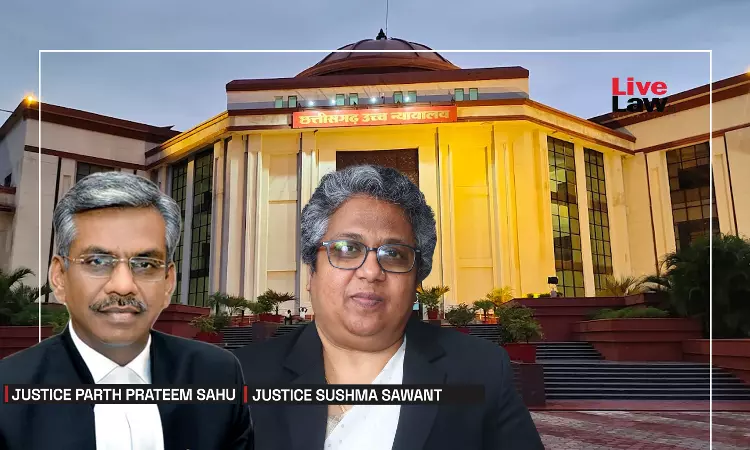
The Chhattisgarh High Court has set aside a divorce decree granted to a husband after finding that his wife had left the matrimonial home due to his habitual intoxication, abuse and physical assault. The Court held that a spouse who compels the other to live separately through their own cruel conduct cannot be granted divorce by treating that separation as cruelty committed by the other spouse.
A Division Bench of Justice Parth Prateem Sahu and Justice Sushma Sawant was hearing an appeal filed by the wife, challenging the Family Court's decree dissolving her marriage under Sections 13(1)(i-a) and 13(1)(i-b) of the Hindu Marriage Act, 1955, on the grounds of cruelty and desertion.
The husband alleged that the wife had voluntarily left the matrimonial home in September 2022, refused to resume cohabitation despite repeated efforts, and subjected him to mental cruelty.
The wife, however, alleged that her husband was addicted to alcohol and other intoxicants and would abuse and assault her whenever she objected to his habits. She further claimed that her husband continued to assault her despite being admitted to a de-addiction centre, and that she had sought police assistance following an assault in October 2020.


The Family Court had rejected the husband's claim of desertion, finding that the wife had sufficient reason to live separately. However, it still granted him divorce on the ground that her continued separate residence amounted to cruelty.
The High Court noted that the Family Court itself had taken into account the husband's addiction to intoxicants, the medical record documenting an assault, and the husband's mother's admission that he had assaulted the wife. It observed that the husband had not approached the Family Court with clean hands and had attempted to suppress material facts.
The Bench observed that the husband's regular return home in an intoxicated condition, coupled with abuse and assault, provided sufficient cause for the wife to live separately with their minor child.
“… conduct of the respondent/husband of coming into home under intoxicated conditions regularly abusing, harassing, and assaulting the appellant/wife, based upon which criminal case was also registered, is sufficient to show that it is not the respondent/husband, who was being treated with cruelty but act of respondent/husband against appellant/wife to be cruel which gives cause and reason to the appellant/wife to reside separately from her husband along with minor child,” the Court remarked.
The Court further held that though the Family Court appropriately took the above facts into consideration, it contradicted its own finding on desertion by subsequently treating the wife's separate residence as cruelty.
“… the learned trial Court… erroneously considered separate residence of appellant/wife to be act of cruelty. The said finding recorded by learned Family Court is contradictory to the finding recorded to the Issue No.1, which is not sustainable,” the Court observed.
The Court further observed that whether a spouse had been subjected to cruelty must be determined by evaluating the pleadings and evidence in their entirety, rather than isolating individual statements or instances.
“The spouse treated with cruelty is to be ascertained upon evaluating the pleadings and the evidence in its entirety. By taking any instance in isolation or one sentence of evidence or pleading recording conclusion and finding would not be correct and lawful,” the Court held.
The Court clarified that where one spouse is compelled to leave the other for valid and compelling reasons, such separate residence cannot be treated as cruelty by the spouse who leaves. Rather, the conduct compelling the separation may itself amount to cruelty.
Accordingly, the High Court allowed the wife's appeal and set aside the Family Court's judgment and decree dated November 27, 2024.
Case Title: Varsha Sahu v. Rajesh Kumar Sahu [FA(MAT) No. 436 of 2024]