



- Home
- /
- High Courts
- /
- Delhi High Court
- /
- Liquor Policy: Delhi High Court...
Liquor Policy: Delhi High Court Grants Last Opportunity To Arvind Kejriwal, Others To Respond To ED's Plea Against 'Adverse Remarks'
Nupur Thapliyal
2 April 2026 1:38 PM IST
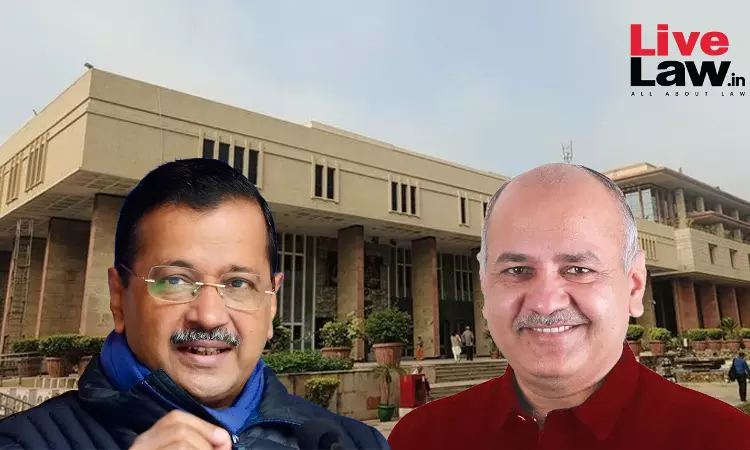
The Delhi High Court on Thursday granted last opportunity to AAP leaders Arvind Kejriwal, Manish Sisodia and various others to respond to ED's plea seeking expunging of certain adverse observations made by a Special Court while discharging them in the excise policy corruption case.Justice Swarana Kanta Sharma asked the respondents to file the responses within a week, failing which their right...
This is a premium content
Available exclusively to
Our subscribers
Subscribe Premium 
INR 1099+GST
Your support helps us to bring you more content at
an affordable subscription scheme !!!
All payment options available
The Delhi High Court on Thursday granted last opportunity to AAP leaders Arvind Kejriwal, Manish Sisodia and various others to respond to ED's plea seeking expunging of certain adverse observations made by a Special Court while discharging them in the excise policy corruption case.
Justice Swarana Kanta Sharma asked the respondents to file the responses within a week, failing which their right to file reply shall be closed.
At the outset, ASG SV Raju appearing for the agency said that only one person (Vinod Chauhan) had filed the reply. He said that while one more individual had filed the response but no copy was served upon ED.
Noting that others had chosen not to reply despite an opportunity was given to them on March 19, the Court said:
“The respondents were granted time on March 19 (to file replies). However, they still need time. Last opportunity is granted for filing replies within one week failing which the opportunity to file the reply will be closed.”
The Court also called for the trial court records and listed the matter for hearing next on April 22.
ED has said that it was not a party to the CBI proceedings in any capacity, and was not afforded any opportunity to be heard before the adverse observations were recorded. As per the agency, the situation is “flagrantly violating the fundamental principles of natural justice and judicial decorum.”
“If such sweeping, unguided, bald observations are permitted to stand, which have been passed behind the back of the Enforcement Directorate based on pure conjectures, without anchoring itself on any material or evidence gathered by the Enforcement Directorate since the Court was not concerned with the prosecution complaints filed by the Enforcement Directorate while making these observations, grave and irreparable prejudice would be caused to the public at large as well as the petitioner herein,” the plea states.
For context, the trial court had observed that if investigative agencies such as the CBI or ED were permitted to enter the electoral arena merely on allegations of “cash spending”, “illegal funding”, or “unaccounted expenditure”, the inevitable consequence would be the criminalisation of electoral competition.
“The position is no different, and indeed more restrictive, under the PMLA. The statute cannot be set in motion in a vacuum. It is predicated on the prior existence of a scheduled offence and the generation of “proceeds of crime” therefrom,” the trial court had said.
It had also said that investigations by the State police, the CBI, or the Enforcement Directorate cannot be initiated or sustained solely on allegations of election-funding irregularities and excess expenditure.
The trial court had also observed that PMLA, amongst other enactments, cannot be employed as a substitute for election-law remedies, nor as a device to convert political accusations into prosecutable offences, unless a clear, independent, and cognisable criminal offence, wholly distinct from election-law violations, is prima facie disclosed in accordance with law.
ED says that the paragraphs which concern the investigation independently conducted by the ED under the PMLA deserve to be expunged as it amounts to a “clear case of judicial overreach.”
The agency has said that the observations were made by the special judge without looking at the evidence gathered by it and without even affording it an opportunity of hearing.
The agency has argued that the Special Court was only concerned with whether charges were made out in the CBI case and had no occasion to comment on the separate PMLA investigation.
It has submitted that such remarks, if allowed to remain, would cause serious prejudice to the ED's ongoing proceedings and amount to judicial overreach.
On February 27, the trial court discharged all the 23 accused persons in the case, including political leaders Kejriwal, Sisodia and K Kavitha.
All who have been discharged are Kuldeep Singh, Narender Singh, Vijay Nair, Abhishek Boinpally, Arun Pillai, Mootha Gautam, Sameer Mahendru, Manish Sisodia, Amandeep Singh Dhall, Arjun Pandey, Butchibabu Gorantla, Rajesh Joshi, Damodar Prasad Sharma, Prince Kumar, Arvind Kumar Singh, Chanpreet Singh, K Kavitha, Arvind Kejriwal, Durgesh Pathak, Amit Arora, Vinod Chauhan, Ashish Chand Mathur and Sarath Reddy.
Case TItle: ED v. Kuldeep Singh & Ors

Nupur Thapliyal
Nupur Thapliyal is a Principal Correspondent with LiveLaw, based in New Delhi. She reports from the Delhi High Court and trial courts in the national capital

