CJP Leaders Saurav Das, Ashutosh Ranka Withdraw From Delhi High Court Plea Challenging Judicial Custody
Nupur Thapliyal
21 Oct 2026 1:45 PM IST
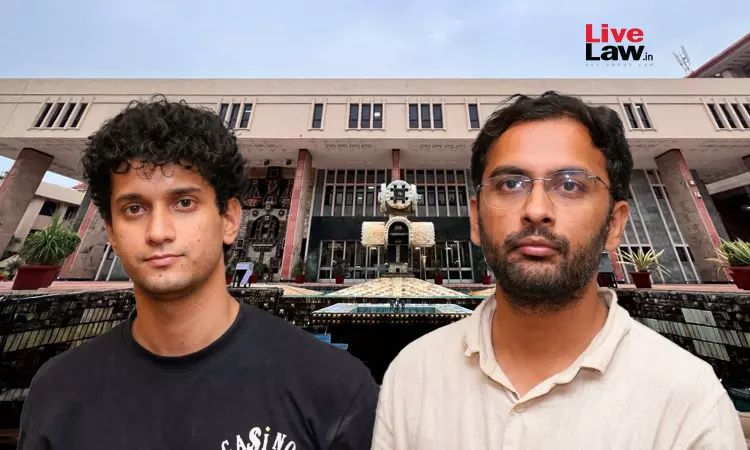
Cockroach Janta Party (CJP) leaders Saurav Das and Ashutosh Ranka today withdrew from Delhi High Court their plea challenging an order passed by Special Executive Magistrate Court extending their judicial custody by two more days, in connection with anti-CEC protests.
The withdrawal comes after Justice Subramonium Prasad expressed disinclination to entertain their writ petition, in view of availability of alternative remedy.
"Liberty is sacrosanct. But if the Code provides for remedy… when there is already provision available," the judge said during the hearing.
Significantly, Das and Ranka will be produced before SEM Court as their two days judicial custody expires today. In this backdrop, Justice Prasad orally told the petitioners, "Would it not be better for you to withdraw this, see what happens at 2 PM and then follow the course of law."


Eventually, the Court permitted withdrawal of the petition without making any opinion on merits.
The case involves alleged violation of earlier peace bonds executed by them by attempting to unfurl the national flag at Jantar Mantar in breach of prohibitory orders.
The two were earlier remanded to five days of judicial custody by Executive Magistrate Mahesh Kumar Meena on October 14. The matter was listed for further proceedings on October 19 on which date the petitioners' judicial custody was extended by two days.
Advocate Abhik Chimni appearing for Das and Ranka argued that he is seeking setting aside of October 19 order issued by the SEM. The court orally noted that the allegation against the petitioners was that they had broken bond by going to Jantar Mantar, which was de-notified as a protest site on October 11.
The court said that it will go into correctness of breaking of bail bond later, however questioned whether insistence on a surety by SEM can be termed as illegal. The court further orally noted that the challenge to Jantar Mantar's de-notification is pending before the Supreme Court and the notification is not yet stayed.
Noting that the petitioners went to Jantar Mantar and broke a barricade, the court remarked that in such a situation chances of 10-20 more people joining is "bright".
"I am not saying good bad or anything. There might be persons not in your control and they do things. You could have started with something you say is peaceful. For that purpose you take police permission which is to prevent unwanted persons who join your group and spoil your name," the court orally said.
It also noted that when the cause of an organisation keeps changing, the factual scenarios assume relevance while dealing with liberty of its members. Referring to the GenZ protests in July against NEET paper leak in which the duo was involved, the Court noted that Das and Ranka are aged 27 and 31 years, respectively, and they are not GenZ.
"Then you are not GenZ. What age of people are millennials? It was student protest, Children were there but now its another cause. People remain same but cause is changed. Next question is who are you? What is your association? What is purport of the association? When there is apprehension of breach of peace and tranquility, all this questions will assume importance. Whether such group of persons whose causes keep on changing…the question is when magistrate goes into question of breach of tranquility, such questions are to be considered. Keep the debate in an appropriate proceeding, not now when the issue is only insistence on bond".
The court said that the petitioners had broken a bond and hence their remedy lies in revision, remarking that there is a "difference between maintainability and entertainability" of a writ petition.
It further questioned that if the SEM's order was revisable, why had the petitioners invoked Article 226 jurisdiction. Chimni however questioned the effect of violation of a personal bond by the petitioners on the exercise under Section 135(3) BNSS.
For context, the provision permits a magistrate during an inquiry, to direct a person to execute an interim peace bond if immediate prevention of a breach of peace, public disorder, or an offence is necessary.
The court meanwhile suggested that it would be better for the petitioners to withdraw the petition and take a decision after production of the petitioners before SEM's court later today.
It orally said that the reason for which the first bond was invoked had come true–i.e., that the petitioners have a "tendency to break peace"– which the petitioners had done by going to Jantar Mantar. It further asked whether the authorities were not right in putting the petitioners to a stricter rule.
Chimni however pressed that the custody was not sustainable at all. He argued that the SEM's order had a finding that test of violation of public order was fulfilled.
The court said that if the petitioners get a relief in their favour from the SEM's court today, then the issue will be closed. If not, then the petitioners can file a revision tomorrow.
However Chimni said that rejection of petitioners' surety is bad in law and sought their release on furnishing personal bond. The court asked if the petitioners were furnishing fresh sureties today and whether the rejection of sureties is an appealable order. Chimni however insisted that the sureties were rejected arbitrarily.
Chimni said that if the petition is withdrawn today, and if their sureties are rejected today the petitioners will have to come back again. He urged that preventive custody cannot be applied in an arbitrary manner.
To this the court said that while liberty is sacrosanct but the BNSS provides for a remedy in such cases. It further said that in cases of preventive detention, the appropriate remedy is a habeas corpus petition, emphasizing that preventive custody and preventive detention are different.
Chimni said that the October 19 order does not give an explanation on "imminent threat" posed because of which judicial custody was necessary. He said that SEM's order only states that the magistrate has heard the State and there is an apprehension but does not give any reason.
The court at this juncture asked whether violation of first bond is not imminent enough. Chimni responded that the petitioners were not habitual offenders. The court however said that the petitioners had breached a bond they gave on October 11 to maintain peace.
It further said that an appellate court can go into facts only in an appeal but in a writ petition the court can only go into decision making process and not the decision itself.
After some time, Chimni on instructions, withdrew the petition which was permitted.
Background
The petitioners' were apprehended at an airport on October 10 and were subjected to preventive proceedings under Sections 126 and 170 BNSS ahead of the protests announced in Delhi against the Chief Election Commissioner.
While extending their judicial custody, Special Executive Magistrate Ritu Raj in its October 19 order observed that the respondents had deliberately breached their bonds and immediately committed a breach of peace.
The court said the grounds of apprehension presented by the investigating officer raised concerns about the respondents' alleged habitual conduct of calling protests at de-notified areas. It added that their assurance before the court that they would not repeat the alleged conduct did not inspire confidence, in view of the material placed on record by the police.
The court had also directed the respondents to furnish fresh sureties after finding that the sureties produced before it were unfit to stand as sureties. The order noted discrepancies between the photographs on the bond documents and the Aadhaar cards of the sureties, as well as their inability to provide satisfactory answers during the inquiry.
(Compiled by Malavika Prasad)