



- Home
- /
- High Courts
- /
- Delhi High Court
- /
- 'Litigant Can't Dictate How Judge's...
'Litigant Can't Dictate How Judge's Children Live': Justice Sharma On Kejriwal Citing Her Children's Appointment As Govt Counsel
Nupur Thapliyal
20 April 2026 8:18 PM IST
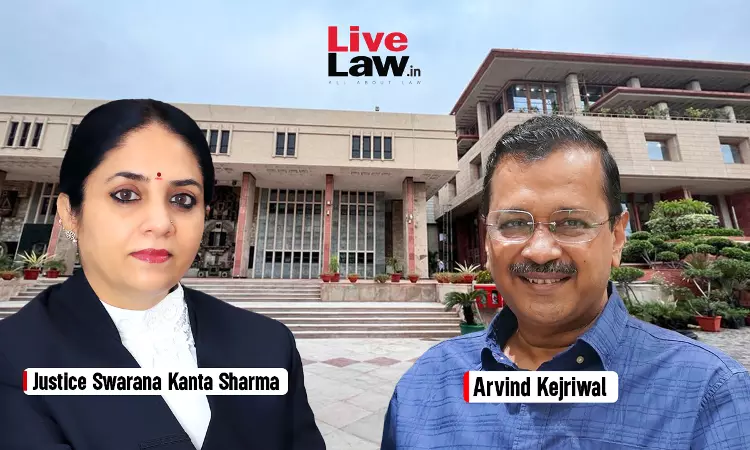
Delhi High Court's Justice Swarana Kanta Sharma while dismissing AAP supremo Arvind Kejriwal's plea seeking her recusal from the liquor policy case on the ground that her children are central government panel counsel, observed that a litigant cannot dictate how children of judges live their lives in absence of any proof that the office of the judge has been misused. Kejriwal had argued that...
This is a premium content
Available exclusively to
Our subscribers
Subscribe Premium 
INR 1099+GST
Your support helps us to bring you more content at
an affordable subscription scheme !!!
All payment options available
Delhi High Court's Justice Swarana Kanta Sharma while dismissing AAP supremo Arvind Kejriwal's plea seeking her recusal from the liquor policy case on the ground that her children are central government panel counsel, observed that a litigant cannot dictate how children of judges live their lives in absence of any proof that the office of the judge has been misused.
Kejriwal had argued that a number of cases were marked to Justice Sharma's children by the Solicitor General, who appeared for the CBI in the liquor policy cases.
Justice Sharma today said that her children's empanelment had no connection with the dispute.
"CBI stated that neither of relatives of this court appeared or were connected with excise policy case before any court in any capacity. Even if relatives are empaneled on govt panels, the litigant has to show relevance and impact on this case. No such nexus has been shown. Their empaneled or relationship has no connection with this dispute," the judge said while pronouncing her order in the open Court.
The Court added that merely because she's a judge, her children cannot be debarred from pursuing the legal profession of advocacy.
"A litigant can't dictate how children of judge have to live their lives, in absence of any proof that office of judge was misused. If children of politicians can enter politics, how will it be fair to question when children or family of judge enter legal profession and struggle and prove themselves like others...Relatives of this court have no connection with this dispute. They have no proximity to the lis...if such allegation is accepted, then the court will not be able to hear any matter in which Union of India is a party...Such insinuation is not only unfounded but also overlooks judicial office and integrity attached to it".
Portrayal of conflict of interest in present case
On whether any conflict of interest has arisen in the matter on the allegation that Justice Sharma's children are central government counsel, the court said that on one hand there is an actual conflict of interest. On the other hand, it is projected in a manner so that everybody feels that there is a conflict of interest.
In the present case, Justice Sharma said, it had been "portrayed" that there was a conflict of interest, which was not the case at all.
The court further said:
"A litigant cant be permitted to create situation that lowers judicial process. It can't be assumed from remote circumstances. It must rest on tangible materials with clear connection with lis. A lie even if repeated thousand times in court or social media doesn't become a truth. Truth doesn't lose its strength merely because falsehood is repeated".
The court further remarked that Solicitor General of India did not allot cases only to her children but also to other panel lawyers of the Central Government. It further remarked that the court was being selectively targeted and that Kejriwal had taken contrary stands in his affidavits.
For context, the high court took on record earlier today Kejriwal's rejoinder opposing CBI's stand that Justice Sharma's children never dealt with liquor policy cases. Kejriwal has claimed that the "conflict arises not from prior participation in the present proceedings, but from the admitted existence of a live, active and ongoing professional relationship with the prosecuting side..."
Litigant's general unease over not getting relief no ground to allege bias
On submissions made by the applicants, including Kejriwal, that 'justice should not only be done but should also be seen to be done', the court questioned as to who decides the appearance of justice being done.
"A litigant may not always be successful and only higher court can determine whether judgment is contrary or one sided. A judgment of district court can be upheld by HC and same thing for High Court which will be seen by Supreme Court," the court remarked.
It however said that a litigant's "general unease" that the court may not grant relief, cannot be a ground for alleging bias against the judge.
Pointing to her career which expands over 30-years, Justice Sharma said that she has "undergone every test" before she became a judge, and she was tested me on legal issues and also ethically throughout her career-span.
Justice Sharma however questioned if judges have to now pass "additional tests put by a litigant".
"Judges have to then satisfy manufacture test that they have not attended any social or legal function or their families work in legal profession. High Court judge can be judged on personal belief or misbelief of a litigant. A judge can't abandon judicial responsibility in face of allegations. Personal attacks on judge are attacks on institution itself," the court said.
Case title: CBI v/s Kuldeep Singh & Others
Case No.: CRL.REV.P.-134/2026
Litigant can't dictate how children of judge have to live their lives, in absence of any proof that office of judge was misused : Justice Swarana Kanta Sharma. https://t.co/9ykaJ0T6l3
— Live Law (@LiveLawIndia) April 20, 2026


