



- Home
- /
- High Courts
- /
- Delhi High Court
- /
- Many Judges Would Have To Recuse If...
Many Judges Would Have To Recuse If Children Being Central Govt Counsel Is Accepted As Ground Of Bias: Delhi High Court
Nupur Thapliyal
22 April 2026 10:06 AM IST
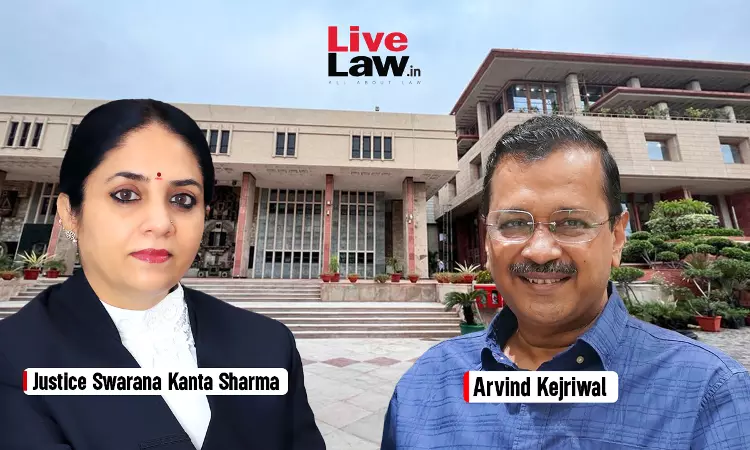
Justice Swarana Kanta Sharma made this observation rejecting Arvind Kejriwal's recusal application.
The Delhi High Court has observed that many judges would have to recuse from hearing matters if their children's empanelment as lawyers on government panel is accepted as a ground of bias raised by a litigant.Justice Swarana Kanta Sharma made the observation while rejecting the application filed by Aam Aadmi Party Chief Arvind Kejriwal seeking her recusal from hearing the liquor policy...
This is a premium content
Available exclusively to
Our subscribers
Subscribe Premium 
INR 1099+GST
Your support helps us to bring you more content at
an affordable subscription scheme !!!
All payment options available
The Delhi High Court has observed that many judges would have to recuse from hearing matters if their children's empanelment as lawyers on government panel is accepted as a ground of bias raised by a litigant.
Justice Swarana Kanta Sharma made the observation while rejecting the application filed by Aam Aadmi Party Chief Arvind Kejriwal seeking her recusal from hearing the liquor policy case.
Kejriwal alleged that there was a conflict of interest of Justice Sharma in the case, as a large number of cases had been marked by the Central Government to her two children, who are in the panel of Govt counsel, in the last three to four years.
Rejecting the said allegation of bias, the Court said:
“This Court wonders that if the test of “apprehension bias‟ relates to whether the children or spouses of judges are empanelled by the Central Government, the Judge should not hear such cases, then a large part of the judiciary, from the District Courts to the highest Court, would have to recuse from hearing such matters.”
Justice Sharma said that even if her relatives are empanelled on Government panels, Kejriwal was still required to show the proximity, relevance, and impact of such empanelment on the case in hand or on the decision-making power of the Court.
The Court said that no such nexus was shown by Kejriwal and that independent professional engagements of her children have no connection whatsoever with the dispute, nor do they create any financial or personal stake of the Court in the outcome of the proceedings.
Regarding the social media campaign on the issue, Justice Sharma said :
“This Court, having served as a Judge for nearly thirty-four years, is adequately trained to pay little heed to what may be said on social media, whatever be the intent or motive behind it. Although, when such campaigns are sought to be brought into judicial proceedings to cast aspersions on the integrity of a Judge, the Court may take note of the seriousness of such attempts, yet judicial decisions are rendered on the basis of law and the record before it, not on social media perceptions."
Justice Sharma added that a litigant cannot dictate how the children or family members of a Judge are to live their lives, whether they must rise through their own struggles and hard work, or whether they should be prevented from doing so.
The Court concluded that in the absence of any proof beyond doubt that the office of the Judge has been misused for the benefit of her children or family, even a whisper of such allegations cannot be permitted.
“In the absence of any bias or doubt regarding their integrity or ability, how can anyone question this? If the sons or wives of politicians can become politicians, there have also been instances at the Bar which have produced stellar judges who were themselves the children of politicians, yet not a single finger has been raised regarding their bias,” the Court said.
“Therefore, if the wife of a politician can be a politician without having to explain her expertise or experience in that field, and if the children of politicians can enter politics, how would it be just to question the children of a Judge who study like others, struggle like others, and prove themselves in Court like others to earn their livelihood? Accepting such an argument would mean taking away the fundamental rights of the family members of judges, as if merely because their parent is a Judge, their spouse is a Judge, their sibling is a Judge, they can never enter the legal profession,” the Court added.
Justice Sharma also said that empanelment as a Government counsel is a professional engagement and nothing more and a Judge cannot be judged on the basis of the independent professional choices of family members who are not even connected with the lis.
While clarifying that her children have no connection with the liquor policy case, Justice Sharma said that accepting Kejriwal's submission would mean that only because her relatives are empanelled on a Central Government panel, she should never hear any matter in which the Union of India is a party, or where the Solicitor General appears on behalf of the Union or any of its departments etc.
“Thousands of cases before constitutional courts involve the Union Government or the State Government in one form or another. Similarly, in criminal cases, the State is invariably a party to the lis. By that logic, even if a relative is empanelled by the State Government on the civil side, or say as a prosecutor before the Trial Court, the Judge would be expected never to sit on the criminal roster in the High Court at all, since the same Government also appears through the State in all criminal proceedings,” the Court said.
Title: CBI v. Kuldeep Singh & Ors
Tags

Nupur Thapliyal
Nupur Thapliyal is a Principal Correspondent with LiveLaw, based in New Delhi. She reports from the Delhi High Court and trial courts in the national capital

