



Awarding Government Contract Without Inviting Tenders Can Amount To Criminal Misconduct: J&K&L High Court
LIVELAW NEWS NETWORK
24 Nov 2026 2:40 PM IST
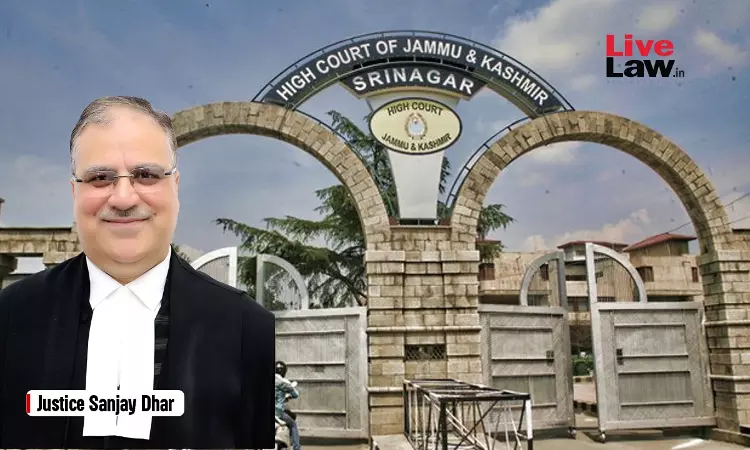
The Jammu & Kashmir and Ladakh High Court has held that public servants who abuse their official position to confer an undue pecuniary advantage upon a private party by awarding a government contract without inviting open tenders can be prosecuted for criminal misconduct, even where the alleged benefit is conferred upon a third party rather than upon the public servants themselves.
Dismissing a petition filed by former Jammu Development Authority (JDA) officials and a private contractor seeking quashing of a corruption case, Justice Sanjay Dhar observed that the officials had cancelled an earlier tendering process, under which another firm had emerged as the lowest bidder, and subsequently awarded the work to the private contractor without inviting fresh tenders.
The Court held that public authorities cannot distribute contracts or other forms of State largesse at their discretion like private individuals. They are legally obligated to ensure open competition among eligible contractors and adhere to standards that are neither arbitrary nor irrational.
The Court observed that “by not doing so, petitioner Nos.1 and 2 have, prima facie, abused their official position.” It further clarified that under Section 5(1)(d) of the J&K Prevention of Corruption Act, criminal misconduct is attracted even when a public servant abuses his position to obtain a pecuniary advantage for another person.


Background
The petitioners had challenged a charge sheet arising out of FIR registered at Police Station Anti-Corruption Bureau, Jammu, for offences under Section 5(1)(d) read with Section 5(2) of the J&K Prevention of Corruption Act and Section 120-B RPC. They also challenged the order dated April 9, 2025, passed by the Special Judge, Anti-Corruption, Jammu, framing charges against them.
According to the prosecution, petitioner No.2, who was then serving as Vice Chairman of the JDA, initially approved the installation of ten two-ton air conditioners and allied electrical works at the ground floor of Vikas Bhawan, Rail Head Complex, Jammu. Tenders were accordingly invited by the Executive Engineer, JDA.
During the tendering process, M/s Lumen Engineers emerged as the lowest bidder (L1). However, instead of awarding the contract to the said firm, the tender was cancelled on April 8, 2011, allegedly on verbal directions of petitioner No.2, who was acting in concert with the then Superintending Engineer, T.R. Salgotra, and petitioner No.1, the then Executive Engineer, JDA.
The scope of the work was subsequently enlarged from installation of air conditioners and allied electrical works to renovation and interior works, along with installation of air conditioners. The contract, valued at ₹40.83 lakh, was then awarded to petitioner No.3, a private firm, on nomination basis without inviting fresh tenders.
The investigation further alleged that the private firm executed the electrical, renovation and interior works despite its licence having expired, and that payment of ₹40.53 lakh was released in its favour.
The Anti-Corruption Bureau's Engineering Wing initially projected a loss of ₹2,12,295 to the State exchequer on the basis of sanctioned schedule rates. Following a subsequent inspection and scrutiny of the records, including the petitioners' response, the alleged loss was recalculated at ₹1,46,828 after deducting ₹9,600 towards transportation and installation charges included in the unit price of the air conditioners.
The petitioners had earlier challenged the FIR before the High Court through CRM(M) No.351/2020. Although an interim direction had initially restrained the investigating agency from filing the charge sheet, the direction was subsequently modified, permitting the agency to file its report.
After considering the material, the Special Judge, Anti-Corruption, Jammu, held that offences under Section 5(1)(d) read with Section 5(2) of the J&K Prevention of Corruption Act and Section 120-B RPC were made out and framed charges against the petitioners.
Before the High Court, the petitioners argued that the alleged loss to the State exchequer had been incorrectly calculated. They contended that the investigating agency had relied upon the CPWD Book of Analysis Rates of 2010, whereas the rates under the CPWD Schedule of Rates, 2012, applicable to the period when the work was executed, would show that no loss had been caused to the Government.
They also argued that the work was specialised in nature and could appropriately be entrusted to an experienced entity such as petitioner No.3, which was empanelled with Jammu and Kashmir Bank. According to them, the decision not to invite tenders did not, by itself, constitute criminal misconduct.
The Anti-Corruption Bureau opposed the petition, maintaining that the work was neither so specialised nor technically complex that it could be executed only by the private contractor. It further defended its assessment of the financial loss and alleged that the contract had been awarded through a premeditated arrangement to confer undue benefit upon the firm.
Court's Observation
Justice Dhar first examined the limited scope of the High Court's jurisdiction while considering a challenge to an order framing charges.
Referring to the Supreme Court's decisions in Sajjan Kumar v. CBI and Amit Kapoor v. Ramesh Chander, the Court reiterated that, at the stage of framing charges, the Court is not required to conduct a mini-trial or determine whether the prosecution will ultimately secure a conviction. The material has to be examined to ascertain whether the ingredients of the alleged offences are prima facie disclosed.
The Court emphasised that its jurisdiction under Section 528 BNSS to interfere with an order framing charges was limited to examining whether the trial court could, on the basis of the charge-sheet material, form an opinion that the accused had committed the alleged offences.
Applying this standard, the Court noted that it was an admitted position that the contract had been awarded to petitioner No.3 without inviting tenders, even though tenders had initially been floated and another firm had emerged as the lowest bidder.
The Court observed that the original tender was cancelled, the scope of the work was enlarged and the contract was subsequently awarded to the private firm without following an open tendering process.
Rejecting the petitioners' argument that the work was of a specialised nature, the Court noted that there was no material to establish that petitioner No.3 was the only entity in the country competent to execute such work.
It further observed that renovation of an office complex and installation of air conditioners could not be treated as work requiring such specialised technical expertise that only the selected contractor could undertake it. The Court held,
“However, petitioner Nos.1 and 2 without inviting tenders proceeded to award the contract to petitioner No.3, which is a clear case of favouritism and nepotism.”
It added that public authorities, while entering into contracts or granting other forms of State largesse, cannot act arbitrarily at their discretion like private individuals. Public servants are required to adhere to standards and norms that are not arbitrary, irrational or irrelevant.
The Court observed that the officials were under a legal obligation to invite open competition from all eligible contractors before awarding the contract.
Turning to the ingredients of criminal misconduct under Section 5(1)(d) of the J&K Prevention of Corruption Act, the Court explained that the provision covers a public servant who, by corrupt or illegal means or by otherwise abusing his official position, obtains a valuable thing or pecuniary advantage either for himself or for any other person.
The Court clarified that it was not necessary for the public servant to obtain the pecuniary advantage personally. A public servant who abuses his official position to confer such an advantage upon a private individual can also attract the provision.
In this regard, the Court relied upon the Supreme Court's judgment in Neera Yadav v. CBI, (2017) 8 SCC 757, which interpreted the corresponding provision of the Central Prevention of Corruption Act. It noted the Supreme Court's observation that nepotism involves the distribution of favours among a select group at the cost of others who may be more deserving.
Applying these principles, the Court held that the admitted cancellation of the earlier tender and subsequent award of the contract to petitioner No.3 without inviting tenders provided a prima facie basis to infer dishonest intention on the part of petitioner Nos.1 and 2.
“From this circumstance, it can be inferred that petitioner Nos.1 and 2 were having dishonest intention so as to confer undue benefit upon petitioner No.3,” the Court observed.
The Court also rejected the petitioners' argument that no criminal case could survive because the alleged loss to the State exchequer had been calculated using incorrect rates.
The petitioners had relied upon their own calculations to dispute the Anti-Corruption Bureau's assessment, contending that the CPWD Schedule of Rates, 2012, should have been applied instead of the rates adopted by the investigating agency.
However, Justice Dhar held that examining the competing calculations at the stage of quashing charges would require an evaluation of evidence, which was impermissible in the limited jurisdiction exercised by the High Court.
The Court observed that the question whether the rates under the 2012 CPWD Schedule or the mean of the rates taken from the 2010 and 2012 schedules should be applied was a matter to be determined during trial, after the engineering experts of the investigating agency had deposed and faced cross-examination.
“This Court is not an expert to decide as to what rates are required to be applied while calculating the loss to the State exchequer,” the Court remarked.
It further held that once the material collected by the investigating agency, taken at its face value, disclosed that loss had been caused to the State exchequer through the award of the contract without following the prescribed formalities, the charge could not be described as groundless.
Finding no merit in the petition, the High Court dismissed the challenge to the charge sheet and the order framing charges against the petitioners.


