



- Home
- /
- High Courts
- /
- High Court of J & K and Ladakh
- /
- State Cannot Deny Old Pension...
State Cannot Deny Old Pension Scheme Benefits Due To Appointment Delay Caused By Its Own Error: J&K&L High Court
LIVELAW NEWS NETWORK
17 Jun 2026 7:15 PM IST
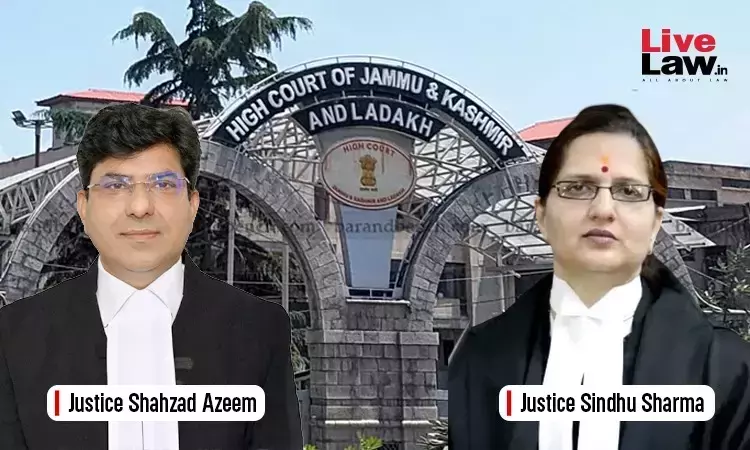
The High Court of Jammu & Kashmir and Ladakh has held that where a candidate is wrongfully denied appointment due to an error attributable to the appointing authority, the State cannot subsequently rely upon the delayed appointment to deny benefits that were available to similarly situated selectees at the relevant time.Upholding the grant of Old Pension Scheme benefits to a Junior...
This is a premium content
Available exclusively to
Our subscribers
Subscribe Premium 
INR 1099+GST
Your support helps us to bring you more content at
an affordable subscription scheme !!!
All payment options available
The High Court of Jammu & Kashmir and Ladakh has held that where a candidate is wrongfully denied appointment due to an error attributable to the appointing authority, the State cannot subsequently rely upon the delayed appointment to deny benefits that were available to similarly situated selectees at the relevant time.
Upholding the grant of Old Pension Scheme benefits to a Junior Engineer who was appointed years after the original selection process because of an erroneous decision of the authorities, the Court held that a candidate cannot be made to suffer adverse service consequences for a delay solely attributable to the State.
The Court was hearing a writ petition filed by the Union Territory of Jammu & Kashmir and its Power Development Department challenging an order passed by the Central Administrative Tribunal, Jammu Bench, in a transferred application.
The Tribunal had directed the authorities to reckon the respondent's appointment as Junior Engineer (Electrical), Grade-II notionally from the date on which other selected candidates from the same selection process were appointed, re-fix his seniority, extend consequential promotional benefits and treat him as governed by the Old Pension Scheme.
A Division Bench of Justice Sindhu Sharma and Justice Shahzad Azeem observed,
"... The delay caused in offering the appointment to a meritorious candidate and which was found to have been attributable solely to the appointing authority, in that event, penalizing a selected candidate would amount to rewarding to the lapse of the appointing authority which is of course violative of the Article 14 of the Constitution."
The respondent had applied for the post of Junior Engineer (Electrical), Grade-II pursuant to recruitment advertisements issued by the Services Selection Board under the Reserved Backward Area category. Although he participated in the same selection process as other candidates, he was not considered under the category on the ground that the certificate issued under the Jammu and Kashmir Reservation Rules, 2005 had been submitted after the cut-off date.
The respondent maintained that he had already submitted a valid category certificate issued under the earlier reservation rules and had furnished the fresh certificate before completion of the selection process.
Upon conclusion of the selection process, the last selected candidate in the category had secured 58.34 points, whereas the respondent had obtained 59.54 points. Despite securing higher merit, he was not selected.
Aggrieved by his exclusion, the respondent approached the High Court through a writ petition. The Court allowed the petition and directed the Services Selection Board to include him in the select list under the Reserved Backward Area category and recommend him for appointment. Pursuant to those directions, the Board recommended his candidature and the Government appointed him as Junior Engineer (Electrical), Grade-II in July 2014.
The respondent thereafter sought parity with candidates selected through the same recruitment process who had been appointed in August 2009. His representations seeking notional appointment, seniority and consequential service benefits did not yield any result. The matter ultimately reached the Central Administrative Tribunal, which allowed the claim and granted notional appointment, re-fixation of seniority, promotional benefits and coverage under the Old Pension Scheme.
Challenging the Tribunal's order, the petitioners contended that the respondent had accepted his appointment in 2014 without protest and that seniority or pensionary benefits could not be granted for a period during which he had not actually served. They further argued that since he entered service after 1 January 2010, he was not entitled to the Old Pension Scheme.
Court's Observations:
The Court noted that there was no dispute that the respondent had participated in the same recruitment process as other selected candidates and that his exclusion from selection was subsequently found to be erroneous by the Court. The respondent's appointment was delayed solely because he had been wrongly treated as ineligible by the recruiting authorities.
The Bench examined the reasoning adopted by the Tribunal and noted that reliance had been placed upon the decisions of the Supreme Court in Sanjay Dhar v. Jammu & Kashmir Public Service Commission (2000) 8 SCC 182 and C. Jayachandran v. State of Kerala (2020) 5 SCC 230. The Tribunal had found that where a candidate is wrongfully denied appointment and later succeeds in obtaining relief, the candidate is entitled to notional appointment and consequential service benefits.
Referring to C. Jayachandran, the Court observed that the Supreme Court had granted notional appointment and consequential seniority to a candidate who had participated in the same selection process but was denied appointment due to an illegal action that was later corrected. The Court also referred to Sanjay Dhar, wherein the selected candidate was directed to be treated as having been appointed along with the original batch and assigned seniority in accordance with his merit position.
The Court held that where exclusion from appointment is attributable to arbitrary action of the appointing authority, the candidate is entitled to be treated as part of the original selection process for purposes of seniority and consequential benefits. In this regard, the Bench observed,
".... Such candidate, of course is to be treated as part of the original appointment for seniority purposes and consequential benefits, because wrongful action of the appointing authority, cannot be used to prejudice a candidate for none of his fault."
The Court further observed that arbitrary denial or delay in appointment violates the guarantee of equality under Article 14 of the Constitution and that once the illegality is corrected through judicial intervention, the affected candidate must be restored to the position that would have existed had the wrongful action never occurred. The Bench noted,
"... Arbitrary denial or delay caused by the appointing authority violates the right to equality as envisaged under Article 14 of the Constitution."
The Court also examined Rule 24 of the Jammu and Kashmir Civil Services (Classification, Control and Appeal) Rules, 1956 relating to seniority. While noting that seniority ordinarily flows from the date of substantive appointment, the Court observed that notional fixation constitutes an equitable exception where the delay is attributable to the appointing authority and is necessary to preserve the integrity of the common select list and the right to equality.
Turning to the issue of pension, the Court held that once the respondent was found entitled to notional appointment from the same date as similarly situated selectees, the Tribunal had correctly concluded that he would be governed by the Old Pension Scheme which was in force at that time. The Court found no infirmity in the Tribunal's reasoning that the respondent could not be placed under the New Pension Scheme merely because the authorities had wrongfully delayed his appointment.
In view of these findings the Court dismissed the writ petition and upheld the relief granted in favour of the respondent.
Case Title: State (Now Union Territory) of Jammu & Kashmir & Ors. v. Raghu Singh Jandla
Citation: 2026 LiveLaw (JKL) 278


