



- Home
- /
- High Courts
- /
- High Court of J & K and Ladakh
- /
- Ex-Servicemen Need Not Prove...
Ex-Servicemen Need Not Prove Entitlement To Disability Pension, Benefit Of Doubt Must Favour Them More Liberally: J&K High Court
LiveLaw News Network,
13 Nov 2025 7:15 PM IST
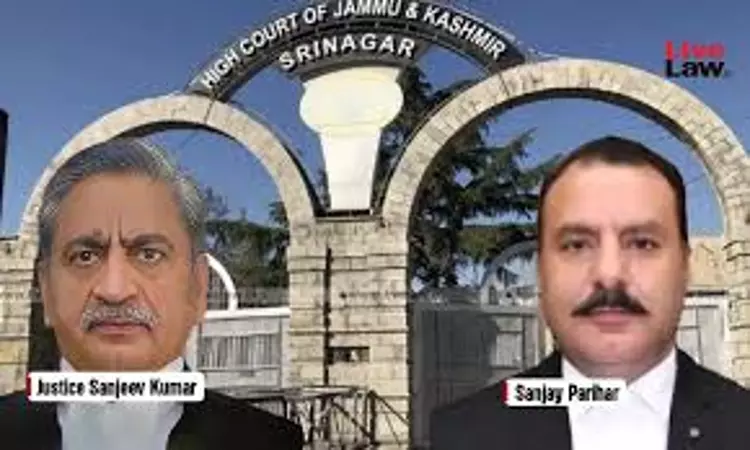
The Jammu and Kashmir and Ladakh High Court has reaffirmed the welfare-oriented approach governing disability pension claims, holding that a claimant is not required to prove entitlement, and that the benefit of every reasonable doubt must be given to the serviceman more liberally so in field or afloat service cases.A Division Bench comprising Justice Sanjeev Kumar and Justice Sanjay...
This is a premium content
Available exclusively to
Our subscribers
Subscribe Premium 
INR 1099+GST
Your support helps us to bring you more content at
an affordable subscription scheme !!!
All payment options available
The Jammu and Kashmir and Ladakh High Court has reaffirmed the welfare-oriented approach governing disability pension claims, holding that a claimant is not required to prove entitlement, and that the benefit of every reasonable doubt must be given to the serviceman more liberally so in field or afloat service cases.
A Division Bench comprising Justice Sanjeev Kumar and Justice Sanjay Parihar delivered this significant ruling while dismissing 45 writ petitions filed by the Union of India, all challenging orders of the Armed Forces Tribunal (AFT), Regional Bench, Srinagar at Jammu, which had granted disability pensions to several ex-servicemen.
Background:
The petitions before the High Court arose from a series of AFT orders in favour of 45 respondents, all ex-servicemen who had been invalided out or discharged in a lower medical category on account of various ailments, including hypertension, heart diseases, psychiatric disorders, and other service-related disabilities.The respondents had approached the AFT contending that their disabilities were either attributable to or aggravated by the stress and strain of military service.
The AFT, after examining the relevant service and medical records, allowed their claims, holding that the disabilities were connected to service and that the claimants were entitled to disability pension. The Union of India, challenged these orders, arguing that the disabilities were neither attributable to nor aggravated by service and that the 2008 Entitlement Rules required the claimants to meet a stricter standard of proof.
On the other hand, counsel for the ex-servicemen, led by Senior Advocate Rajnish Raina, defended the AFT's orders, asserting that the Tribunal had merely followed the settled principles laid down in Dharamvir Singh v. Union of India (2013) 7 SCC 316 and Union of India v. Rajbir Singh (2015) 12 SCC 264, both of which emphasize a presumption in favour of the soldier and a liberal interpretation of the rules governing disability pension.
Courts Observations:
Authoring the judgment, Justice Sanjeev Kumar undertook an exhaustive analysis of the Pension Regulations for the Army, 1961 and 2008, along with the Entitlement Rules of 1982 and 2008, observing that while the procedural framework evolved over the years, the underlying principle of presumption in favour of the serviceman remained constant.
The Court observed,
“With a view to appreciating the controversy raised in all these petitions in proper perspective, we need to formulate few questions that precisely arise in these petitions for determination... An advertence to the legal landscape obtaining in the matter would be of utmost necessity.”
It referred to Regulation 173 of the 1961 Regulations, which permits the grant of disability pension to a soldier invalided out due to disability attributable to or aggravated by military service and assessed at 20% or above. The Court also noted Regulation 173-A, which extends the same benefit to individuals discharged in a lower medical category where no alternative employment could be provided.
Importantly, the Bench emphasized the liberal presumptions codified under Rule 5 of the 1982 Entitlement Rules, which state that a member of the armed forces is presumed to be in sound health upon entering service, and any deterioration in health during or after service is presumed to be due to service conditions.
Citing Rule 9, the Court stressed,
“The claimant shall not be called upon to prove the conditions of entitlement. He or she will receive the benefit of any reasonable doubt. This benefit will be given more liberally to the claimants in field or afloat service cases.”
The Court further elaborated that the onus to disprove the connection between service and disability lies squarely upon the authorities, and not upon the soldier. “The Government or the Medical Board cannot reject a claim merely on suspicion or presumption unbacked by medical reasoning,” the Bench noted, adding that the failure of authorities to provide detailed medical justification weakens the government's case.
Justice Kumar observed that the Entitlement Rules, 2008, though newer in form, retained the same compassionate spirit as the 1982 Rules. The liberal approach, he said, must not be diluted merely by reclassification of rules or by technical distinctions drawn by medical boards.
Referring to Rules 10 and 11 of the 1982 Rules, the Court observed that even in post-discharge cases where diseases manifest within ten years of retirement, the connection to service must be recognized, and if a pensioner dies within ten years of invalidment, the benefit of doubt must go to the family, unless clear contrary evidence exists.
The Court underscored that the disciplinary and duty framework of armed service personnel leaves little scope for personal choice or rest, exposing them continuously to physical and mental stress. Hence, the presumption that disabilities arise from such service conditions is “not a legal fiction but a realistic recognition of the nature of military life”, the court underscored.
Quoting directly, the Bench observed,
“It is the obligation of the competent authority to view these claims not through the prism of technicality but through the lens of welfare. The principles of beneficial interpretation that guide the grant of pensionary benefits must apply with full force to disability pension claims as well.”
The High Court held that the AFT's findings were fully in consonance with the law, and that the Union of India had failed to show any perversity or legal infirmity. Dismissing the entire batch of petitions, the Court directed the Union to release the disability pension to the respondents along with arrears carrying 9% interest.
Reiterating the essence of welfare jurisprudence in military matters, the Bench concluded,
“The claimant shall not be called upon to prove the conditions of entitlement. He/She will receive the benefit of any reasonable doubt. This benefit will be given more liberally to the claimants in field/afloat service cases.”
Case Title: Union of India & Ors. v. Nirman Singh Jamwal & Connected MattersCitation: 2025 LiveLaw (JKL)
Click Here To Read/Download Judgment


