



Fair Trial Under Article 21 Does Not Require Certified Copies Of Trial Proceedings Before Confirmation Of Sentence: J&K&L High Court Upholds BSF Rule
LIVELAW NEWS NETWORK
6 Nov 2026 10:31 AM IST
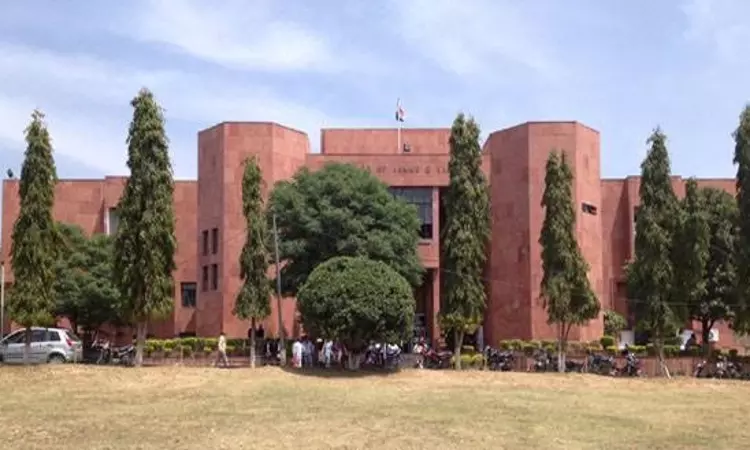
The High Court of Jammu & Kashmir and Ladakh at Srinagar has held that the Constitution guarantees a fair opportunity to defend, but does not prescribe that such opportunity must invariably take the form of possession of certified copies of trial proceedings.
The Court upheld the constitutional validity of Rule 129 of the Border Security Force Rules, 1969, holding that the regulated postponement of supplying copies until confirmation of the finding and sentence does not violate Article 21, as the right of inspection under Rule 120 provides meaningful access. The Court allowed the Letters Patent Appeal and set aside the judgment of the Writ Court.
The Court was hearing a Letters Patent Appeal filed by the Union of India challenging the judgment and order passed by the learned Single Judge in a writ petition, whereby the Single Judge had struck down Rule 129 of the Border Security Force Rules, 1969 as ultra vires Part III of the Constitution. The Writ Court had quashed the proceedings concluded by the General Security Force Court from the stage of leading defence evidence and directed the supply of certified copies to the accused.


A Bench of Chief Justice Dr. Pushpendra Singh Bhati and Justice M.A. Chowdhary, observed,
“The Constitution guarantees a fair opportunity to defend; it does not prescribe that such opportunity must invariably take the form of possession of certified copies. The distinction between access to proceedings and possession of copies must therefore be maintained.”
Background
The respondent was a member of the Border Security Force. On 27.11.2017, an incident occurred in the BSF campus at Bandipora, in which Head Constable Chander Bhan was shot dead. FIR was registered under Section 302 RPC.
Since the respondent was a member of the BSF, the competent authority exercised the statutory option for trial before a General Security Force Court (GSFC), and the criminal case was transferred for trial under the BSF Act. The respondent was tried for commission of offences punishable under Section 302 RPC read with Section 46 of the BSF Act.
The trial before the GSFC commenced, the Court found the respondent guilty and awarded imprisonment for life and dismissal from service. During the trial, the respondent sought certified copies of the challan along with allied documents, as also the certified copies of the statements of prosecution witnesses. The request was opposed on the basis of Rule 129. However, the respondent was not excluded from the proceedings or deprived of the opportunity to inspect the record in terms of Rule 120 of the Rules.
The respondent approached the Writ Court challenging the constitutional validity of Rule 129, contending that denial of certified copies before confirmation deprived him of an effective opportunity to prepare and conduct his defence, thereby infringing the guarantee of fair trial under Article 21.
The Writ Court allowed the petition, primarily holding that although Rule 120 confers the right to inspect, inspection could not be equated with furnishing certified copies, and that postponement of the supply of copies until confirmation prejudiced the accused.
The appellants contended before the High Court that the GSFC is a statutory court under a special parliamentary enactment. It was argued that Rule 120 expressly provides an accused with the right to inspect the proceedings at all reasonable times before the Court is closed to consider the finding, and the statutory scheme does not shut the accused out from the evidence against him.
The appellants relied on Union of India v. Ex. Flt. Lt. G.S. Bajwa (2003). Per contra, the respondent argued that the statements of prosecution witnesses are essential material for preparing cross-examination and defence, and merely allowing inspection is not equivalent to providing copies. It was further argued that Article 33 does not confer an unrestricted power to abrogate fundamental rights.
Court's Observation
The Court observed that Section 87 of the BSF Act incorporates the general law of evidence only subject to that special enactment. The Court held,
“The principle generalia specialibus non derogant has application here. The BSF Act is a special parliamentary enactment regulating the constitution, discipline, offences, trial, evidence, confirmation and execution of sentences concerning members of the Force.”
The Court noted that Rule 120 grants the accused a right of inspection during the trial, and Rule 129 regulates the time at which the person tried becomes entitled to obtain a copy of the proceedings, which is after confirmation. Viewed together, the Court held that there is no absolute denial of access.
The Court relied on the judgment of the Hon'ble Supreme Court in Union of India v. Ex. Flt. Lt. G.S. Bajwa (2003), which held that the right of inspection at reasonable times enabled the accused to go through the proceedings and prepare his defence, and the non-supply of day-to-day copies did not violate natural justice. The Court noted,
“Rule 100 itself incorporates the principle of natural justice by giving to the respondent an opportunity to go through the proceedings and for this purpose to inspect the same at all reasonable times. This meets the requirement of the principles of natural justice.”
The Court analysed Article 33 of the Constitution, which empowers Parliament to restrict fundamental rights in their application to members of the Armed Forces. The Court held,
“The question is whether the procedural scheme created by Parliament for adjudication of offences within a disciplined armed force is reasonably connected with the proper functioning of that force and its disciplinary system.”
The Court held that the postponement of copies until confirmation is embedded in the statutory process governing Security Force Court proceedings and preserves the integrity of the proceedings during the period in which findings and sentence remain subject to review.
The Court further held,
“The distinction between access to proceedings and possession of copies must therefore be maintained. The former is integral to fairness. The latter is subject to legislative regulation.”
The Court concluded that the respondent was given access through inspection, and the postponement of copies by a rule forming part of a constitutionally permissible special procedure did not violate Article 21.
The Court further observed that no material had been brought to its notice demonstrating that the respondent was actually prevented from inspecting the proceedings, prevented from cross-examining a material witness, or prevented from raising a specific defence. The Court held,
“A physical copy may undoubtedly be useful. It may even be preferable in many cases. But where Parliament has legislated a special procedure and has authorised the accused to inspect the proceedings, the constitutional court cannot substitute its own preferred procedure unless the statutory procedure crosses the constitutional threshold of manifest unfairness.”
Accordingly, the appeal was allowed, and the judgment and order of the Writ Court were set aside. The competent authorities were directed to proceed in the matter in accordance with the Border Security Force Act, 1968 and the Border Security Force Rules, 1969.


