



- Home
- /
- High Courts
- /
- Karnataka High Court
- /
- Candidate With Recognised First...
Candidate With Recognised First Degree Can't Be Denied Admission In 3-Year LLB Course By Reassessing 10+2 Qualification: Karnataka High Court
Amruta Gangajaliwale
6 Nov 2026 12:40 PM IST
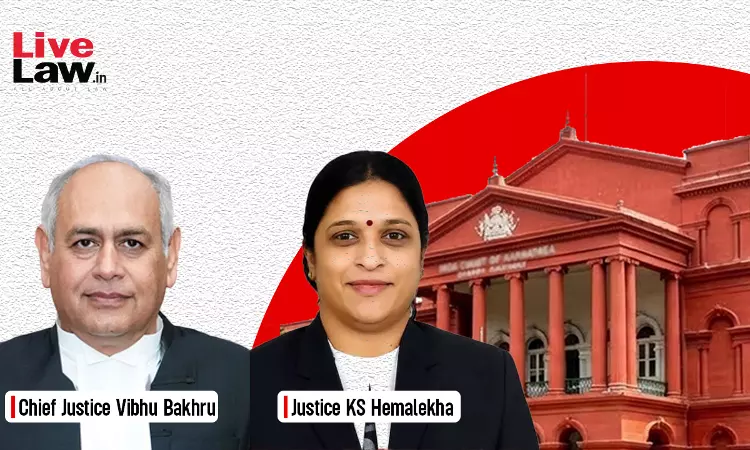
The Karnataka High Court has held that if a candidate applying for a three-year LL.B. course has a valid undergraduate degree/first degree, the University then cannot deny him eligibility certificate required to secure admission in the course by reassessing his 10+2 qualification afresh. For context, Rule 5 of the Rules of Legal Education, 2008 prescribes eligibility criteria for admission to...
This is a premium content
Available exclusively to
Our subscribers
Subscribe Premium 
INR 1099+GST
Your support helps us to bring you more content at
an affordable subscription scheme !!!
All payment options available
The Karnataka High Court has held that if a candidate applying for a three-year LL.B. course has a valid undergraduate degree/first degree, the University then cannot deny him eligibility certificate required to secure admission in the course by reassessing his 10+2 qualification afresh.
For context, Rule 5 of the Rules of Legal Education, 2008 prescribes eligibility criteria for admission to law courses. Under Rule 5(a), a candidate seeking admission to a three-year LL.B. course must have graduated in any discipline from a recognised university. On the other hand, Rule 5(b), which deals with admission to an integrated five-year law degree programme, requires candidates to have completed Senior Secondary School (+2) or equivalent (such as 11+1, 'A' level in Senior School Leaving certificate course).
The present case arose from the Karnataka State Law University's refusal to issue an eligibility certificate to the first respondent, Rakesh Shetty, which was required for securing admission to a three-year LL.B. course. Instead of following the conventional 10+2 education path, Shetty had completed his Job-Oriented Pre-University Diploma in Computer Techniques (JOC). This, the varsity said, was not equivalent to the required Pre-University Course (PUC).
Shetty approached the High Court against the University's endorsement dated October 18, 2024, which had denied him the eligibility certificate. The Single Judge allowed his plea and directed the University to issue the certificate. Aggrieved by the order, the University preferred an appeal.
Rejecting the varsity's reasoning, the Division Bench of Chief Justice Vibhu Bakhru and Justice K.S. Hemalekha held that 10+2 qualification shall not have independent relevance as a qualifying criterion for seeking admission to a three-year course.
“A plain reading of Rule 5(a) of the Rules, read with the proviso and the Explanation thereto, clearly indicates that the (+2) qualification would not have independent relevance as a qualifying criterion for admission to the three year LL.B course in the case of a candidate who has secured a recognized first degree after possessing the basic qualification required for pursuing the course of study leading to that degree,” the Court said.
The Court noted that Shetty had secured a valid Bachelors of Commerce degree from the Mangalore University in 2005, thus fulfilling the eligibility stipulated in Rule 5 for applying to a three-year LL.B. course.
The Bench also relied on the Madras High Court's ruling in M. Ramchandran vs. Chairman, Law Admissions (2018), wherein it was held that “once a recognised university or board has issued a certificate or degree, another authority cannot question the validity of such certificate or degree on the ground that the candidate was ineligible to obtain such qualification, unless it has been cancelled by the competent authority or declared invalid by a Court of law.”
Applying this principle, the High Court observed that Shetty had obtained his degree through a regular course of study and that the University had neither questioned his eligibility for admission to the B.Com. course nor claimed that the degree had been cancelled or declared invalid.
“In the present case, respondent No.1 pursued a regular course of study to secure the B.Com degree from Mangalore University. It is not the appellant's case that respondent No.1 was ineligible for admission to the said course on the basis of the qualification possessed by him. Nor is it the appellant's case that the B.Com degree awarded by Mangalore University has been cancelled or otherwise declared invalid,” the Court said.
It added, “Thus, respondent No.1, having successfully completed a regular course of study and obtained a recognized first degree in commerce from Mangalore University, satisfies the eligibility criteria prescribed under Rule 5(a) of the Rules for admission to the three year LL.B course. The University was, therefore, not justified in declining to issue the eligibility certificate.”
Accordingly, the High Court upheld the Single Judge order.
Tags


